

Audio By Carbonatix
France is to boost its nuclear arsenal and extend the deterrent to cover other European countries, in a major development of its nuclear defence policy.
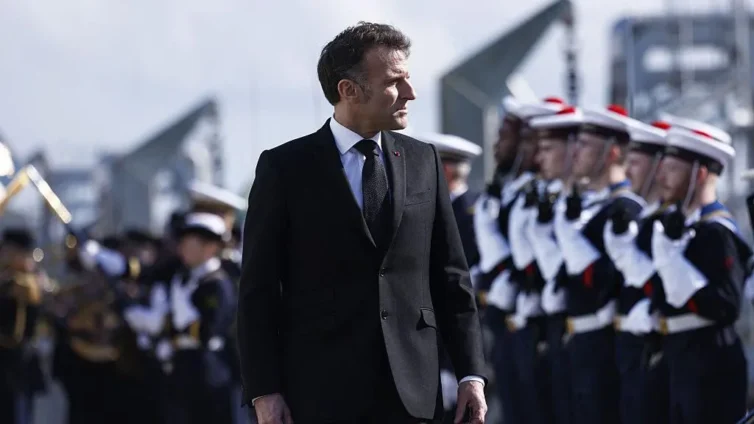
In a speech in Brittany, President Emmanuel Macron explained the changes as the response to an increasingly unstable strategic environment.
"The next 50 years will be an era of nuclear weapons," he said.
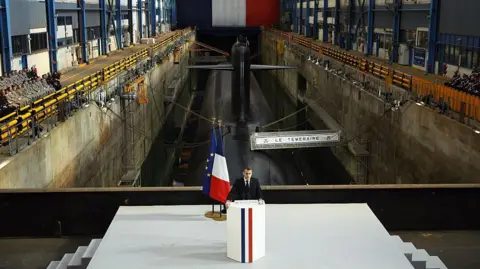
Speaking to naval officers in front of a nuclear submarine at the Ile Longue base near the port of Brest, he said the number of French nuclear warheads would be increased from their current level of around 300.
He announced the launch in 2036 of a new nuclear-armed submarine to be called The Invincible.
He said eight other European countries – the UK, Germany, Poland, the Netherlands, Belgium, Greece, Sweden and Denmark – had agreed to participate in a new "advanced deterrence" strategy.
Writing on X, Polish Prime Minister Donald Tusk referenced the decision, saying: "We are arming up together with our friends so that our enemies will never dare to attack us."
Macron said the eight European countries could take part in exercises of France's air-launched nuclear capacity – or force de frappe - and also host air bases where France's nuclear bombers could be stationed.
This would allow France's Strategic Air Forces (FAS) to "spread out across the depth of the European continent... and thus complicate the calculations of our adversaries", the president said.
He added that France's partners would also share in the development of "auxiliary" capacities under the new nuclear doctrine: space-based alarm systems; air defence to shoot down incoming drones and missiles; and long-range missiles.
Described by officials as the most significant change in French strategic thinking since 1960, "advanced deterrence" nonetheless retains much of the original concept as defined by then-President Charles de Gaulle.
There will be no explicit "guarantee" given to partner countries, and it is the president of France who will retain sole decision-making power over when to fire a nuclear missile.
The aim remains to convince potential adversaries that "if they have the audacity to attack France... there will be an unsustainable price to be paid," the president said.
Until now there has been a deliberate vagueness about what France regards as its "vital interests", an attack on which would trigger a nuclear response.
In recent years governments have hinted that "vital interests" could also include interests in Europe. With Macron's "advanced deterrence", this concept has been given further shape – though in accordance with the general theory of deterrence nothing is spelled out.
Under the same principle, Macron said that from now on France would no longer communicate to the world the number of nuclear warheads in its possession.
France already has a cooperation agreement with Europe's only other nuclear power – the United Kingdom. Recently UK officials took part for the first time in exercises by France's FAS.
Shortly after the speech, France and Germany jointly announced plans for "closer cooperation" in the field of nuclear deterrence.
The two countries will "take the first steps this year, including German participation in French nuclear exercises... and the development of conventional capacities with European partners," according to a text signed by Macron and German Chancellor Friedrich Merz.
"This cooperation will complement, not replace, Nato's nuclear deterrent," they said.
Latest Stories
-
Assemblies of God requires pastors to resign before entering partisan politics – Rev. Wengam
3 minutes -
Ghana targets 20% annual reduction in maternal deaths – Health Minister
8 minutes -
Cyber attacks in Africa grow faster than global rate, report finds
10 minutes -
Ghana signs UAE deal to create 5,000 overseas jobs
17 minutes -
One Million Coders Programme targets 100,000 digital jobs in two years – Sam George
21 minutes -
John Jinapor, Italian Ambassador explore opportunities for energy sector investment
22 minutes -
NHIA seeks legal reforms to support Free Primary Healthcare
26 minutes -
Beatrice Annan defends Afi Agbenyo’s EC appointment, cites record of gender advocacy
29 minutes -
Ghana seeks investment deals in Bangkok amid global economic crises
33 minutes -
IMF raises Ghana’s 2026 growth forecast to 5.7%, sees inflation falling to 4.8%
35 minutes -
Ablakwa urges Africans not to view immigrants as threat to national progress
39 minutes -
Mahama Cares must fund treatment, not looting – Asogli chiefs
40 minutes -
Ghana’s economic salvation lies not in shifting geo-political allegiances – Dr Atuahene
43 minutes -
BoG proposes tougher rules on loan repayment assessment
48 minutes -
Government plans mandatory drug tests for public service jobs — Muntaka
53 minutes