

Audio By Carbonatix
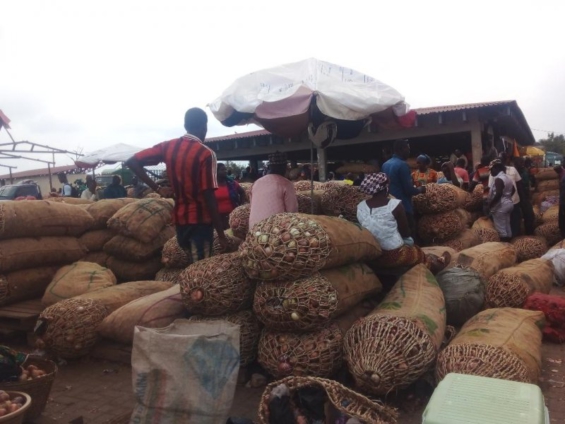
The Programme Officer of the Peasant Farmers Association of Ghana (PFAG) says no attention is given to how farmers can produce onions on a large scale because that aspect of farming has not been prioritised by government.
Dr Charles Nyaaba said as a result, Ghana would have to continue depending on Niger for onions despite its borders being closed.
"When you come to onions, I doubt if any research is done to improve the varieties that we're using. So attention has not been there and government itself has not actually invested in onion production," he said on the AM show on Monday.
Speaking on whether some of the universities could help conduct research into how the country can produce the variety of onion seeds that are high-yielding, Dr Nyaaba expressed that that could be done but given that it would take some time, the country can only depend on Niger for now.
"In a very short term, I think we still have to rely on Niger for the seed. The variety that we need usually takes five to six years before they'll be able to come out with the variety that they want. So that will take some time," he explained.
Reports have indicated that some onion trucks are stranded in Niger due to the closure of its borders in the wake of the coup.
Ghana depends highly on onion importation from Niger. The situation will affect the country and might even result in prices of onions shooting up.
The coup in Niger has spanned at least two weeks now. The ECOWAS, after giving the leadership of the coup a week's ultimatum, will now send its Standby force.
But the directive of the African bloc has since been met with criticisms from various experts.
According to some, the bloc has not exhausted all available options before jumping to the option of military intervention.
The Director of the Faculty of Academic Affairs and Research at the Kofi Annan International Peacekeeping Training Centre (KAIPTC) says the ECOWAS' Standby force was instituted to respond to civil wars and not to be engaged in eras of constitutional changes within its member states as it seeks to do presently in the wake of the coup in Niger.
Professor Kwesi Aning says there is no conflict or civil war in Niger, therefore, the bloc should rather consider using "a graduated set of responses" to resolve the situation.
"The standby force idea was also to respond first and foremost to civil wars and not to constitutional changes or internal political misunderstandings where there is massive bye-in as to what is happening. I mean there's no conflict in Niger per se.
"There rather ought to be a graduated set of responses as an internal crisis escalates," he said on Newsfile.
Latest Stories
-
Friends of Bridget Bonnie Marks her 35th birthday with donation to Kasseh Model Health Centre
24 minutes -
Landfilling waste management creates no value, it’s an economic waste
51 minutes -
Photos: Speaker Bagbin Commissions MPs constituency office under parliamentary decentralisation programme
1 hour -
Black Stars technical advisor Winfried Schäfer sacked as GFA shakes up backroom staff
1 hour -
Wenchi water project almost complete, critical to gov’t agenda – GWL MD
1 hour -
Anti-LGBTQ+ bill not part of government’s legislative agenda – Inusah Fuseini
1 hour -
Anti-LGBTQ Bill: Forget the rumour mongers, I’m a man of action, and will pass the bill – Speaker
2 hours -
Women and children among those killed in Sudanese army shelling of wedding celebration
2 hours -
President Mahama is not sincere with Ghanaians on LGBTQ bill matter – Hassan Tampuli
3 hours -
Gov’t to establish Prison Industrial Hub to equip inmates with income-generating skills – Prison Service boss
3 hours -
Alhassan Tampuli donates cement, roofing sheets to support storm victims in Gushegu
3 hours -
Alhassan Tampuli appeals for urgent support for storm victims in Gushegu
3 hours -
The hypocrisy must stop; pass Anti-LGBTQ+ Bill now – Alhassan Tampuli to Mahama
3 hours -
Imprisonment should be rehabilitative, not punitive – Ghana Prisons boss at UNGA
3 hours -
Ga Adangbe traditional priests petition Mahama over McDan aviation licence revocation
4 hours