


Audio By Carbonatix
Nigerians are heading to the polls to elect state and local representatives, two weeks after the presidential poll.
Ballots are being cast in 29 of the country's 36 states.
In oil-rich Nigeria, some state governors control budgets larger than those of neighbouring countries and so these are often keenly contested.
President Muhammadu Buhari beat his main rival Atiku Abubakar in the 23 February election, securing a second term.
Across the country, Mr Buhari's All Progressives Congress (APC) got 15.2 million votes while Mr Abubakar's People's Democratic Party (PDP) received 11.3 million. There are 73 million registered voters.
The APC won 19 states, while the PDP secured 16 plus the capital Abuja.
Mr Abubakar said the election was a "sham" and was not free and fair. He has since filed a petition challenging President Buhari's win.
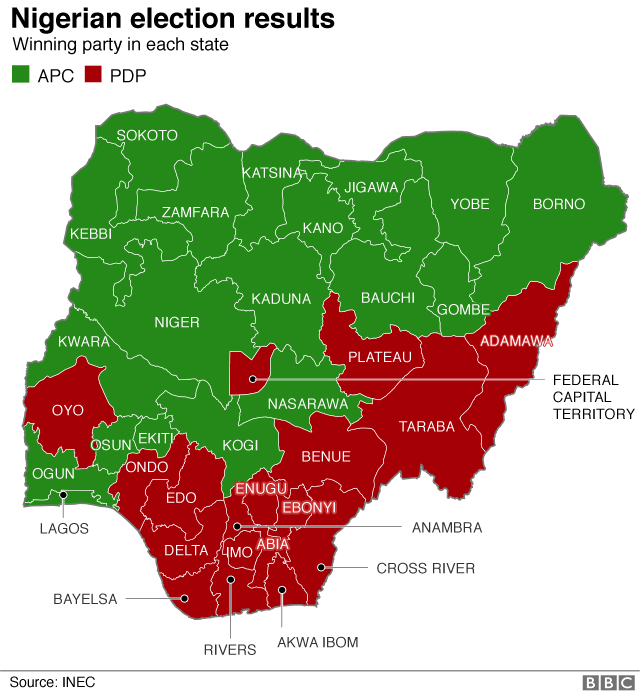
Although turnout for the presidential election was low across the country, it was higher in the northern states - one factor behind Mr Buhari's victory.
Fears of possible election-related violence has led to the massive deployment of security personnel across the country.
Seven states - Kogi, Bayelsa, Ekiti, Osun, Ondo, Edo and Anambra - will not hold elections because their governors have not finished their four-year terms.
The turnout for the state elections is expected to be higher than the 35.5% in last month's presidential election, down from 44% in 2015.
Most Nigerians take state elections seriously because their lives are directly impacted by the governor and representatives in the state legislature.
For instance, in 2000 - Governor Ahmed Sani Yerima introduced sharia law in Zamfara state and some other state governors in the north followed suit, even though the federal government wasn't fully in support of that idea.
The governors also enjoy political influence and control huge budgets.
Lagos, one of the most contested states, has an estimated population of 17.5 million people - this is more than the combined population of Gabon, The Gambia, Liberia, Cape Verde and Sierra Leone.
The state's GDP is more than that of Kenya. In fact, Lagos would be the fifth largest economy in Africa if it were a country.
Other key battle grounds that will be hotly contested between the APC and PDP are Kaduna, Akwa Ibom, Imo, Kano and Kwara.
Latest Stories
-
Why diaspora investors are using Accra real estate to hedge against global uncertainty in 2026
4 minutes -
GWL urges public support to stem water thefts
5 minutes -
Fire guts 2-storey apartment at Ashaley Botwe
7 minutes -
Come down and account, it’s a constitutional requirement – Martin Kpebu to Ofori-Atta
15 minutes -
The power of the private courtyard: How regalia is redefining resort-style living in Accra
27 minutes -
Beyond roads and bridges: Understanding the true role of your MP
28 minutes -
UK says Russia ran submarine operation over cables and pipelines
29 minutes -
NPRA recovers GH¢27m in 2025, 30% of defaulted pension contributions
32 minutes -
Power fluctuations slash Ashanti region water production by 959,000 cubic metres in March
37 minutes -
Beyond the festivities: Gomoa must turn visibility into development
46 minutes -
DVLA clarifies it is not responsible for Toyota Voxy commercial operations
47 minutes -
Calls for Ofori-Atta’s return a non-issue if trial proceeds in absentia – Pius Hadzide
50 minutes -
France names Ghana first beneficiary of newly established National Health Compact
56 minutes -
US Immigration, extradition outcomes likely to influence each other in Ofori-Atta case – Amanda Clinton
58 minutes -
29-year-old woman rescued after hiding in drain to escape attackers
1 hour