

Audio By Carbonatix
An Economist and Finance Lecturer, Dr Lord Mensah, says he expects the Finance Minister to be moderate in borrowing in the second half of the year.
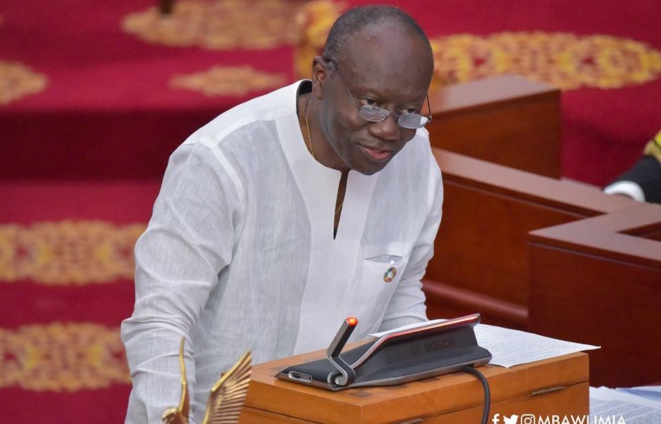
Ken Ofori-Atta Thursday presented the Mid-Year budget review to Parliament in accordance with Section 28 of the Public Financial Management Act, 2016 (Act 921), which mandates the Ministry to undertake the presentation not later than July 31, of each financial year.
“In this second half, I’m expecting the Finance Minister to tone down his appetite for borrowing,” he said on Thursday.
Speaking on JoyNews’ AM Show with Mamavi Owusu-Aboagye, Dr Lord Mensah said the country’s past trajectory in borrowing calls for concern as the debt keeps accumulating.
He noted that Ghana should not have deviated completely from the budget deficit of five per cent Gross Domestic Product (GDP) conditions suggested by the International Monetary Fund (IMF).
“When we went to the IMF, they gave us certain conditions. But suddenly, immediately after we moved out of the IMF, we started increasing our budget deficit, causing the borrowing.
“I think going forward; I expect the Finance Minister to slow down because there was a reason why the IMF gave out that five per cent discipline, and we could have kept that for some years,” he told Mamavi.
He said after the country deviated from the IMF directive, it suddenly “jumped around 11 per cent” recalling that “in the last budget that was read in November which we were expecting some downward trend, it even came to 9.5 per cent and that is where the borrowing is.”
The economist, therefore, suggested that “we should go back to our drawing board, commission a certain kind of review from 2007 that we became active on our borrowing, both domestic and international”, and access the funds that have come in.
He, however, stated that “ I appreciate the fact that most of the time that we go about borrowing, we borrow to defray the existing debt”, but noted that it also ends up adding to the rest of the fund in the country’s coffers.
“So let’s go back to the drawing board and look at the structures that we have, whether it can really stand by itself or we should freeze borrowing and allow those assets to generate cash flows early to pay for those debts.”
Dr Mensah also noted that the country’s revenue collection outline compared to that of interest payments, indicated “about 35 billion and over” for interest payment alone.
“If you combine our grants, all those VATs that we collect, including even our oil revenue, it will not catch up with that 35 billion interest payment.”
He said with the existence of the Covid-19 Delta variant and a third wave, “any prudent management at this level will personalise the budget and ensure that we tone down our borrowing so that we can stay afloat.”
“So I want the Finance Minister to tone down the borrowing,” Dr Mensah stressed.
Latest Stories
-
The 7-foot giant of Ngleshie Amanfro: Seven-foot Ghanaian Ephraim Saawa dreams of joining the national basketball team
30 minutes -
Government promises support for Kumasi Central Market fire victims
36 minutes -
Vibes The Movie: Big Ghun’s Ghanaian film earns five nominations at 2026 REFFA
1 hour -
MamaCare CEO warns unresolved conflicts among health workers could undermine maternal and neonatal care
2 hours -
Health professionals urged to translate medical knowledge into practice to save mothers
2 hours -
Conflicts among care providers linked to maternal, neonatal deaths – Expert
3 hours -
GIS marks 10th TIME conference, champions improved teaching practices
3 hours -
BRICS Or Balance? What Ghana’s bid really means
4 hours -
GPRTU wants full TRAFFITECH-GH implementation to start in 2027
4 hours -
Mahama announces plans to import electric wheelchairs for PWDs
4 hours -
KGL U17 Colts 2026: Western beat Prempeh Elite Academy to set up final final with Greater Accra Region
4 hours -
Late Solanke strike salvages 10-man Spurs draw at Man United
5 hours -
Gender Ministry to monitor welfare of Nana Akua Addo’s children amid domestic violence case
5 hours -
Benedict Okyere Yeboah: Ghana’s football problem goes beyond sacking a coach
5 hours -
GPL 2026/27: Darkwah Wiafe’s winner sees All Blacks beat Kotoko
5 hours