

Audio By Carbonatix
The Bank of Ghana (BoG) Governor has cautioned that, although global oil prices are falling following the ceasefire in the Middle East, Ghana and other emerging economies must remain alert to persistent external risks that continue to threaten economic stability.
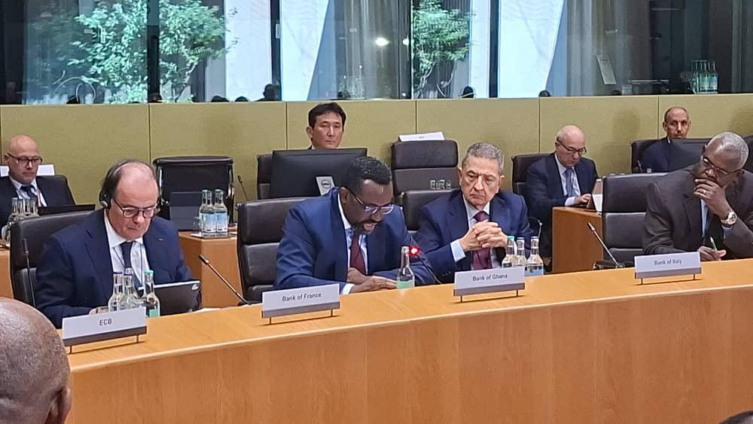
Dr Johnson Asiama, speaking at the Bank for International Settlements (BIS) Roundtable of Governors in Basel, Switzerland, on June 27, said the easing of crude oil prices should not create a false sense of security.
External risks remain
According to the Governor, while lower oil prices offer some relief, the global economy continues to face significant headwinds.
He identified tighter global financial conditions, the strength of the US dollar, and lingering uncertainty in the international economy as major risks confronting countries like Ghana.
For central banks, he stressed, “that means maintaining credible policy frameworks, while preserving room to respond as risks evolve.”
Dr. Asiama also said the recent Middle East conflict demonstrated “how quickly external conditions can change things.”
His comments come as analysts assess whether the latest global developments will influence the Bank of Ghana’s next monetary policy decision.
The Monetary Policy Committee is scheduled to meet from July 20 to July 22, 2026, with a new policy rate expected to be announced on July 22. The benchmark policy rate currently stands at 14%.
Ghana’s economic resilience
The Governor also highlighted Ghana’s recent macroeconomic gains, attributing them to prudent economic management, domestic resource mobilisation and policy reforms.
He noted that inflation has declined from more than 54% in 2022 to 3.7% in May 2026, while the country is recording a primary fiscal surplus.
Dr. Asiama added that Ghana’s gross international reserves reached US$14.4 billion in May 2026, describing the progress as the result of “careful planning.”
Shift towards domestic borrowing
Dr. Asiama said Ghana and many African countries are increasingly relying on domestic borrowing to finance critical infrastructure as external financing becomes more difficult to access.
He explained that “External financing has become more expensive, less predictable and, for some sovereigns, less accessible.”
As a result, he said governments are relying more on domestic capital markets “to reduce exchange rate exposure, diversify their funding sources and mobilize domestic savings to finance development.”
“What began as a response to tighter external financing is increasingly becoming a strategic policy choice,” he added.
However, the Governor warned that the growing dependence on domestic borrowing also carries risks.
He noted that while domestic borrowing is strengthening resilience by reducing exposure to external shocks, it is also shifting risks into local financial systems.
“The next phase of reform must therefore focus on building domestic debt markets that are deeper, longer dated and more diversified, so that today’s solution does not become tomorrow’s vulnerability,” Dr. Asiama said.
Ghana’s debt lessons
Touching on Ghana’s debt restructuring programme, the Governor said the country’s experience offers important lessons for other African economies.
According to him, Ghana’s response has involved a comprehensive debt restructuring programme under the IMF Extended Credit Facility, supported by fiscal consolidation measures and institutional reforms.
He said the objective of those reforms is to restore debt sustainability while rebuilding policy credibility.
Latest Stories
-
Putin warns West that Russia is ready to use every weapon to protect Kaliningrad
1 hour -
Mobile Money Fintech LTD, UMB train hairdressers and beauticians
3 hours -
OpenAI fires workers for mishandling ‘sensitive information’
3 hours -
What’s gone wrong at Nike? How the world’s sportswear giant lost its mojo
4 hours -
Carney pitches oil pipeline as a response to US-Canada trade war
4 hours -
Badenoch welcomes expanded grooming gangs inquiry
4 hours -
GACL MD sues Samuel Buabeng over alleged Facebook defamation
4 hours -
Asylum votes show people want help, says Kemi Badenoch
4 hours -
Christa Pike in critical condition after surviving two lethal injections, lawyer says
4 hours -
Kemi Badenoch backs face covering ban at protest
5 hours -
Man City not ‘above the rules’, says No 10 after backlash to Burnham remarks
5 hours -
Real Madrid submit ‘substantial’ dossier in Barca payments case
5 hours -
Messi completes purchase of second Spanish club
5 hours -
Government must engage horticulturists on tomato crisis – GhIH
5 hours -
King Promise’s ‘Can’t Tame Us’ becomes official Chelsea anthem
5 hours