

Audio By Carbonatix
Any dog lover will tell you their canine friend picks up on their mood and emotions.
Now scientists have worked out exactly what is going on inside a dog's brain when it sees a human - even a complete stranger - smiling or scowling.
Their research involved 14 dogs in total who all sat very still in a brain scanner while they were shown pictures of people's faces.
Photographs of happy, smiling human faces made an area of the brain that is associated with reward "light up" with activity.
This reward circuitry is the part of the brain that is activated when we enjoy and remember good things, like tasty food or praise.
In terms of our own brains, we often refer to it as the "hit" or "high" that is triggered by winning a game or even receiving a positive comment on a social media post.
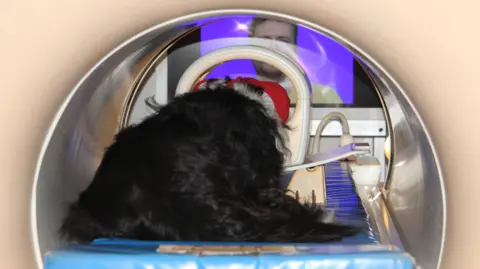
In previous research on dogs, the same brain region has been found to light up when the dogs anticipated a tasty snack, or smelled a familiar person.
"It controls us having motivation to do things - wanting to do things," explained Laura Cuaya, one of the study's lead researchers at the University of Vienna. "So this finding suggests that happy faces, even those of strangers have a positive value for dogs."
Cuaya and her co-researcher, Raúl Hernández-Pérez, went on to investigate how dogs responded to other human emotions - showing dogs images of people displaying happiness, anger, fear, and sadness. But the reward circuitry only responded to happy faces.
"Dogs can distinguish between positive emotions and all the others, but they don't seem to be able to distinguish between the different negative emotions," Hernández-Pérez, also at the University of Vienna, told BBC News.
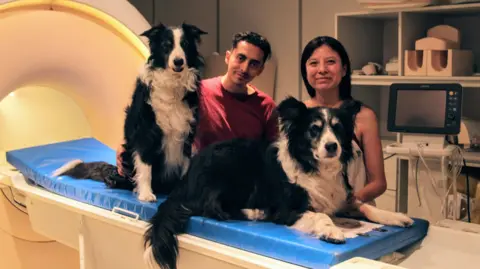
Laura Cuaya and Raúl Hernández-Pérez are partners in research and in life - and something of a canine-cognition power couple. After meeting at secondary school in Mexico the two went on to work together on research projects that have revealed how dogs interpret and respond to human language and behaviour.
It is work that has revealed insights into the biology underlying the unique relationship between humans and their dogs.
The couple's own border collies, Odín and Kun-kun, have taken part in several of their research projects - including this one. And the couple recruited other dogs - and their owners - for their studies by politely approaching people in the dog park.
"If we saw someone with a dog that was the right size [for the scanner] - and looked calm and like it was well trained, we'd ask if they would be interested in helping," recalled Hernández-Pérez.
How humans changed dogs' brains
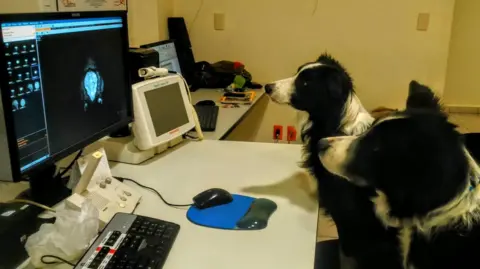
Cuaya explained that, from a neuroscience perspective, "the dog's brain is quite fascinating".
"They are really good at understanding emotions in humans - a species that is completely different from them."
This research is building a picture of exactly how thousands of years of living alongside humans has made this possible by moulding and changing dogs' brain circuitry.
"When we compare humans with other primates, we are looking at abilities that may have come from a common ancestor," Cuaya added.
"With dogs, the story is totally different. They followed a very different evolutionary path, but through domestication, they developed the social abilities needed to understand and cooperate with us."
Cuaya and Hernández-Pérez also hope their findings will help show people to communicate more effectively with their own beloved canine companions.
"We can reward our dogs with treats, but also reward them with happiness," said Cuaya. "So we should smile at the dogs - even at random dogs in the street."
The findings are published in the journal iScience.
Latest Stories
-
Power restoration fault suspected in Kumasi Central Market fire
36 minutes -
The 7-foot giant of Ngleshie Amanfro: Seven-foot Ghanaian Ephraim Saawa dreams of joining the national basketball team
1 hour -
Government promises support for Kumasi Central Market fire victims
1 hour -
Vibes The Movie: Big Ghun’s Ghanaian film earns five nominations at 2026 REFFA
2 hours -
MamaCare CEO warns unresolved conflicts among health workers could undermine maternal and neonatal care
2 hours -
Health professionals urged to translate medical knowledge into practice to save mothers
2 hours -
Conflicts among care providers linked to maternal, neonatal deaths – Expert
4 hours -
GIS marks 10th TIME conference, champions improved teaching practices
4 hours -
BRICS Or Balance? What Ghana’s bid really means
4 hours -
GPRTU wants full TRAFFITECH-GH implementation to start in 2027
5 hours -
Mahama announces plans to import electric wheelchairs for PWDs
5 hours -
KGL U17 Colts 2026: Western beat Prempeh Elite Academy to set up final final with Greater Accra Region
5 hours -
Late Solanke strike salvages 10-man Spurs draw at Man United
5 hours -
Gender Ministry to monitor welfare of Nana Akua Addo’s children amid domestic violence case
5 hours -
Benedict Okyere Yeboah: Ghana’s football problem goes beyond sacking a coach
6 hours