

Audio By Carbonatix
Ghana’s decision to apply to join BRICS is not a diplomatic footnote; it is a strategic signal.
On October 6, 2026, Foreign Affairs Minister Samuel Okudzeto Ablakwa announced that Cabinet had decided to pursue membership, saying the objective was to diversify partnerships, widen economic opportunities and deepen cooperation with the Global South.
.India, whose foreign minister was visiting Accra, has been approached to help Ghana navigate the application.
The World Bank puts Ghana’s 2025 GDP at $114.2 billion, with 6.0 percent growth, while its population stands at 35.1 million.
Ghana is not a great power seeking to rewrite the international system or dictate the rules of global commerce. It is a middle-sized African state seeking more room to manoeuvre within it.
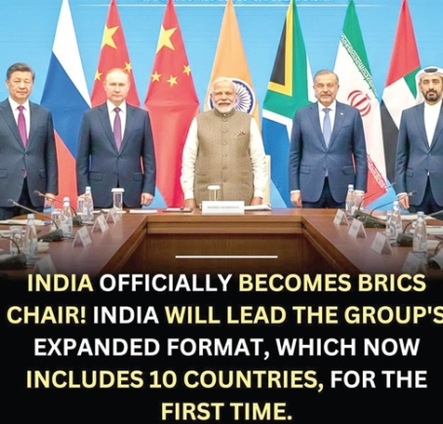
BRICS has grown considerably beyond the original Brazil-Russia-India-China grouping. Its current membership comprises 11 states, representing about 49 percent of the world’s population, 39 percent of global GDP and 23 percent of international trade.
Its expanding economic and geopolitical weight offers Accra a platform for trade, investment and diplomatic coalition-building.
Membership could provide another channel for engaging major emerging economies, reducing excessive dependence on traditional Western partners and broadening Ghana’s strategic options.
The attraction is not ideological alignment with every member, but the opportunity to operate in a wider economic and diplomatic ecosystem as global power becomes more dispersed.
Membership, however, is not automatic. Ghana has announced a bid, not secured a seat.
BRICS says accession moves from formal interest to potential membership and then full membership, with Sherpas, foreign ministers and ultimately leaders deciding by consensus.
Accra must demonstrate that its application can win political support from members.
The bid is therefore the opening move in a consequential geopolitical negotiation, not a guaranteed victory.
The test is whether Ghana can convert its interest into gains without damaging longstanding relationships with the United States, European Union and other Western partners.
The Economic Logic Is Powerful, But Not Magical
Ghana already trades heavily with BRICS economies, China and India. Ghana-China trade reached a record $14.1 billion in 2025, up 19.3 percent. In 2024, China supplied 45.9 percent of Ghana’s imports from Asia, while India supplied 13.7 percent.
This concentration creates opportunity and vulnerability.
A formal BRICS relationship could help Ghana move beyond buying manufactured goods and exporting raw commodities, supporting investment in processing, infrastructure, digital technology, energy and transport.
The New Development Bank makes the prospect relevant. It has $52.7 billion in paid-in capital and supports development projects across member countries.
For a country seeking infrastructure and industrial financing, engagement with the BRICS ecosystem could open additional channels of capital and development cooperation.
But BRICS cannot substitute for economic reform.
Ghana’s debt problems, currency risks, productivity constraints and dependence on commodities will not disappear because Accra sits at the table.
Diplomatic access is not guaranteed investment, and every proposed project must still meet Ghana’s needs, affordability tests and transparency standards.
The strategic prize is bargaining power.
Ghana could use closer ties with China, India, Brazil, the Gulf and other emerging economies to negotiate from a broader base with Western partners.
The objective should not be to replace one sphere of dependence with another, but to expand Ghana’s room for manoeuvre.
Membership can strengthen that position if Accra treats it as an instrument of diversification and strategic autonomy.
The Security Question Is More Complicated
BRICS is not a military alliance and offers no Article 5-style collective-defence commitment.
Its significance is political: it provides a forum for coordinating positions on global governance, sanctions, development and the international order.
Joining would not give Ghana a BRICS security guarantee against jihadist violence spilling south from the Sahel, maritime insecurity in the Gulf of Guinea or cyber threats.
Ghana’s existing Western security relationships remain substantial.
In August 2026, the Defence Ministry said US cooperation included joint exercises, intelligence sharing, counter-terrorism support, maritime security and plans involving drone-based intelligence, surveillance and reconnaissance.
In September, Ghana reaffirmed its defence and security partnership with Washington, including logistics, institutional development, peacekeeping, cyber defence and maritime security.
Strategic balance is essential. Accra should not allow BRICS membership to undermine interoperability with the United States, European partners or African security institutions.
The objective should be diversification rather than substitution: add partnerships, markets and diplomatic options without trading one dependency for another.
The Geopolitical Price of Greater Autonomy
The deeper consequence is diplomatic. Ghana’s bid would place it more visibly in the debate over whether the international system should remain predominantly Western-led or become more plural and representative.
BRICS says it seeks stronger Global South participation and reform of global governance.
A stronger voice within Global South coalitions could reinforce its calls to reform institutions whose voting structures often lag behind economic realities.
But autonomy has a cost. BRICS includes China and Russia, whose relations with the United States and its allies are marked by strategic rivalry and, in Russia’s case, war-related sanctions.
Ghana may face pressure to clarify positions on sanctions, conflicts, technology standards and contested international norms.
BRICS criteria emphasize good relations among members, support for governance reform and, for partners, avoiding unilateral sanctions not authorized by the UN Security Council. Accra must be disciplined.
Ghana should join only if it can preserve what has made its foreign policy effective: flexibility, credibility and the ability to work across competing blocs.
The objective is strategic autonomy, not bloc politics.
The smartest policy is conditional engagement.
Ghana should seek market access, investment, technology, development finance and diplomatic leverage from BRICS while maintaining US and European security partnerships, ECOWAS commitments and wider African obligations.
The test is simple: does membership expand Ghana’s choices?
If yes, the bid is strategically sound. If it merely replaces one external dependence with another, it is not diversification; it is dependency under a different flag.
Ghana’s geopolitical asset is not allegiance, but room to manoeuvre as rival powers compete for influence.
Ghana is not choosing between East and West.
It is trying to ensure that, in an increasingly fractured world, it has enough partners to choose for itself.
— The writer is a lecturer in journalism and media studies and the CEO of The International Lens (theinternationallens.com).
Latest Stories
-
Conflicts among care providers linked to maternal, neonatal deaths – Expert
14 minutes -
GIS marks 10th TIME conference, champions improved teaching practices
21 minutes -
BRICS Or Balance? What Ghana’s bid really means
47 minutes -
GPRTU wants full TRAFFITECH-GH implementation to start in 2027
1 hour -
Mahama announces plans to import electric wheelchairs for PWDs
1 hour -
KGL U17 Colts 2026: Western beat Prempeh Elite Academy to set up final final with Greater Accra Region
1 hour -
Late Solanke strike salvages 10-man Spurs draw at Man United
2 hours -
Gender Ministry to monitor welfare of Nana Akua Addo’s children amid domestic violence case
2 hours -
Benedict Okyere Yeboah: Ghana’s football problem goes beyond sacking a coach
2 hours -
GPL 2026/27: Darkwah Wiafe’s winner sees All Blacks beat Kotoko
2 hours -
ITF World Tour : Patel Wins Boys’ Singles Final at J100 Accra
2 hours -
Ghana must pursue BRICS partnership if it brings economic benefits – Kpebu
2 hours -
Success and Wright Claims J100 Accra Girls’ Doubles Championship
2 hours -
ITF J100: America’s Wright wins J100 Accra Girls’ Singles Title
2 hours -
Expedition hopes to find aviator Amelia Earhart’s plane on remote island
2 hours