

Audio By Carbonatix
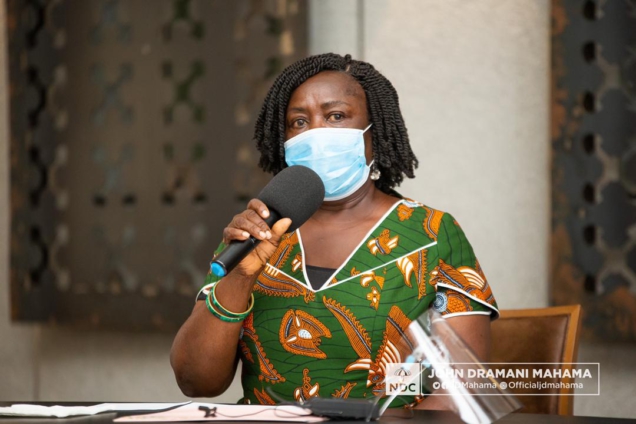
The National Democratic Congress (NDC) made history last week when the flagbearer, former president John Mahama named Prof. Jane Naana Opoku-Agyemang as his running mate in the upcoming December elections. Social media was awash with many feminists, jubilating and celebrating the news of her nomination.
In the ensuing days, many feminist groups, women advocacy groups and gender activists issued pressers to congratulate her on the potential of becoming the first female Vice president of Ghana should the NDC wrestle power from the NPP in December 2020.
Why are activists happy?
Although this is not the first time that a woman has been named as running mate, this news hits differently because it is the firsttime that a woman has been nominated under the ticket of a major political party that is actually capable of winning an election. It simply means that Professor Opoku-Agyemangstands a 50 percent chance of becoming the first female vice president of the Republic of Ghana. Actually, and we do not wish so to happen, but if we should lose the ‘president’ in the middle of the journey, she could become the first female president in the country.
For many years, gender activists and many women and feminist groups have decried the number of women who choose politics as a career or who vie for high political office. Representation of women in all forms of governance remains awfully low. In Ghana’s parliament, out of 275 seats, only 36 are occupied by women. This figure represents a meagre 12.75 percent of women in the legislative arm of government, far less than the UN recommended threshold of 30 percent. Female ministers of state are about 21 percent and for a country with 52 percent of its population being women, this number is very discouraging.
Over the years, political parties have made several promises on Affirmative Action to get many more women elected into power. In fact the NPP in the ran off to the December 2016 polls committed to allowing only females to contest the few seats that were already being occupied by women but this policy was shot down by party members. The then flagbearer and current president also promised that women will make up to 30 percentof his cabinet and this was included in the party’s manifesto.
This promise, however, wasn’t fulfilled when the party came into power. Likewise, the NDC in its 2000 manifesto made a commitment to women’s representation of 40 per cent executive positions and at all government levels. This promise also didn’t see the light of day. It was, therefore, a piece of welcome news when former President Mahama who seemed to be out of the race named a woman as his running mate. That single act, brought back hope into the camps of activists as they were now sure that someone was interested in walking the talk after all.
Why voting for the NDC will be a feminist choice
For several years, feminists and gender activists have fought for women to be given a seat to at the table. Therefore, for a woman to be nominated to the second highest level of decision making on the land is no mean feat. While some feminists are conflicted about the choice of voting for her by virtue of the political party she is affiliated to, others are unfazed because they believe that her nomination will open doors for many competent and overqualified women who have been knocking at the door for several years and are yet to be let in.
While it is possible that her nomination is a bait to bring former president Mahama back into the game and to appeal to a certain demographic to vote in favour of the NDC as many analysts have said, her nomination also brings the gender agenda to a point where it will in the future become normalised for major political parties to field women as running mates or even as flagbearers. Prof. Opoku-Agyemang’s nomination has shuttered the proverbial glass ceiling and has paved way for yet another ‘first’ to be demystified and for women in high office in Ghana to no longer be seen as an anomaly. For this reason, voting for the NDC in the upcoming election will mean being part of history that will change the gender dynamics of our politics post-elections 2020.
Why voting against the NDC will also be a feminist choice.
Ghana’s political history and precedents set over the years however tells us that one woman in a high political office cannot bring about much effective change. This is evident in the fact that, we have women in parliament and even currently have a deputy majority leader in parliament who heads the women’s caucus, yet the affirmative action bill is yet to be passed. Sometimes, women in power will want to bring the necessary change but may be forced to conform to the status quo because they may not have the required support.
I am in no way making a case for otherwise inefficient or corrupt women in power, my point is that, for those who genuinely want to make an impact on the gender front, they are usually constrained by the numbers and they are not effective in pushing any meaningful feminine agenda. Also, there are those who believe that Prof. Opoku-Agyeman’s nomination doesn’t mean much as long as former president Mahama will be the president. The reality that voting for her in solidarity with feminism will mean voting for former president Mahama and the NDC is something that some feminists cannot overlook and this feeling is also valid.
The bottom line is that either choice is a feminist choice. Many Ghanaians vote on tribal lines, family traditions and party affiliation and sometimes even on trivial subjects such as looks. Feminists are also therefore free to make a choice between voting for one woman to fill the second-highest office of the land and make history or choose to vote for another party based on their belief that they have the interest of women at heart and will equally push the feminine gender. Either way, in this year’s elections, gender will definitely be on the agenda!
*****
The writer is an Assistant Lecturer at the Department of Communication Studies of the University of Ghana and a gender activist.
Latest Stories
-
Indian foreign minister hails talks with Iran to open Strait of Hormuz, FT reports
14 minutes -
Africa-bound India-flagged fuel tanker sets sail from east of Hormuz, Indian official says
24 minutes -
How Iranians are evading internet blocks to contact family abroad
34 minutes -
South Africa’s president authorises deployment of 2,200 troops to help fight crime
43 minutes -
Israeli forces kill Palestinian couple and two of their children in occupied West Bank
53 minutes -
Two die including uni student in meningitis outbreak
1 hour -
Severe flooding kills 66 in Kenya, as heavy rains continue
1 hour -
Oscars 2026: Nominees list in full
4 hours -
Why Afrobeats went global faster than Nollywood – Omotola Jalade-Ekeinde
4 hours -
Ayra Starr opens up about her dilemma in private relationship
4 hours -
Lady I wanted child with ended relationship after two months – Omah Lay
4 hours -
I used to be very aggressive – Omotola Jalade [VIDEO]
5 hours -
Joeboy explains why it’s now more difficult for new artistes to go mainstream
5 hours -
Lots of Nollywood actors don’t earn what I earned for movie role 30 years ago – Eucharia Anunobi
5 hours -
Afrobeats mainly for Lagos, Yorubas – Omah Lay
5 hours