

Audio By Carbonatix
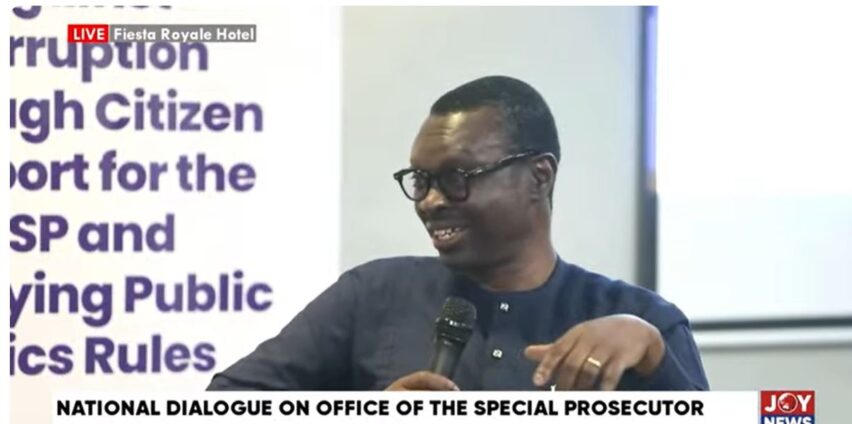
Chairperson of the African Union Advisory Board Against Corruption, Edem Senanu, has defended the performance of the Office of the Special Prosecutor (OSP), stating that the institution has made notable progress despite operational constraints and public criticism.
Speaking during a national dialogue on the Office of the Special Prosecutor on Tuesday, March 31, Senanu noted that building a resilient anti-corruption institution takes time, particularly in an environment marked by limited resources and political pressure.
“The OSP has performed above average. It is very difficult to build an institution under attack and without adequate resources, yet still expect it to deliver instant results,” he stated.
The anti-corruption campaigner stressed that the OSP’s effectiveness should not be measured solely by prosecutions, but also by its deterrent impact on public officials.
“There’s so much that institutions achieve just by existing. The presence of the OSP alone has influenced the conduct of politicians,” he noted.
He pointed out that the OSP has handled about 67 cases, with seven completed, alongside some financial recoveries—contrary to claims that the office has achieved little.
Senanu expressed concern over what he described as a misleading public narrative, often amplified by political actors across media platforms.
"It is not accurate to say the OSP has achieved nothing. Cases have been completed and monies recovered, but the communication around these achievements has been weak,” he said.
To address this, he called for the establishment of clear performance indicators to better measure and communicate the OSP’s impact.
According to him, institutional success should also be assessed through: Established operational systems, defined procedures and strengthened investigative capacity. “These are foundational to long-term effectiveness,” he added.
Senanu also highlighted the importance of strengthening the broader justice system, including the creation of specialised anti-corruption courts to handle complex cases explaining that “without the right judicial support systems, even strong investigations may not lead to convictions.”
He therefore urged stakeholders to support the OSP rather than undermine it, noting that the institution is on a positive trajectory.
“The data is encouraging. What we need now is better communication and stronger institutional backing to enable the OSP to fully deliver on its mandate.”
Latest Stories
-
Tech giant Oracle makes ‘significant’ job cuts
7 minutes -
Iran will play World Cup games in US – Infantino
18 minutes -
World Cup risks being ‘stage for repression’ – Amnesty
28 minutes -
Barcelona move difficult to turn down – Cucurella
38 minutes -
England beaten by Japan in final match before World Cup squad is named
50 minutes -
Newcastle not looking to make Howe change at moment – CEO
60 minutes -
Italy fail to reach third straight World Cup after penalty shootout loss to Bosnia
1 hour -
Fire at Ashaiman Tulaku brought under control
1 hour -
WFP, UK Govt push for fortified rice in school feeding to tackle child malnutrition
2 hours -
Tottenham Supporters’ Trust says it cannot support De Zerbi appointment
2 hours -
Gyokeres’ late winner fires Potters’ Sweden past Poland to World Cup
2 hours -
SIC MD denies political interference claims, admits SIGA only ‘encouraged’ state entities
2 hours -
Turkey beat Kosovo to reach first World Cup in 24 years
2 hours -
Tiger Woods had pills in pocket at crash scene, say police
2 hours -
Mahama to review IMANI petition on insurance sector concerns – Kwakye Ofosu
2 hours