

Audio By Carbonatix
Police in northern Iran have arrested a man accused of murdering his 14-year-old daughter in an "honour killing" that has sparked widespread outrage.
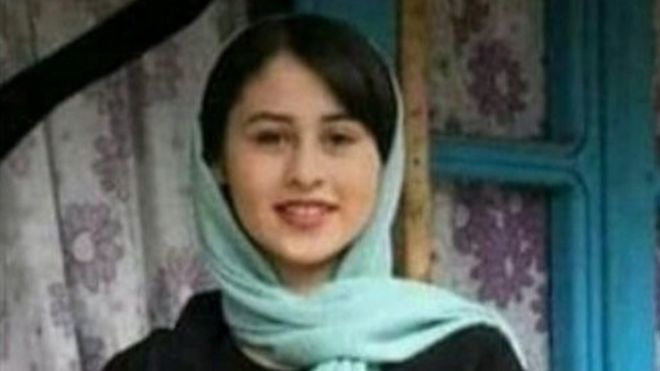
Romina Ashrafi ran away from home in Gilan province with her 35-year-old boyfriend after her father objected to their marriage, local media said.
The pair were found by police and Romina was sent home despite reportedly telling them she feared for her life.
Last Thursday night, she was allegedly attacked by her father in her bedroom.
News outlet Gilkhabar.ir reported that Romina was "decapitated" with a sickle, and that afterwards the father walked outside the house "with the sickle in his hand and confessed".
On Wednesday, a number of national newspapers highlighted Romina's story on their front pages.
"Insecure paternal home", read the headline in the pro-reform Ebtekar, which lamented the failure of existing legislation to protect women and girls.
Meanwhile, the Persian hashtag #Romina_Ashrafi has been used more than 50,000 times on Twitter, with most users condemning the killing and the patriarchal nature of Iranian society in general.
Shahindokht Molaverdi, a former vice-president for women and family affairs and the current secretary of Iran's Society for Protecting Women's Rights, wrote: "Romina is neither the first nor will she be the last victim of honour killings."
She added that such murders would continue "as long as the law and dominant cultures in local and global communities are not deterring enough".
4-As long as the current laws discriminating against girls and empowering abusive parents exist, unfortunately the cycle of violence will continue. Iran will see more Ruminas and Atefehs tragically killed by their fathers. This cycle of violence needs to end
— Masih Alinejad 🏳️ (@AlinejadMasih) May 26, 2020
Iran's Islamic penal code reduces punitive measures for fathers and other family members who are convicted of murder or physically harming children in domestic violence or "honour killings".
If a man is found guilty of murdering his daughter, the punishment is between three and 10 years in prison, rather than the normal death sentence or payment of diyeh (blood money) for murder cases.
There are no statistics on the prevalence of "honour killings" in Iran, but human rights activists reported last year that they continued to occur, particularly among rural and tribal populations, according to the US state department.
Latest Stories
-
Ga Adangbe traditional priests petition Mahama over McDan aviation licence revocation
10 minutes -
Anti-LGBTQ Bill: NDC’s arrogance is worrying – Hassan Tampuli
20 minutes -
Let’s give OSP time to mature, not to scrap it – Hassan Tampuli
24 minutes -
Nigeria convicts 386 Islamist militants in mass trials
29 minutes -
Djibouti president wins election with 97.8% of vote, state media says
34 minutes -
We don’t have mandate to deduct tax from rent allowance of security services personnel – Interior Ministry clarifies
48 minutes -
Ablakwa receives Presidential Special Envoy on Reparations to advance global agenda
1 hour -
Christina Koch becomes first woman to travel around the moon on Artemis II
1 hour -
Epstein survivors’ calls to meet King Charles and Queen harder to ignore as US visit approaches
1 hour -
UN Secretary-General names Ghana’s Anita Kiki Gbeho as South Sudan envoy
1 hour -
Mali withdraws recognition of Sahrawi Republic, backs Morocco’s autonomy plan
1 hour -
Gov’t distributes over 8,500 laptops to One Million Coders project
1 hour -
Julius Debrah, ‘man to beat’ as NDC’s James Agbey dismisses Musah Dankwah’s polls
2 hours -
GPRTU in Savannah Region to protest alleged eviction in Damongo
2 hours -
Re: Reinsurance does not replace process — A response to the SIGA–SIC defence
2 hours