

Audio By Carbonatix
Over thirty unemployed graduates in the Ashanti region have been trained to develop mobile applications.
The initiative by local business incubator, Kumasi Hive, is in line with the government’s vision to support the youth in Ghana to venture into entrepreneurship.
Organisers are enthusiastic that the project would alleviate unemployment in the region and empower the youth in establishing their own businesses.
Available statistics indicate that Ghana has the highest mobile penetration in West Africa.
Mobile adoption in the country stood at 55 percent at the end of 2019, higher than the West African average, which is at 44.8 per cent.
With an increasing usage of mobile technology, a horde of people can be served through digital services to positively impact the growth of the digital economy.
The business incubation firm, Kumasi Hive, believes the mobile space holds huge potential for the youth.
According to the Project Lead for the Kumasi StartUps Summit, Priscilla Serwaah Gyasi, “part of Kumasi Hive’s vision is to get the youth in Kumasi and across the country to understand and introduce them to digital skills. The participants were trained in mobile app development with Flutter. The youth, after the training, were tasked to develop mobile apps to provide solutions to societal problems.”
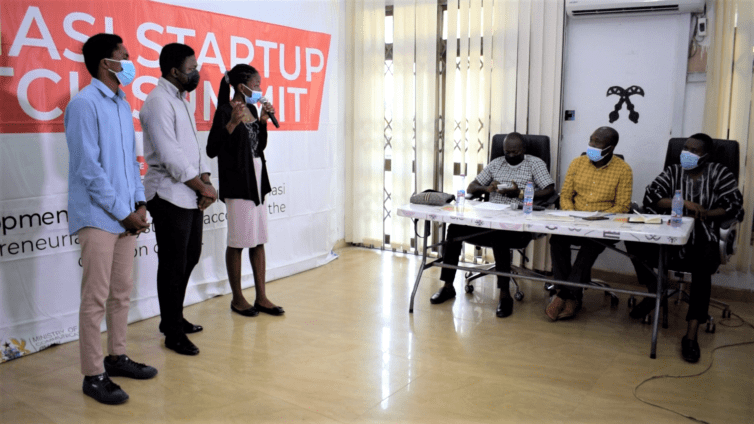
The Kumasi StartUps Pitch Summit assembled over 30 youth from different parts of the Ashanti region, who pitched their business ideas under a 6-week training programme.
The business development training birthed a mobile application expected to aid in purchase of groceries for students in boarding schools.
The young developers, who emerged winners of the pitch, explained that difficulties experienced by students accessing groceries at boarding schools, influenced the development of the app.
The project lead, Derrick Agyei noted that, “the app is to help guardians easily order groceries for their wards who may have run out of edibles.
“With the prevailing [COVID-19] pandemic, students in most second-cycle institutions are not allowed to regularly exit school to purchase these groceries.
“So, I believe with such an app, parents would no longer have difficulty in purchasing and delivering provisions to their wards at school.
“Parents just have to order for a specific package on the app, and we will deliver them safely to their wards at school,” he said.
Development Officer for the Otumfuo Charity Foundation, Kwabena Owusu Ababio, is optimistic that the mobile application development training would reduce the increasing unemployment situation in the Ashanti region.
“This project has helped in harnessing the entrepreneurial capabilities of youth in the Ashanti region.
“This project is in line with the aims of the Otumfuo Foundation to ensure the majority of the youth in Ashanti become entrepreneurs to better the unemployment situation in the region and the country largely,” he said.
Latest Stories
-
Arrest of Manhyia South MP should involve Parliament, not police station – Kpebu
12 minutes -
Two Nigerians sentenced to 189 months in US prison over $2.4m cyber fraud
35 minutes -
Cristiano Ronaldo leaves Portugal’s training camp after rift with Head Coach
35 minutes -
Ghana Energy Awards opens nominations for landmark 10th anniversary edition
37 minutes -
Aayalolo contra-flow: Are we treating the symptom instead of the disease?
40 minutes -
GTEC orders Colleges of Education to begin 2026/2027 admissions despite fees approval delay
43 minutes -
Legal reforms must solve real problems, improve justice – Bagbin
45 minutes -
Ofori-Sarpong named Alumni President of the Year, honoured for PRESEC dormitory project
1 hour -
Germany commits $132m to Ghana for skills development and training university – Pelpuo
1 hour -
‘Influence should go beyond visibility’ – Taadi Banyinba GH launches The TB Impact
1 hour -
Videos: Government announces emergency LEAP package for Hohoe flood victims
2 hours -
Salomey Baffoe’s children are crying for their mother – Family appeals for her release
2 hours -
Shortage of trained investigators and prosecutors hampers Ghana’s fight against money laundering – Report
2 hours -
GoldBod generates US$1.87bn in September FX operations, exceeding monthly target
2 hours -
Roads Minister says it is time to change one-year defect liability period for contractors, consultants
2 hours