

Audio By Carbonatix
Parliament has failed to be an effective check on the Executive arm of government, the Minority Leader, Haruna Iddrisu, and a Deputy Attorney General, Alfred Tuah-Yeboah, have said.
But while Mr Iddrisu attributes the failure of Parliament to extreme partisanship and the extensive powers granted the Executive by the 1992 Constitution, Mr Tuah-Yeboah is of the view that the legislative body has the necessary powers to be effective but has failed to utilise them.
The two were among a panel of three lawyers at a colloquium to mark the 20th anniversary of the 2002 Class of the Ghana School of Law (GSL), which was moderated by the Chairman of the National Media Commission (NMC), Yaw Boadu-Ayeboafoh, himself a member of the 2002 Class of the GSL.
The third panellist was Victoria Barth, a private legal practitioner and lecturer at the GSL. All three panellists were members of the 2002 Class of the GSL.
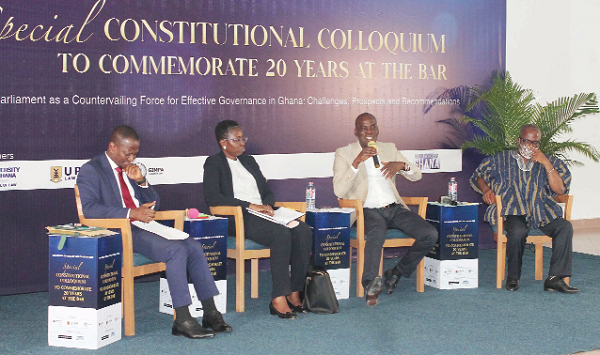
The colloquium was on the theme, 'Parliament as a Countervailing Force for Effective Governance in Ghana: Challenges, Prospects and Recommendations.'
It was attended by two Justices of the Supreme Court, Justice Nene Amegatcher and Prof Justice Henrietta Mensa-Bonsu; the Majority Leader in Parliament, Osei Kyei-Mensah-Bonsu; a former Speaker of Parliament, Prof Aaron Mike Oquaye; the Director of the GSL, Yaw Oppong, and many students of law.
Arguments
According to Mr Iddrisu, the 1992 Constitution had indirectly made the President a monarch, with so many powers to the extent that Members of Parliament (MPs), depending on the government in power, performed their functions to please the President.
However, for Mr Tuah-Yeboah, Parliament was equally powerful, if not more than the Executive, as it had the power to remove the President and censure ministers; therefore, any failure on the part of Parliament should be placed at the doorstep of the legislative body.
“No one is denying Parliament the power to check the Executive, but perhaps it has failed to do so from its own doing,” he said.
Passive parliament
Mr Iddrisu said Article 78 of the 1992 Constitution, which enjoined the President to appoint majority of ministers from Parliament, had made the Legislature passive, as MPs would yield to the influence of the Executive in order to get appointments.
“Have you ever seen any Minister of State who is also an MP criticise the government or the President on the floor of Parliament? He wants to please the President in order not to avoid a reshuffle,” he said.
Again, the Minority Leader said, due to excessive partisanship, instead of scrutinising the actions of the Executive, Parliament had become more or less a rubber stamp for the Executive.
For instance, he said Parliament had, over the years, failed to diligently scrutinise loan agreements brought before it by the Executive.
Mr Iddrisu said Parliaments under both New Patriotic Party (NPP) and National Democratic Congress (NDC) governments had been guilty of such failure and mentioned loan agreements such as the STX, CNTI and the recent $750 million.
“Take the agreement on the $750 million loan — it arrives at 5 p.m. and you want it passed in two hours. What due diligence is the Parliament of Ghana doing to get the public purpose and good served?” he asked.
“This is a mark of the failure of our Parliament to undertake scrutiny and due diligence because we want to satisfy the Executive President,” the Minority Leader said.
However, contributing to the discussion, Mr Kyei-Mensah-Bonsu said the hybrid system, whereby a legislator is allowed to also be a minister, should not be a hindrance to the work of Parliament.
He said some of the best parliaments in the world had legislators also acting as ministers.
Parliament to blame
Explaining his position, Mr Tuah-Yeboah said the Constitution had given Parliament so many powers and responsibilities, but the institution had failed to act on some of them.
He cited Article 22 of the Constitution, which enjoins Parliament to pass a law on spousal property rights, and Article 181(5), which gives power to Parliament to pass a law on what constitutes international business transactions that ought to be approved by Parliament.
On what was inhibiting the work of Parliament, the Deputy AG mentioned the qualification of MPs in terms of skills.
“There are no qualification criteria in terms of skills for MPs. How do you expect such MPs to be a check on the Executive?” he queried.
For her part, Mrs Barth said Parliament had failed to pass many gender-sensitive laws, such as the Affirmative Action Bill which had been pending in the House for many years.
Latest Stories
-
Communities affected by construction of Akosombo Dam urge government to speed up compensation process
15 minutes -
World Cup visa scandal: Sports Ministry not shielding anyone – Sports Minister’s special aide
35 minutes -
World Cup visa scandal: Over 30 people misrepresented as GTA board members to US Embassy – Vincent Assafuah alleges
37 minutes -
Fire destroys wooden structure near Yesu Mo Villa at Bush Road
38 minutes -
NDC threatens sanctions over oversized campaign posters, gives aspirants 5 days to comply
2 hours -
Star Oil paid GH¢2.7bn in taxes, levies in nine months of 2026
2 hours -
Samson’s Take: The rule of law is cheaper before the bulldozer
2 hours -
GRA blames system failure for delay in issuing receipt over passenger’s customs duty
2 hours -
Livestream: Newsfile discusses World Cup visa scandal, beach demolitions, education strikes, BRICS bid
2 hours -
NC-PTAs welcomes end of teachers’ strike, urges parents to prepare children for Monday
2 hours -
Government procures over 2,000 transformers as Ghana’s electricity access hits 89.13% – Energy Minister
3 hours -
UTAG-UG threatens strike on October 19 over unpaid allowance
3 hours -
Let The Constitution direct Chieftaincy to deliver “All Development Is Local”
4 hours -
John Jinapor outlines renewable energy, nuclear power priorities for 2027
5 hours -
Ghana explores centre of excellence for hearing, communication and cochlear implant care
5 hours