

Audio By Carbonatix
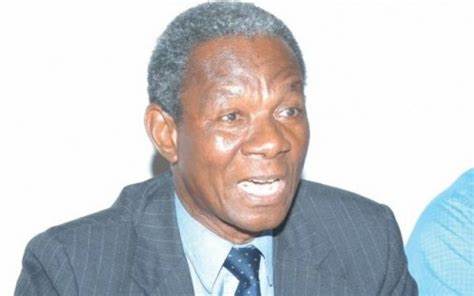
Renowned economist, Kwame Pianim, has criticized the license revocation approach adopted by the Bank of Ghana and the Securities and Exchange Commission in cleaning up the financial sector.
As part of the efforts to sanitize the financial sector, the Central Bank and the SEC were forced to withdraw licenses of firms that were insolvent.
But speaking at the Tesah Capital Webinar on “investing in the financial sector post clean up”, Mr. Pianim said this should have been the last approach.
He also raised issues about the lack of regulatory coordination of the sector.
“I think that what happened in the past was due partly to lack of jurisdiction. With some of the ponzi schemes, it was not clear whether the Bank of Ghana or the Securities Exchange Commission was to regulate them.”
“Revoking a license is not the right way to do to these companies. The idea is to be there, guide them when they are going wrong and let them know that you’re monitoring their accounts so if they’re not paying their bills, you are going to deal with them,” he said.
Meanwhile, the Deputy Director General of the Securities and Exchange Paul Ababio has been giving details on payment to be made to customers of Black Shield Capital.
“Gold Coast is still in court with us so we haven’t got a liquidation order for them. So, on that side, it’s a partial bailout but once we secure the liquidation order or know the outcome, we’ll know the way forward.”
“What is happening now is that those we have liquidated are those we bring into the full bailout. So those who do not have will be in the partial bailout until it is completed,” he said.
Financial sector clean-up
On Monday August 14, 2017, the BoG revoked the licenses of two prominent indigenous banks – Capital Bank and UT Bank.
At the same time, the Central Bank had approved a Sale and Purchase Agreement that allowed GCB Bank to immediately take over the assets of the distressed banks.
It followed with subsequent revocation of licenses of uniBank, The Royal Bank, Beige Bank, Sovereign Bank, and Construction Bank that were merged into Consolidated Bank Ghana (CBG).
Governor, Dr. Ernest Addison explained at a press briefing that these banks were vulnerable with inadequate capital, high levels of non-performing loans, and weak corporate governance.
Latest Stories
-
The legal effect of the United Nations resolution declaring the Transatlantic Slave Trade the gravest crime against humanity
3 hours -
KNUST boosts petroleum engineering output with largest MSc cohort
3 hours -
E&P dispatches final batch of 30 dump truck buckets to Tarkwa site
3 hours -
NIB returns to profitability with over GH₵343M Profit After Tax – 2025 financial report
4 hours -
We knew it was weak – Resident says after deadly Accra New Town collapse
4 hours -
Government to borrow GH¢15.231bn via T-bills, bonds between March and June 2026
4 hours -
UN resolution just the beginning – Mahama on adoption of slave trade declaration
4 hours -
UN adoption of resolution declaring transatlantic slave trade gravest crime historic – Mahama
5 hours -
“This is a proud moment for Ghana, Africa” – Mahama after UN slave trade resolution
5 hours -
New Town building collapse: Two dead, 14 rescued so far as mission intensifies
5 hours -
Prolonged Middle East conflict poses significant risk to economy – BoG
5 hours -
Kafui Dey suggests seat fillers to fix late TGMA start
6 hours -
World Bank, GCEA provide FIDIC contract management training in Accra
6 hours -
T-bills auction: Government records 20.1% undersubscription; interest rates continue to surge
6 hours -
Scientists from Ghana, Brazil and UK gather in Kumasi to tackle biodiversity crisis with technology
6 hours