


Audio By Carbonatix
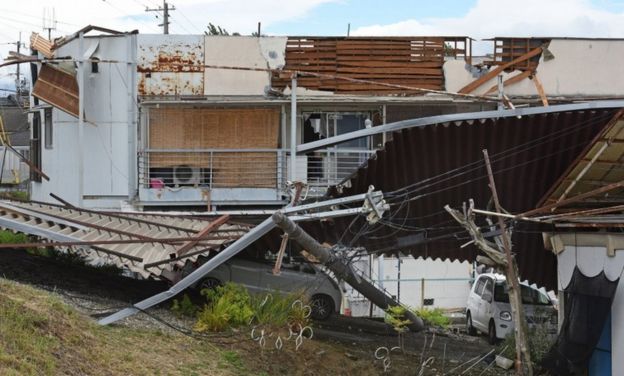
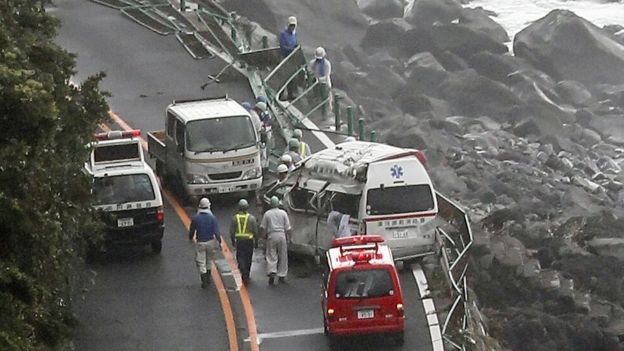
A powerful storm has hit central and western Japan, injuring at least 19 people and cutting power to thousands of homes.
Typhoon Jongdari (or "skylark" in Korean) brought torrential rain and winds of up to 180km/h (110mph).
It made landfall on the country's main island, Honshu, at 01:00 (16:00 GMT Saturday) on Sunday.
Weather officials have since downgraded it to a tropical storm, but warn that heavy rain could trigger landslides.
Japan's public broadcaster NHK reports that 150,000 homes are without power.
As of midday local time, the storm was moving westwards and tens of thousands had been urged to leave their homes.
On Saturday, evacuation orders were issued to 36,400 people in the western city of Shobara, and 6,300 in the city of Kure.
"We are afraid that people may not be able to evacuate due to strong wind or floods blocking evacuation routes," said Hiroshima's governor, Hidehiko Yuzaki.
"I would like people to evacuate in advance so that they can save their lives."
Images have shown huge waves crashing onto rocks off the coast south-west of Tokyo, and ferry services have been suspended.
Late on Saturday, the rough seas smashed through the window of a hotel restaurant in the tourist town of Atami, injuring five people.
"We didn't expect this could happen... Waves gushed into the restaurant as the window glass broke but we are grateful that customers followed evacuation instructions," a hotel staffer told AFP.
Hundreds of flights were also cancelled over the weekend as the storm neared the coast.
Provinces have been on high alert. One resident in Okayama, one of the prefectures worst-hit by the floods, told NHK he was afraid Typhoon Jongdari would "deal a double punch" to the region.
Meanwhile, Okayama crisis management official Koji Kunitomi told AFP: "We have been on emergency alert the whole time since the rain disaster" in early July.
"Fortunately, so far, we haven't seen new flooding" as a result of Typhoon Jondari, he added.
'Double punch'
Japan is still reeling from one of its worst flooding disasters in decades earlier this month, which saw more than eight million people ordered to leave their homes. More than 4,000 survivors are still living in temporary shelters.
The floods were swiftly followed by an unprecedented heatwave which was declared a natural disaster.
The country is now in the grip of typhoon season, which sees tropical storms barrel across the Pacific throughout the summer months.
Latest Stories
-
AFCON 2025: Senegal beat Morocco to win second title
4 hours -
Sports journalist Alex Kobina Stonne elected UniMAC External Affairs Commissioner
4 hours -
NDC’s economic gains ‘cosmetic’; real impact yet to be felt – Bryan Acheampong
4 hours -
WEF warns geoeconomic confrontation now world’s biggest threat
5 hours -
Top 10 safest countries in Africa for travellers in 2026: Ghana places 7th
6 hours -
Inflation to remain within lower bound of medium-term target of 8 ± 2% – BoG
6 hours -
Bright Simons: Ghana’s budget should follow gold, not oil
6 hours -
Stress test on restructured government bonds: Banks appear resilient to shocks – BoG
6 hours -
T-bills auction: Investor interest continued to surge, but interest rates soar
6 hours -
2025/26 Ghana League: Holy Stars edge Bechem United to secure vital home victory
8 hours -
Gun amnesty programme extended by two weeks
8 hours -
Tano North farmers threaten demonstration against Newmont ‘unfair compensation’
8 hours -
GPL 2025/26: Richmond Opoku brace sees Young Apostles draw with Hohoe United
8 hours -
Over 75% of NPP Parliamentary candidates outpolled Bawumia in 2024 – Bryan Acheampong
9 hours -
Kyebi Zongo to become a model for excellence, environmental stewardship – Chief of Kyebi Zongo
9 hours