

Audio By Carbonatix
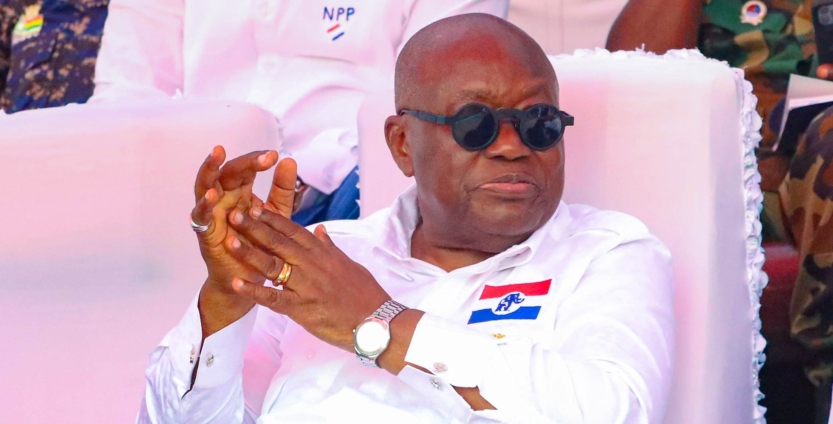
A Private Legal Practitioner, Dr. Justice Srem Sai has chastised President Akufo-Addo for refusing to assent to some bills passed by Parliament.
According to Dr. Justice Srem Sai, the power bestowed on the President by the constitution is not a blank cheque for him to use to settle political or personal scores.
His comment follows statements from the Presidency explaining that the bills, sponsored by the NDC MP for Madina, Francis-Xavier Sosu must come from the Executive and not as a Private Members Bill.
The bills are; Criminal Offences (Amendment) Bill, 2023, Criminal Offences (Amendment) (No.2) Bill, 2023, and Armed Forces (Amendment) Bill, 2023.
Also read: Akufo-Addo’s refusal to assent to witchcraft bill breach of constitution – Minority
In July, Parliament passed the Armed Forces Bill which seeks to amend sections of Act 29 and the Armed Forces Act, 1962 (Act 105) to replace the Death Penalty with life imprisonment.
The Criminal Offences Amendment Bill 2023 also seeks to prohibit the act of declaring, accusing, naming, or labeling an individual as a witch, among other related matters.
But in a letter to the Speaker of Parliament read to the House, the President insisted that his government will soon present bills on the same subjects before Parliament.
Reacting to this in a social media post, Dr. Srem Sai said "the President is not seeking to change or amend any provision of the bill."
He stressed that, the only reason for the President "exercising the veto power is that the bill came from an MP (Hon. Francis Sosu) and not from him (President Akufo Addo).”
Below is the full statement by Justice Srem Sai
A law passed by Parliament (a bill) is not a full law (an Act) until the President signs it. This means that the President has the power to sign or to refuse to sign a bill. When he signs, we say he has given his assent; when refuses, he has vetoed it.
In August and in November this year, Parliament passed and presented some bills to the President to sign into Acts. Now, the President is claiming that he has vetoed the bills. The question is – is the President’s purported veto valid?
Read also: I am unable to assent to Witchcraft, Armed Forces Bills – Akufo-Addo tells Parliament
The beginning point of the answer to this question is that the President’s veto power is not a blank cheque – he can’t do as he wishes or behave as he pleases with the power. For his veto to be valid, he must act in accordance with the Constitution.
We know a few things: we know, for instance, that the President, in the exercise of the veto power, is limited (restricted) in at least 2 clear ways. He is limited in respect of TIME. He’s also limited in respect of the GROUNDS on which he may veto a bill.
TIME: Generally, he has up to 21 days (from the day the Speaker of Parliament presents the bill to him) to exercise the veto power. First, he has 7 days to “signify” to the Speaker that he has vetoed the bill; then, an additional 14 days to provide the grounds for the veto.
If the President defaults in satisfying any of these timelines – the 7 days, or the 14 days – the veto becomes invalid. In such a situation, he may be deemed to have assented to the bill notwithstanding that he has not actually signed it.
On the facts, one of the bills in question was presented to the President in August. The other 2 were presented to him in November. No one heard from him in respect of the memorandum until December 12. Now, do the maths. That’s not all.
REASON: The President’s veto power is exercisable only where he seeks a change or an amendment to “any SPECIFIC provisions of the bill”. This means that the President’s reasons for vetoing a bill is limited to the content of the bill.
If the President has any other concerns over a bill, he (like any other citizen), would have to use other established mechanisms for enforcing the Constitution. The veto power, as I said, is not a blank cheque for him to use to settle political or personal scores.
In this case, however, the President is not seeking to change or amend any provision of the bill. His only reason for exercising the veto power is that the bill came from an MP (Hon. Francis Sosu) and not from him (President Akufo Addo).
Latest Stories
-
Prof. Mike Oquaye recounts how he blocked Special Prosecutor’s attempt to arrest Bawku Central MP
12 minutes -
Make health sovereignty a priority for Africa – Mahama
24 minutes -
Dorimon Naa, Wa West DCE lead massive clean-up exercise; threaten sanctions against recalcitrant residents
41 minutes -
Photos From Adom FM Y2K Jam
43 minutes -
Praye Tiatia steals the show at Adom FM Y2K Jam [Watch]
52 minutes -
Boakye Agyarko congratulates John Boadu, pledges support for NPP leadership
1 hour -
Antwi HiMight thrills fans with Antwi ne Antwi hits at Adom FM’s Y2K Jam [Video]
1 hour -
Amb. Edward Boateng congratulates Boadu, Kodua on election wins
2 hours -
John Boadu pledges to rebuild NPP from grassroots and restore ‘winning machinery’
2 hours -
Ashaiman Assembly deploys monitoring system to curb dumping in storm drain
2 hours -
John Boadu must rebuild, unite NPP for 2028 – Edward Boateng
2 hours -
Executive intimidation of opposition undermines separation of powers – Prof Oquaye
2 hours -
I have no issue with John Boadu; we’ll work together – Justin Kodua
3 hours -
Adom FM Y2K Jam delivers a night of music, fashion and nostalgia
4 hours -
Lawrence Kobena Nsarko Otoo, Esq
5 hours