

Audio By Carbonatix
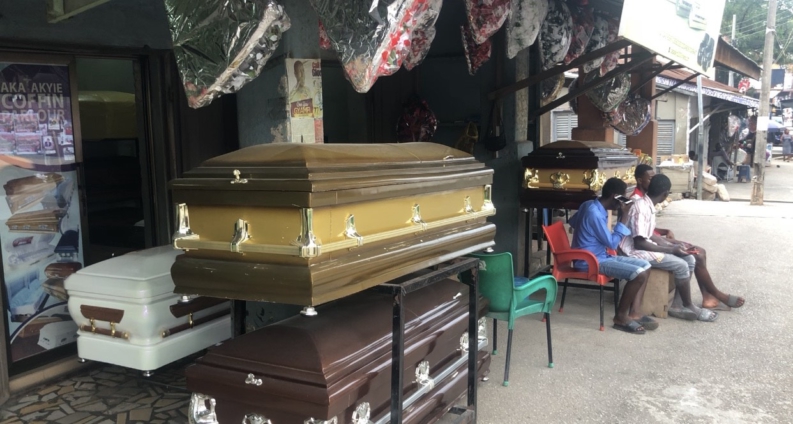
Coffin and casket manufacturers at Asafo in Kumasi are lamenting the high cost of raw materials.
The producers say they are frustrated over the high prices of significant materials like fillers, nails, pine, saw and fabrics to line coffins.
The extra expenditure on production is pushing the manufacturers to increase the prices of caskets in order to stay in business.
With inflation rising high, coupled with fuel and utility tariff increases, local businesses are on the brink of collapse.
Agya Appiah, who has about 30 years of experience in the production of caskets and coffins, says he is compelled to increase the prices of his products.
“I was an apprentice in 1992, but now I run my own business. The fabric we use to decorate the casket I bought for ¢200 on Friday, I was told today to pay ¢240. I couldn't buy it, so I had to come home to solicit the remaining amount.
"Things are expensive, I would also not sell them [caskets] at a reduced price. All manufacturers here have come to a consensus to increase and stick to one price, latest by next week,” he said.
“This casket is called ‘Abenwaha’, with a price range of ¢1,500 to ¢2,000. But now, If I don't sell it at ¢2,800, I may not be able to accrue my profit,” he added.
Kwame Malvin, who has been in the business for 3 years, says patrons are complaining about the new prices.
“Our work has been affected. I used to buy this filler at ¢80, currently, I buy it at ¢230. I used to finish two coffins a day. Buyers keep complaining because we scare them with the pricing.
"Starting next week, the prices of coffins will increase. The ¢1,000-priced coffins will be sold at ¢1,500. The ¢800-priced coffins would be sold at ¢1000,” he said.
Other producers like Akwasi Amoako Yeboah, who has been in the casket manufacturing business for 25 years, say he is recording low patronage due to the new prices.
He has called for the government’s support and intervention, especially in respect of access to wood.
“People come from Burkina Faso to purchase our wood because we are unable to buy them ourselves. With the high increase in materials, we have also increased our goods and it is affecting patronage.
"People hardly come around to purchase coffins. We need government to do something about it. This is very sad,” he said.
Latest Stories
-
We don’t have mandate to deduct tax from rent allowance of security services personnel – Interior Ministry clarifies
14 minutes -
Ablakwa receives Presidential Special Envoy on Reparations to advance global agenda
31 minutes -
Christina Koch becomes first woman to travel around the moon on Artemis II
42 minutes -
Epstein survivors’ calls to meet King Charles and Queen harder to ignore as US visit approaches
48 minutes -
UN Secretary-General names Ghana’s Anita Kiki Gbeho as South Sudan envoy
50 minutes -
Mali withdraws recognition of Sahrawi Republic, backs Morocco’s autonomy plan
54 minutes -
Gov’t distributes over 8,500 laptops to One Million Coders project
55 minutes -
Julius Debrah, ‘man to beat’ as NDC’s James Agbey dismisses Musah Dankwah’s polls
1 hour -
GPRTU in Savannah Region to protest alleged eviction in Damongo
2 hours -
Re: Reinsurance does not replace process — A response to the SIGA–SIC defence
2 hours -
Gender Ministry supports Harriet Amuzu in ongoing abuse case
2 hours -
AG joins plaintiff to scrap OSP ?: We should be mindful of the mischief in this – Bobby Banson
2 hours -
Samson Lardy Anyenini questions willingness of Attorneys-General to prosecute political colleagues
2 hours -
It is only fair the OSP is heard in Supreme Court case – Bobby Banson
2 hours -
Asiedu Nketia resumes Ashanti tour, second leg kicks off on Sunday
2 hours