

Audio By Carbonatix
Throughout the 21st century, especially after the institution of the Sustainable Development Goals (SDGs) in 2015, several countries have been striving to achieve gender equality in education in general, and science in particular. Ghana is not an exception.
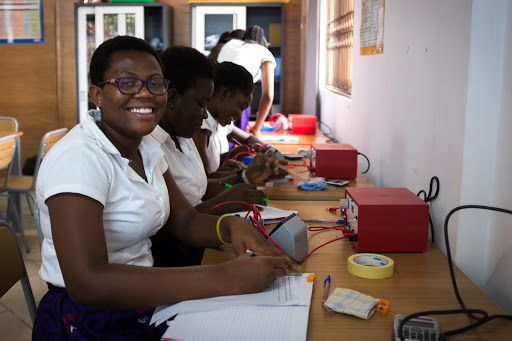
There has been significant investment towards bridging the gender gap in access to education and opportunities in science. As we mark the 2022 International Day for Girls and Women in Science, this paper reflects on the progress made in achieving gender parity in Science, Technology, Engineering, and Mathematics (STEM) in Ghana and offers some suggestions going forward.
Equality is critical to building peaceful, prosperous societies. While we may all agree on this fundamental tenet, its application thereof continues to be elusive. Gender parity is arguably the foremost goal in the education equality advocacy. Globally and locally, there are ongoing efforts aimed at achieving gender equality in access to education, healthcare, job opportunities, dignity, and wealth creation.
One may probably ask, what precisely is the need for women in science? Why must women be specifically encouraged to build careers in STEM? The answer appears to lie in the understanding that Science must work for everyone. Many scientists ground their scientific enquiry on their personal curiosity. Therefore, without gender equality in STEM, scientific enquiry, and scientific innovation will be dominated by male perspectives. Indeed, we are beginning to witness some practical effects of male dominance in digital innovation, where some algorithms are built based on male behavioural patterns thereby making men the standard of humanity and women, the exception.
Thus, the government’s efforts to encourage more girls in STEM appears to be an emphatic response to changing the existing narrative. The Free SHS policy has significantly broken down financial barriers to education thereby allowing more girls to pursue science courses in secondary schools. Since 2017, over 92% of JHS graduates have been placed in SHS; whereas in 2018 alone, over 470,000 new students were admitted into secondary schools under the Free SHS policy, including female students from low-income families, who otherwise would have been denied secondary education.
The government’s ambition to build an all-girls STEM SHS at Kpone Katamanso, Accra, affiliated with the African Institute for Mathematical Sciences (AIMS) further cements its vision for girls in STEM. This unprecedented project seeks to create a safe space for only girls to pursue their passion in STEM and develop into leading problem solvers for our society.
In January 2022, H.E. Nana Addo Dankwa Akufo-Addo cut the sod for the construction of a STEM Academy in Accra. The Accra STEM Academy – like twenty STEM Centres being constructed across the country – will increase access to STEM education in Ghana, thereby encouraging more STEM careers. These projects and policy interventions emphasise the government’s commitment to creating equitable access to STEM education.
Beyond the government’s efforts, evolution of the Ghanaian perception of women in science is quite inspiring, as evidenced by the manner in which the nation collectively celebrated Francisca Lamini of Keta Senior High Technical School for her efforts in the 2021 National Math and Science Quiz (NMSQ). Our collective adulation of Francisca as a young national icon and the venerable quiz mistress will greatly inspire other brilliant girls to pursue their passion in STEM.
However, despite this progress, there remains great room for further bridging the gender gap in STEM. We are a long way from mainstreaming female STEM voices and creating national female STEM ambassadors to inspire and mentor young girls in STEM. In this regard, the exploits of Ivy Barley of Developers in Vogue and Regina Honu of Soronko Solutions need to be celebrated for their work in bringing STEM education closer to girls.
According to the United Nations Children’s Fund (UNICEF), in Ghana, while 16% of adolescent boys have digital skills, only 7% of adolescent girls do. This statistic suggests that women in will be underrepresented in jobs of the future which are hugely computer-dominated. Indeed, we are beginning to see this trend in developed countries where women constitute only 28% of the workforce in STEM. However, government’s unrelenting commitment to developing STEM education and ensuring equitable access for girls appear quite encouraging. In fact, the 2020 Ghana Education Strategic Plan, which I was privileged to have been part of the technical team to complete, aims at achieving a science to humanities ratio of 60:40 in institutions of higher learning by 2030.
Furthermore, parents and teachers can play a role in nurturing STEM interest in their female wards at an early age by exposing them to math and digital literacy. Research suggests that there are no inherent cognitive differences between boys and girls in terms of math ability. Differences in performance, however, are influenced by stereotypes fostered by misrepresentation and gender bias towards females in early child educational materials. For this reason, the government’s new curriculum for basic schools, which I led in its development, attempts to preserve STEM interest in young girls by ensuring that the learning materials did not contain any form of gendered representations of STEM careers.
Our current developmental challenges and the problems of the future require technology and innovation to solve. In order to create inclusive solutions towards these problems, we need to ensure both genders are equally represented by embarking on a concerted effort to develop and train more girls in STEM. We need a multifaceted approach that includes participation from government, development agencies, educational institutions, STEM mentors and the family.
We need to create the atmosphere for girls to dare to dream and for women to dare to believe that they can learn and work in STEM and be treated equally as their male counterparts. Together, let us work to secure the inclusive future we desire for the girl-child in STEM.
*****
The author, Prince Hamid Armah, PhD is the Member of Parliament for Kwesimintsim Constituency, Vice Chairman of the Parliamentary Select Committee on Education and a former Director-General of the National Council for Curriculum and Assessment (NaCCA).
Latest Stories
-
‘We have turned the tide’ – Ato Forson says Ghana is ready to take off
1 minute -
Police arrest man captured in viral video assaulting wife in Agona Nkwanta
3 minutes -
KATH Mother and Baby Unit construction stalled for 14 months over unpaid contractor arrears
17 minutes -
Government wanted to ‘tilt the balance’ with new EC appointments – Kwakye Ofosu
24 minutes -
Angry Tema Community 25 residents threaten to sleep at GWL over water shortage
37 minutes -
BoG takes financial literacy drive to Techiman, vows to protect depositors
37 minutes -
‘Stop the distractions’ – Akosua Manu demands answers over GH¢49.7m South Africa evacuation cost
38 minutes -
Formula 1 to return to Africa with Rwanda Grand Prix in early 2030s
44 minutes -
Mahama says Ghana is safer today as he commissions 85-bed ward at Police Hospital
49 minutes -
LA 2028: Black Queens face Zambia in final Olympic qualifier
57 minutes -
WAFU Zone B: Black Starlets seal semifinal place with 3-1 win over Benin
1 hour -
Black Queens thrash Mauritius 7-0 to advance 10-0 on aggregate in Olympic Qualifiers
1 hour -
Kaizen as a strategic pathway for micro business scale-up in Ghana
1 hour -
Minister orders suspension of Obuasi SHS headmaster over alleged sexual misconduct following JoyNews investigation
1 hour -
Over 38,000 commercial, 150,000 residential customers unbilled – Ghana Water MD
2 hours