

Audio By Carbonatix
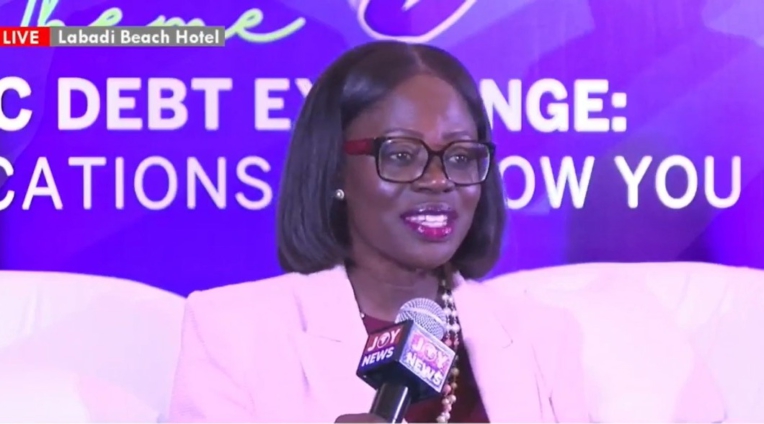
The Managing Director of the Ghana Stock Exchange, Abena Amoah, has called on the current and future governments to spend wisely and refrain from borrowing at expensive rates for consumption.
Speaking at the Graphic Business/Stanbic Bank Breakfast Meeting, she advised government to prioritise its investment and spend in areas that yield benefits.
This, she believes, will be critical in restoring investor confidence in the economy and also sustain the socio-economic development in Ghana.
“Fiscal discipline is necessary for sustainable economic growth. Government must prioritise economic and social investments and must avoid using expensive debt to pay emoluments and service more debt”.
“The day we spend more than 40% of revenue paying emolument and the rest paying public debt. We need to spend where it matters most.”
The Managing Director of the Ghana Stock Exchange further called for more public-private partnerships to enhance collaborations and deepen knowledge sharing amongst the two sectors.
“This is another area we must to look at. This helps leverage resources and expertise of both public and private sectors for the benefit of the economy. “
“We must conduct ourselves in a transparent and an accountable manner, build trust with other stakeholders”, she added.
On the importance of diversifying investments, Ms Amoah called for more investments in the capital market.
She added that for the country to achieve economic transformation, it must have a vibrant capital market.
She also called for extensive transparency and accountability on the part of all stakeholders.
Background
Ghana’s economy has encountered turbulent times in the past year.
The aftermath of the Covid-19 pandemic, Russia’s war on Ukraine and escalating debt resulting from huge expenditure on the part of government. This has led to the one time promising middle income economy to run to the International Monetary Fund for credit support.
As part of efforts to cut expenditure, the government of Ghana rolled out the Domestic Debt Exchange programme which essentially sorts to pay part of obligations due fixed income investors. The External Debt Exchange Programme will see the country seek to have parts of debt it owes certain countries restructured.
Latest Stories
-
Anti-LGBTQ Bill: Forget the rumour mongers, I’m a man of action, and will pass the bill – Speaker
14 minutes -
Women and children among those killed in Sudanese army shelling of wedding celebration
17 minutes -
President Mahama is not sincere with Ghanaians on LGBTQ bill matter – Hassan Tampuli
35 minutes -
Gov’t to establish Prison Industrial Hub to equip inmates with income-generating skills – Prison Service boss
54 minutes -
Alhassan Tampuli donates cement, roofing sheets to support storm victims in Gushegu
54 minutes -
Alhassan Tampuli appeals for urgent support for storm victims in Gushegu
57 minutes -
The hypocrisy must stop; pass Anti-LGBTQ+ Bill now – Alhassan Tampuli to Mahama
1 hour -
Imprisonment should be rehabilitative, not punitive – Ghana Prisons boss at UNGA
1 hour -
Ga Adangbe traditional priests petition Mahama over McDan aviation licence revocation
2 hours -
Anti-LGBTQ Bill: NDC’s arrogance is worrying – Hassan Tampuli
2 hours