

Audio By Carbonatix
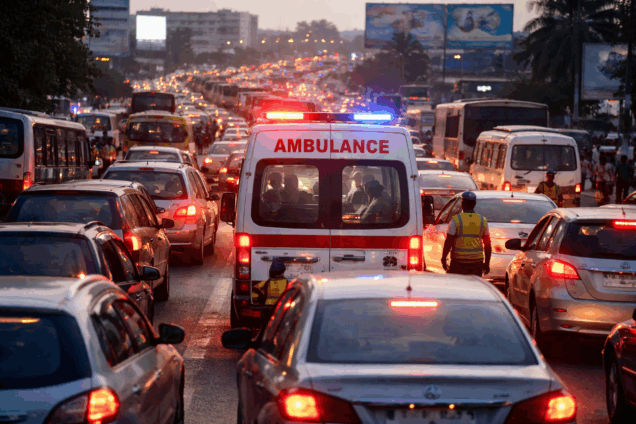
Listening to my Bishop recount his ordeal trapped in the now familiar Accra traffic while desperately trying to reach a hospital was deeply unsettling. It was not just a testimony; it was a warning. A warning that we must stop allowing ourselves to be bullied into normalising dysfunction.
Our cities are choking. Congestion is no longer a nuisance; it is a public safety emergency. When traffic stands still, lives are lost. Emergency response time is often the difference between survival and tragedy, and in our cities, that difference is too frequently decided by gridlock.
Improving emergency response efficiency must therefore be treated as a national urban policy priority. While technological innovations offer opportunities for smarter coordination, a dangerous gap persists between research, policy, and on-the-ground implementation. Dedicated emergency infrastructure remains absent, mainly, despite overwhelming evidence of its life-saving potential.
This is no longer an academic debate. Policy must now respond decisively. We need:
- Legally protected and enforceable emergency lanes on major urban corridors;
- Clear national and metropolitan standards for emergency access in road design, traffic management, and urban redevelopment;
- Institutional coordination among transport authorities, emergency services, metropolitan assemblies, and enforcement agencies;
- Targeted investment in context-appropriate intelligent transport systems that prioritise emergency vehicles; and
- Strict enforcement and public education, so emergency access is respected, not negotiated.
Our transportation engineers, planners, and scholars must work hand in hand with policymakers to deliver solutions that are practical, scalable, and grounded in our realities. Research must move beyond publications into pilot projects, regulations, and implemented systems.
Above all, we must act with urgency. Every delay carries a human cost. Avoidable deaths on our roads and in our traffic must no longer be accepted as inevitable. This is a matter of policy, planning, and political will.
It is too much and far too scary to ignore.
Emmanuel Adinyira (PhD)
Professor and Dean
Faculty of Built Environment
KNUST
Latest Stories
-
Mahama lauds Julius Debrah for shaping Kwahu Business Forum
7 minutes -
Why actors beg in difficulty – Patience Ozokwor on Nollywood financial struggles
18 minutes -
Any man who apologises to woman deserves to suffer – Brymo
30 minutes -
Nigerian artistes no longer put effort into making music – Omah Lay claims
41 minutes -
‘I’m now skeptical about going into politics’ – Davido
53 minutes -
Nigeria’s Seplat Energy resumes operations as oil workers halt strike action
1 hour -
Nigeria launches manhunt after abductions by bandits in northwest Zamfara
1 hour -
Kenya fuel executives resign as state probes supply chain irregularities
1 hour -
Senegal bans ministers from foreign travel as oil price rise bites
2 hours -
Nigerian army rescues 31 hostages after church attack
2 hours -
Spain’s huge pork industry seeks salvation from swine fever threat
2 hours -
Trump declares victory after rescue but threats to US operation in Iran still loom
2 hours -
US Secret Service investigates reports of gunfire near White House
2 hours -
Current account stability to mitigate pressure on cedi; currency to end year at GH¢11.40 to a dollar
3 hours -
Oil back above $110 after expletive-laden Trump threat to Iran
3 hours