

Audio By Carbonatix
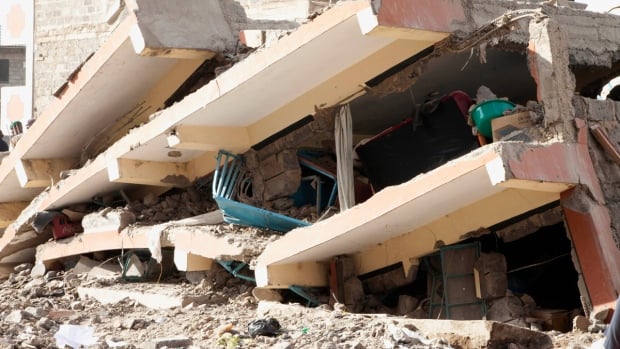
The Engineering Council of Ghana says the rampant collapse of buildings in some parts of the country should be treated as a national emergency.
The Council, which is mandated to regulate the engineering sector, said it had taken the recent disasters seriously and thus, an emergency team would be put in place soon to investigate the causes of the incidents to sanitise the construction industry.
In an interview with Wise Ametefe, the Registrar of the Council, he said the Council would also establish a permanent team that would directly respond to such disasters in the future and offer technical support to Assemblies to enforce building regulations.
The move by the Council follows four cases of collapsed buildings in less than two weeks, leading to loss of lives and injuries.
One person was reported dead on Friday, May 5 after being trapped under the rubble of the collapsed building situated at Nanakrom in the Adentan Municipality.
The tragedy occurred barely four days after a similar three-storey building collapsed at Madina in the Greater Accra Region – which reportedly killed one person and injured three others.
A six-storey building under construction at the city campus of the University for Development Studies (UDS) in Tamale collapsed last Saturday during a rainstorm.
Seven construction workers were injured after a church building collapsed on them at Old Bortianor in the Ga South Municipality of the Greater Accra Region on Tuesday.
Mr Ametefe blamed the repeated incidents on poor supervision on the part of the Assemblies.
He said preliminary investigations at the disaster sites had revealed that the owners of the buildings either did not obtain permits or extended the buildings beyond what was approved.
“The Council is taking the cases very seriously...we agree that there could be failure in one aspect of the regulation but that could not be attributed to the Engineering Council.
“It is mainly the Assemblies who are responsible for approval of buildings but the professionals in the Assemblies should ensure that buildings submitted for approvals are vetted before permits are granted,” Mr Ametefe said.
In the case of the Bortianor church building incident, the Council said preliminary investigations had shown that there were “a lot of flaws in the construction”.
“Concrete columns were there without reinforcement. Concrete work was done porously...there was very little supervision,” Mr Ametefe said.
The Engineering Council said the outcome of the investigations would make a case for punitive measures to be taken against persons found to have flouted the law.
Latest Stories
-
Africa must look inward: Reframing resilience in a shifting global econy
12 minutes -
7 dead, 2 missing after boat capsizes on Volta Lake
23 minutes -
Miss Diaspora Ghana 2026 launched to deepen diaspora ties and drive development
29 minutes -
US warns citizens to reconsider Nigeria travel on safety grounds
54 minutes -
Ivan Toney questions refereeing in Saudi Pro League title race after Al-Ahli draw
55 minutes -
Angola appoint Aliou Cissé as new head coach
1 hour -
Virtual Security Africa showcases digital security vision at Kwahu Business Forum
1 hour -
EBID strengthens regional integration role amid global economic uncertainty
2 hours -
Two assault rifles, ammunition retrieved in Police probe of Tamale gang attack
2 hours -
EBID records strong financial growth with $722m disbursements in 2025 – President, Dr George Donkor
2 hours -
EBID to mobilise $2.69bn under new 2026–2030 growth strategy – Dr George Donkor
2 hours -
An open letter to telcos, regulators and security agencies on mobile money fraud in Ghana
2 hours -
Mobile Money Merchants are driving fraud
2 hours -
Alban Bagbin declines minority’s motion to investigate sale of gold reserves at BoG
2 hours -
NACOC leadership tours drug testing centres in Accra
2 hours