

Audio By Carbonatix
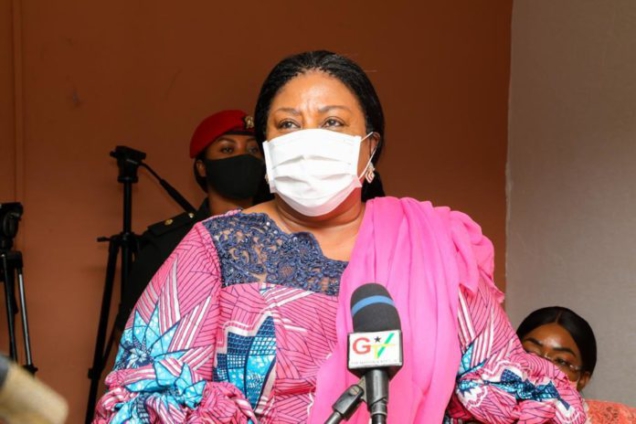
The First Lady, Rebecca Akufo-Addo has on Tuesday launched a report on “Cancer in Sub-Saharan Africa: A Lancet Oncology Commission,” in Accra.
The report called on all stakeholders, especially policy makers in the health sector to unite and chart a collective response to the increasing burden of cancer in Africa.
The Commission, which comprised of national and international experts from academia and healthcare, presented a framework that can be used by governments and non-governmental organisations to increase access to cancer care, accelerate cancer prevention and increase survival in Sub-Saharan Africa.
Professor Wilfred Ngwa, the Commission Chair, said projected trends underscored the devastating costs of inaction on cancer incidence rates and cancer mortality in sub-Saharan Africa.
Professor Ngwa said while the list of barriers hindering effective cancer control in the region was long, the pursuit of robust cancer registries, effective cancer control plans, early cancer screening and detection, and the integration of palliative care into the cancer care pathway was critical.
He called for greater focus on the implementation of telemedicine and new technologies, building and training the oncology workforce, and boosting cancer research to radically improve cancer care across the region.
“Digital health is already being adopted at a high rate as seen in examples in Nigeria and South Africa, including in cancer care, where tele-oncology became a necessity for providing remote chemotherapy supervision, symptom management, and palliative care to many cancer patients.”
Dr Beatrice Wiafe Addai, Commission co-chair, said population knowledge and attitudes about cancer risk factors were critical to reducing the burden of cancer in sub-Saharan Africa.
She said public health campaigns needed to form an instrumental part of any effective cancer control programme to raise population awareness about harmful risk factors, and healthy habits and dispel misinformation.
“At the same time, transformative policies must be in place to foster cancer prevention uptake. Previous case studies have shown that civil societies could work with governments to design cancer awareness education programmes, scalable across the Sub-Saharan Africa in parallel with other initiatives,” she said.
Latest Stories
-
Church of Pentecost supports over 2,000 BECE candidates in Obuasi with career guidance seminar
18 minutes -
Brandon Asante and Coventry all but promoted to Premier League despite Sheffield Wednesday draw
39 minutes -
GPL 2025/26: Late Kwartemaa strike downs Hearts in Tema
46 minutes -
Ghana Faces Sierra Leone Moment as Prosecutorial Powers come under strain
56 minutes -
Don’t consume fish or seafood from Tema Shipyard until further notice – FDA warns
1 hour -
Why volunteering might be Africa’s most underrated career accelerator
1 hour -
ActionAid Ghana raises concern over gender gaps in Feed Ghana Programme
1 hour -
Windstorm wreaks havoc in Gushegu, displacing nearly 2,000 residents and damaging schools
1 hour -
Friends of Bridget Bonnie Marks her 35th birthday with donation to Kasseh Model Health Centre
2 hours -
From Ekumfi Kokodo to the Pulpit Stage: Essi Donkor’s gospel journey takes shape
2 hours -
Landfilling waste management creates no value, it’s an economic waste
2 hours -
Photos: Speaker Bagbin Commissions MPs constituency office under parliamentary decentralisation programme
3 hours -
Black Stars technical advisor Winfried Schäfer sacked as GFA shakes up backroom staff
3 hours -
Wenchi water project almost complete, critical to gov’t agenda – GWL MD
3 hours -
Anti-LGBTQ+ bill not part of government’s legislative agenda – Inusah Fuseini
3 hours