

Audio By Carbonatix
Sadio Mané sat down with CAF Media before the Africa Cup of Nations final for a conversation on a variety of topics from leadership to legacy.
When asked how he wanted to be remembered, the Senegal captain offered a simple answer. “I’ve never wanted to be remembered only as a great footballer,” he said. “I want to be remembered as a great human being. For me, that is far more important.”
On Sunday night in Rabat, with an AFCON final unravelling into chaos, Mané turned those words into action.
Senegal’s victory over hosts Morocco will be remembered for its drama: a disallowed goal, a late VAR-awarded penalty, a walk-off, a saved Panenka, extra time and a stunning winner. But at the centre of the storm was Mané, whose intervention helped prevent a moment of protest from becoming a lasting stain on African football’s biggest stage.
Deep into injury time, Morocco were awarded a penalty after a VAR review, a decision that infuriated the Senegal bench. Urged on by head coach Pape Thiaw, Senegal’s players walked off the pitch in protest, retreating to the touchline as tensions escalated inside the Prince Moulay Abdellah Stadium.
Senegal have been robbed there is no ways thats a penalty to Morocco. This is the worst end to a final i’ve ever seen pic.twitter.com/znEiP6q7EW
— Connor (@Connor_LFC8) January 18, 2026
The moment did not exist in isolation. Minutes earlier, Senegal had seen a late goal ruled out for a foul. Before the final, the Senegal Football Federation had publicly condemned what it described as poor security and hotel arrangements following the team’s late relocation from Tangier to Rabat. Frustration had been simmering, and the penalty decision proved the breaking point.
At Africa’s highest footballing stage, however, the walk-off risked becoming something bigger than a single refereeing decision. It threatened the image of the tournament itself.
Mané, playing what he has said will be his final AFCON, recognised that reality. As players argued and officials scrambled, television cameras caught the forward gesturing to his teammates, urging them to return to the pitch and continue the game. After several minutes of negotiation, they did.
Sadio Mané remobilise les siens !
— M6 (@M6) January 18, 2026
Le capitaine sénégalais fait revenir ses coéquipiers sur la pelouse, la tension est maximale avant la suite
Suivez la finale de la #CAN2025 en direct sur M6 et M6+ : https://t.co/yva3jb9PXw pic.twitter.com/ozyjTZpQso
Brahim Díaz’s attempted Panenka was saved by Édouard Mendy, sending the match into extra time. Senegal would go on to win through Pape Gueye’s powerful strike, securing their second Africa Cup of Nations title.
Have a feeling Brahim Diaz missed the penalty on purpose for Morocco promote "fair play" after protests by Senegal.
— Mark Kinyanjui (@Kiinya_Y) January 18, 2026
Like Marcelo Bielsa when he ordered Leeds United players to cede v Aston Villa after a long moment of refereeing drama. #AFCON2025pic.twitter.com/dXvkVdEF83
After the match, Mané explained his thinking.
“Personally, I don’t think it was a penalty,” he said. “But if the referee decides, you have to respect it. Everyone wanted to come off. I asked Claude Le Roy for his opinion, and he told me to stay and play. Mamadou Niang told me the same thing, as did El Hadji Diouf. So I went and asked everyone to stay. In the end, we were rewarded.”
The counsel mattered. Le Roy is one of African football’s most decorated coaches, while Diouf and Niang are icons of Senegal’s footballing rise. In a moment of chaos, Mané sought perspective, then chose responsibility over reaction.
“I think it was the best thing to do,” Mané added. “This is not just football. The most important thing is the people watching. It would not have been fair to stop the game like that. We have to give a good image for football. I would rather lose than see something like that happen to our game.”
Thiaw later apologised for instructing his players to leave the pitch. “We shouldn’t have reacted like that,” he said. “We apologise to football. Sometimes you react in the heat of the moment. We accept that referees can make mistakes.”
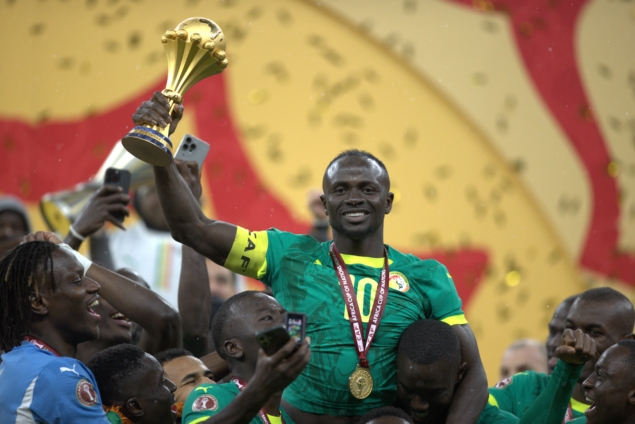
At the trophy ceremony, Senegal’s players lifted Mané onto their shoulders before he lifted the AFCON trophy once more. It was a fitting image given that Mané is not Senegal’s captain. That role belongs to Kalidou Koulibaly, with Idrissa Gana Gueye the vice-captain and wearing the armband in the final in Koulibaly’s absence. Yet at the trophy presentation it was Gueye who passed the armband to Mané and stepped aside, allowing him to lift the cup. Leadership, on this night, was defined by influence rather than designation.
"Today was the match where I had to give everything," Mane said of the game itself.
"There were no excuses. I told myself that this match could be my last in the AFCON. There was no tomorrow, no day after tomorrow, it was today. I had to give everything."
In the dressing room, celebrations gravitated towards Mané, who was congratulated in person by the Senegalese-French actor and Dakar 2026 Youth Olympics ambassador Omar Sy, as well as the Senegalese-American singer Akon.
In six months, Mané is expected to play his final tournament for Senegal at the 2026 World Cup in the United States, Canada and Mexico. Whatever happens there, his legacy was already secure long before the final whistle in Rabat.
On a night when protest might have defined the story, Mané ensured that leadership did instead.
Latest Stories
-
Artemis II crew take ‘spectacular’ image of Earth
48 minutes -
This Saturday on Newsfile: Galamsey taxes, sole-sourcing probes, the Black Stars and presidential dialogue post-mortem
2 hours -
Guardiola wants Rodri to stay but says unhappy stars can go
2 hours -
[Watch Live] Gomoa Easter Carnival: Samini, Kofi Nti and others deliver electrifying performances
3 hours -
US warns its citizens to leave Lebanon citing escalating security risks
5 hours -
Rapper Gucci Mane kidnapped and robbed by fellow artist, prosecutors say
5 hours -
Adom Kwahu Easter: Jerry Justice, Kwame Eugene win LaVonce all-male cooking contest
5 hours -
Ghana’s youth don’t need inspiration rhetoric, they need jobs – Chief of Staff
5 hours -
Momentum builds as 2026 Adom Kwahu Easter heats up at Obomeng
6 hours -
Accra Reset announces 18-member high-level panel to reform global health governance
6 hours -
VVIP Lounge at Accra International Airport temporarily closed for renovation
6 hours -
Dr. Gideon Boako breaks ground for modern maternity ward at Duayaw-Nkwanta Health Center
7 hours -
Mahama urges Ghanaians to hold on to hope during Good Friday Easter Service
7 hours -
President Mahama urges unity and resilience at Good Friday Service
7 hours -
Mahama: It’s a painful irony that Christ’s birthplace has become epicentre of war, violence
8 hours