

Audio By Carbonatix
Ghana is yet to rake in more benefits from its blue economy, precisely the aquaculture industry, to shore up the country’s dwindling economic growth.
Ghana’s new Aquaculture Development Plan aims to increase the country’s fish farming output from 89,376 tonnes in 2021 to 211,697 tonnes by the end of 2027 – an increase of 136 percent.
Although the country anticipates a marginal increase in its fish production capacity, measures including maintaining a healthy water systems remains a bane to operations of the sector.
The quality of the water in the production systems significantly affects an organism’s health and the cost involved with transporting the product to the market.
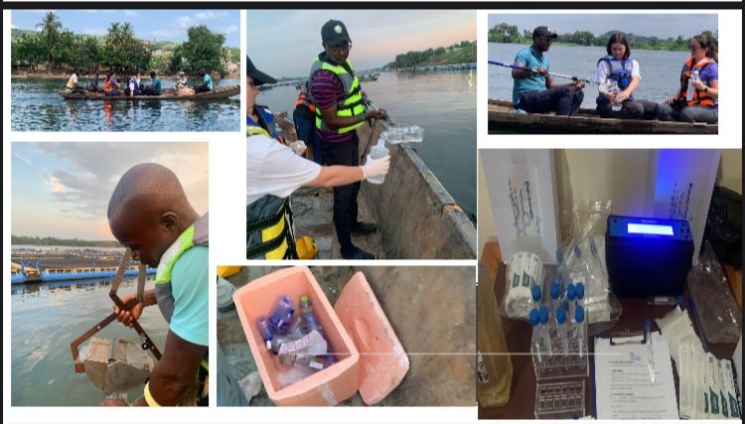
The Global Challenges Research Fund through Innovate UK in collaboration with the Council for Scientific and Industrial Research trained farmers and other industry players in the aquaculture space on rapid bacteria testing kits to improve water quality.
The project looks at strengthening the aquatic environmental health monitoring systems with a focus on aquaculture development zones.
It utilized the Molendotech novel Bacterisk+ technology to routinely analyse water quality for gram-negative bacteria associated with human-induced pollution and aquatic disease.
“The monitoring challenges faced by farmers are fish diseases, bacterial load on the farms. It takes researchers quite a long period for them to analyse the situation and get results,” Dr. Rhoda Lims Diyie said
The test was carried out at eleven sites across Ghana’s coastal and inland estuaries based on the presence of mangrove-based or estuarine/lagoon shellfish.
Four from the Eastern region, two each from Volta, Central and Western regions, and one from Greater Accra region.
The site selection targeted areas that support commercial shellfisheries including the Amanzule Estuary, Whin and Amissano Estuaries, Narkwa Lagoon, Densu Delta, Volta Estuary (Tunu), Volta Estuary (Big Ada), and the Keta Lagoon.
Three replicates of water samples were collected from a location far away from the aquaculture/ fisheries activity.
This was to determine background concentrations away from cages within a minimum distance of 100 m.
The test kit proved efficient with instant provision of test results.
The BacterisK+ testing kits
The testing kits measures the amount of endotoxin - a toxic substance released by a bacteria when it ruptures - present in water sample.
The more endotoxin detected in a sample, the higher the Endotoxin Risk (ER) and therefore the higher the chance the water contains Gram-negative bacteria.
Faecal indicators such as Escherichia coli, a gram negative bacteria, are used to assess environmental, potable and recreational water quality.
Aquaculture, a fast-growing space
The Food and Agriculture Orgnisation posits that Aquaculture is the fastest growing agro sector globally which was valued at US$ 163 billion as of 2017.
Aquaculture production in Ghana amounted to some 89,400 metric tons in 2021.
This volume represented a dramatic increase from 2008, when the country registered only 5.59 metric tons of plants grown in water and fish produced for food.
Testing kits is expeditious
Some persons who participated in the training shared that the kit although expensive could expedite testing processes.
Executive Director of Development Institute, Ken Kenni, emphasized the need of supporting communities to use this particular kit for their analysis.
“This training has helped us know we need to support communities to do physicochemical analysis of the water they use by using the new test to be able to assess pathogen in their own fish ponds. This kit would complement the community science centre we’re trying to build,” he said.
An extension officer, Olivia Mawuko from the Fisheries Commission - Ga South zone believes the tool would facilitate higher productivity in the aquaculture space.
“As an extension officer, it is my paramount duty to equip farmers with the right skills to get the best out of the produce and also minimize losses. If the commission can get every zonal officer with this kits, it would make our work easier for us to provide instant solutions to the farmers.
Latest Stories
-
Ballon d’Or Power Rankings: Lamine Yamal leads race for Golden Ball ahead of Rodri and Kane
2 hours -
‘Nothing worked for us’ – Gideon Mensah takes responsibility for Gambia defeat
2 hours -
2026 Women’s Super Cup: FC Savannah beat Epiphany Warriors to win trophy for first time
4 hours -
Fifa accuses Uefa of ‘misinformation campaign’
4 hours -
Kane and Gordon give England victory over Czech Republic in Nations League
4 hours -
AFCON 2027Q: ‘The last time Ghana won was eight games ago’ – Carlos Queiroz
4 hours -
AFCON 2027Q: Gambia defeat doesn’t make me a loser – Carlos Queiroz
4 hours -
Yamal inspres Spain to homecoming victory over Croatia
4 hours -
2027 AFCONQ: Late goals seal 2-0 for Côte d’Ivoire against Somalia
4 hours -
I’d stick my Man City medals in bin – Keane
4 hours -
AFCON 2027Q: My resignation won’t solve Ghana football issues – Queiroz
4 hours -
Morocco call off Ghana friendly after Black Stars’ AFCON setback
4 hours -
It is time for Tuchel to offer Alexander-Arnold some trust
4 hours -
‘We have to say sorry’ – Queiroz apologises after Ghana’s humiliating defeat to Gambia
5 hours -
New Yorker identified as Yaw Boahene, 57, killed after bag was caught in subway train doors
5 hours