

Audio By Carbonatix
The Securities and Exchange Commission (SEC) says Ghana’s newly enacted Virtual Asset Service Providers (VASP) Bill addresses existing gaps in the country’s digital asset ecosystem, providing a comprehensive framework for the use and regulation of cryptocurrencies.
President John Dramani Mahama has signed the Virtual Asset Service Providers (VASP) Bill into law, officially bringing Ghana’s digital assets sector, including cryptocurrencies, under a regulated framework.
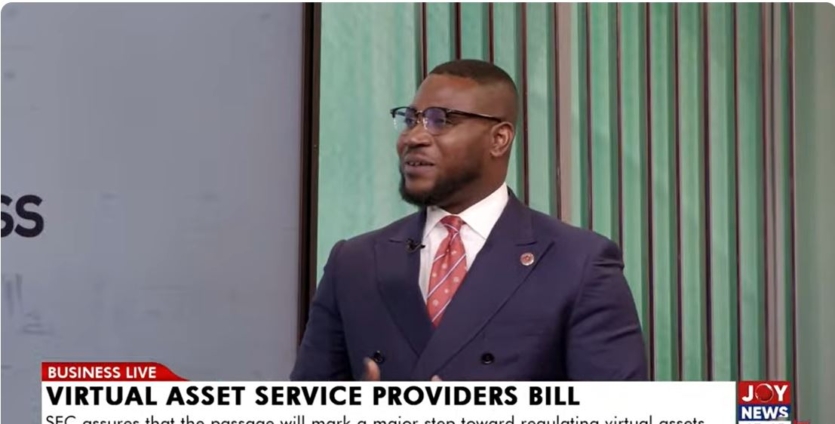
Speaking on the legislation, the Deputy Director-General of the SEC, Mensah Thompson, said the law was designed to legalise virtual asset transactions while ensuring transparency, financial stability, and investor protection.
“We spent over a year developing a legal framework that properly addresses the dynamics of the virtual asset space. This is one of the most consultative bills the government has ever passed,” he noted in an interview on JoyNews' The Pulse on Tuesday.
Mr Thompson explained that the SEC, in collaboration with the Bank of Ghana, Financial Intelligence Centre, Cyber Security Authority, Ministry of Finance, and Ghana Revenue Authority, conducted extensive consultations with stakeholders, including market operators and financial institutions, to craft the legislation.
“Stakeholders helped identify loopholes, guided the drafting process, and ensured that the law supports both innovation and financial stability,” he said.
The Virtual Asset Bill comes amid a surge in cryptocurrency activity in Ghana, with transactions exceeding $10 billion as of November 2025. The law aims to regulate trading, provide real-time visibility of crypto use, and safeguard the financial system against risks associated with unregulated digital assets.
“The country is overexposed to crypto assets. By creating this framework, we are enabling the use of virtual assets in a safe and regulated manner,” Mr Thompson added.
The SEC emphasised that the law is not intended to stifle innovation, but rather to encourage responsible adoption of cryptocurrencies while closing gaps that could be exploited for fraud or financial instability.
Latest Stories
-
Anti-LGBTQ Bill: Forget the rumour mongers, I’m a man of action, and will pass the bill – Speaker
33 minutes -
Women and children among those killed in Sudanese army shelling of wedding celebration
36 minutes -
President Mahama is not sincere with Ghanaians on LGBTQ bill matter – Hassan Tampuli
54 minutes -
Gov’t to establish Prison Industrial Hub to equip inmates with income-generating skills – Prison Service boss
1 hour -
Alhassan Tampuli donates cement, roofing sheets to support storm victims in Gushegu
1 hour -
Alhassan Tampuli appeals for urgent support for storm victims in Gushegu
1 hour -
The hypocrisy must stop; pass Anti-LGBTQ+ Bill now – Alhassan Tampuli to Mahama
1 hour -
Imprisonment should be rehabilitative, not punitive – Ghana Prisons boss at UNGA
2 hours -
Ga Adangbe traditional priests petition Mahama over McDan aviation licence revocation
2 hours -
Anti-LGBTQ Bill: NDC’s arrogance is worrying – Hassan Tampuli
2 hours -
Let’s give OSP time to mature, not to scrap it – Hassan Tampuli
2 hours -
Nigeria convicts 386 Islamist militants in mass trials
2 hours -
Djibouti president wins election with 97.8% of vote, state media says
2 hours -
We don’t have mandate to deduct tax from rent allowance of security services personnel – Interior Ministry clarifies
3 hours -
Ablakwa receives Presidential Special Envoy on Reparations to advance global agenda
3 hours