

Audio By Carbonatix
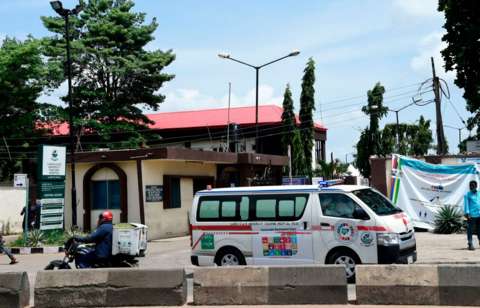
Services in government hospitals in Nigeria dried up on the first day of a strike called by public service doctors, with patients facing difficulties in accessing healthcare.
It came as the president of the resident doctors’ union told the BBC that his members had exhausted all options available to them to resolve the crisis.
At the Aminu Kano Teaching Hospital in Kano, the largest city in the north-west, people were told to take their sick relatives home as no doctor was available to attend to them.
Khadijah Hassan brought her husband who was involved in a car accident to the hospital at midnight on Wednesday but doctors declined to attend to him.
The patient was left lying down in the hospital corridors. “What are we going to do? We will have to sit here in the hospital till the doctors resume work,” she said.
Khadijah’s case was not much different from Ishiaku Musa, who had brought his elder brother from neighbouring Yobe state to the teaching hospital in Kano 12 days ago.
He had been suffering from migraine headaches. He told the BBC that although his brother’s condition had not improved, they were given prescriptions and asked to leave because of the strike.
In the capital Abuja, the local chapter of the union said they were waiting for a statement from the national body before joining the strike, so patients were being attended to.
At the University of Port Harcourt Teaching Hospital in the southern Nigerian city of Port Harcourt, doctors were seen handing their patients over to the few consultants available.
At the commercial hub of Lagos, doctors were still attending to patients who were admitted but no new patients were allowed.
Resident doctors, who make up the largest percentage of doctors in Nigeria’s tertiary hospitals, say they are on strike until the government meets their demands over salaries and welfare.
The medics are demanding the immediate payment of salary arrears owed to them and a new hazard allowance, as well as a training fund.
Nigeria has a fragile healthcare system and strikes by resident doctors could have a major impact on medical services in government hospitals across the country.
Latest Stories
-
“Whatever the decision of CAS, we will respect it” – CAF President Motsepe after AFCON final meetings in Morocco
1 minute -
Emma Ankrah: When waiting becomes part of treatment – Reflections on hospital care
5 minutes -
Ghana urges travellers to prepare for new EU border system roll-out
14 minutes -
Mahama enforces fuel coupon ban for ministers as cabinet moves to slash fuel taxes
18 minutes -
Task force probes strange fish deaths in Tema
21 minutes -
Neglected traffic lights turn Awoshie–Anyaa highway into deadly hotspot
43 minutes -
EOCO declares Dr Gabriel Tanko Kwamigah-Atokple a fugitive over alleged gold fraud
55 minutes -
GSE records GH¢1.09bn trade in equity market; 10 stocks register gains
1 hour -
Fuel prices: Ghana places 15th in Africa
1 hour -
Africa must look inward: Reframing resilience in a shifting global economy
2 hours -
7 dead, 2 missing after boat capsizes on Volta Lake
2 hours -
Miss Diaspora Ghana 2026 launched to deepen diaspora ties and drive development
2 hours -
US issues travel warnings for Nigeria and São Tomé and Príncipe as security risks mount
2 hours -
Ivan Toney questions refereeing in Saudi Pro League title race after Al-Ahli draw
2 hours -
Angola appoint Aliou Cissé as new head coach
2 hours