


Audio By Carbonatix
Scientists in the UK and The Gambia say they have the first evidence that dogs can sniff out malaria.
They have trained dogs to recognise tell-tale aromas using clothes from people infected with the disease.
It is hoped the animals can be used to stop malaria spreading and eventually help with eradication.
Although the research is still at an early stage, experts say the findings may even lead to new ways of testing for the disease.
Studies have already shown that being infected with the malaria parasite changes our aroma to make us more attractive to the mosquitoes that spread the disease.
Now dogs are on the scent, too.
Smelly socks
Socks worn overnight by children in the Upper River Region of The Gambia, in West Africa, were packaged and shipped to the UK.
Of the 175 pairs sent, 30 had been worn by children infected with the parasite.
The smelly footwear arrived at the Medical Detection Dogs charity in Milton Keynes.
The supremely talented noses there are already being trained to sniff out cancer and even the early stages of Parkinson's disease.
When it came to spotting malaria, the results, presented at the annual conference of the American Society of Tropical Medicine and Hygiene, showed dogs could pick out seven in 10 samples from infected children.
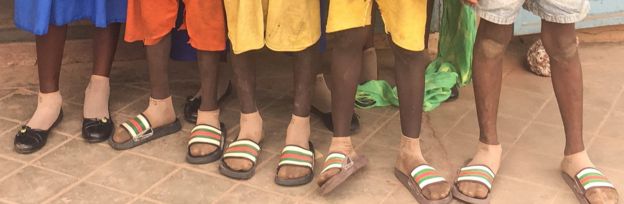 Image copyrightLSHTM
But they also incorrectly thought one in 10 healthy children had malaria.
Lead researcher Prof Steve Lindsay, from Durham University, said he was "really excited" by the findings so far, but that dogs were not yet ready to be used more routinely.
The researchers still need to improve the dog's accuracy and test them on people rather than socks, as well as investigate whether the animals can sniff out different species of malaria.
The aim is to one day use specially trained dogs at airports to curb the spread of the disease and to find symptomless carriers to help eradication efforts.
Dogs could test a whole community in a short space of time.
Faster than science
Dr Chelci Squires, from the London School of Hygiene and Tropical Medicine, told the BBC: "Dogs are actually nature's super-smellers so it is a great gift to have them.
"They are much faster than existing rapid diagnostic tests which can take up to 20 minutes and require a fully trained professional to do."
New tools to detect, treat and prevent malaria are needed as progress is stalling.
According to the last global report on the disease, cases had increased by five million to a new total of 216 million cases a year.
The research was a collaboration between The National Malaria Control Programme in The Gambia; the Medical Research Council Unit, The Gambia; Medical Detection Dogs; Durham University; the London School of Hygiene & Tropical Medicine and the University of Dundee.
Latest Stories
-
Asylum votes show people want help, says Kemi Badenoch
1 hour -
Badenoch welcomes expanded grooming gangs inquiry
1 hour -
GACL MD sues Samuel Buabeng over alleged Facebook defamation
1 hour -
Christa Pike in critical condition after surviving two lethal injections, lawyer says
1 hour -
Kemi Badenoch backs face covering ban at protest
2 hours -
Man City not ‘above the rules’, says No 10 after backlash to Burnham remarks
2 hours -
Real Madrid submit ‘substantial’ dossier in Barca payments case
2 hours -
Messi completes purchase of second Spanish club
2 hours -
Government must engage horticulturists on tomato crisis – GhIH
2 hours -
King Promise’s ‘Can’t Tame Us’ becomes official Chelsea anthem
2 hours -
Afenyo-Markin demands Baffour Awuah’s release from EOCO’s custody, end to alleged political intimidation
2 hours -
Rapper Rick Ross arrested on domestic violence charges
2 hours -
Minority demands security review of Ghana-Colombia visa waiver and port deals
2 hours -
Pursue drug kingpins, not persecute political opponents – Afenyo-Markin tells EOCO
3 hours -
‘I am disappointed’ – Yaw Ampofo Ankrah breaks silence after NSA suspension
3 hours