

Audio By Carbonatix
A defining feature of South Africa is the level of inequality in almost all spheres of society. Nowhere is this more observable than in the schooling sector.
It’s not unusual to find wealthy schools, comparable to the best anywhere in the world, within 5km of poor schools. Some blame for this inequality can be attributed to the lingering effects of racially biased funding that favoured white people during apartheid.
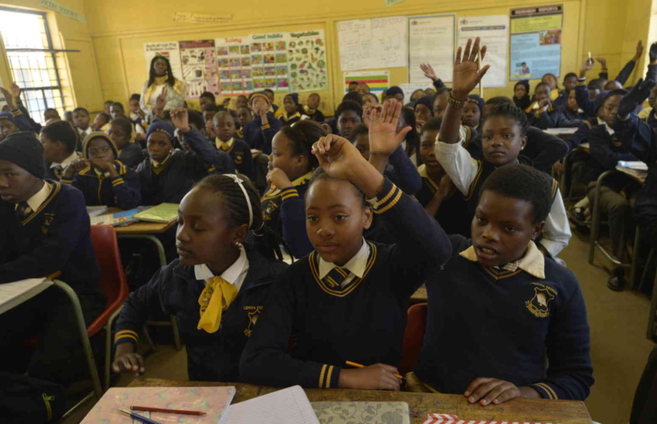
But it does raise the question of why, after more than two and a half decades of democracy, poor children of South Africa continue to sit in overcrowded classrooms with crumbling floors and broken windows. There are still schools in South Africa where pit latrines are in use, a fact that education authorities are well aware of.
To its credit, the state implemented a school funding policy in 2006 with the intention of achieving equity. This no-fee school policy ranks public schools according to five groups or quintiles. The poorest schools, those serving the poorest communities, fall into quintile one. The richest schools are in quintile five.
Schools in quintiles one to three cannot charge school fees. They receive a larger allocation per learner from the Department of Basic Education budget than the fee-paying schools in quintiles four and five.
But it’s clear that the school funding policy hasn’t had the equity effects that were intended.
Poor schools have lost fee-paying parents to better resourced schools. So poor schools get poorer and richer ones benefit. Not only are the allocations inadequate for no-fee schools, the categorisation of schools is sometimes incorrect. And recent budget cuts will be felt most by the poorest schools.
Our study showed what kinds of financial struggles these schools have and suggests that a better way to finance schools and reduce inequality would be to review the existing no-fee policy. We also suggest that the allocation per learner be raised to bring about some degree of equivalence across the schooling system.
Changing demographics
We interviewed principals from eight schools in the city of Durban in South Africa. The schools fell into quintiles three to five. Participants said the demographics of their schools had changed and that pupils had moved to better resourced schools.
Demographics have changed in South African cities since apartheid ended. This has also altered the racial profile of schools, especially those that serve children from new and growing informal settlements. Principals in our study complained that their schools had been incorrectly categorised or that their poverty status had changed.
Principals from quintiles four and five said that in the last decade, their schools had admitted increasing numbers of poor children but attempts to get a change in status had not been successful. Parents could not pay fees and this could make their children feel ashamed.
Our interviews with school principals, especially of poor schools that had few opportunities to raise extra funding, revealed that budget allocations were far from adequate. Often, funds were transferred to schools quite late in the school year. This made the day-to-day survival of these schools very difficult.
Richer schools can decide on their own annual school fees, benefit from donations from wealthy former learners, and use their business-networked parent body to attract donations from the corporate sector. Many such schools have professional finance teams that oversee their financial management. They can plan for and spend on building extensions and sports facilities.
Budget cuts
Principals revealed that budget cuts by provincial education departments meant they would receive a smaller allocation in 2022. The effect on richer schools is likely to be minimal, given their flexibility to raise school fees. Poor schools, faced with rising costs due to inflation, pay more each year for operational expenses such as water and electricity. They are likely to cut back on teaching and learning resources like textbooks and stationery.
Already deprived children are likely to get an even worse learning experience. Some poor communities, as reported by principals in our study, had resorted to illegal electricity connections to keep the lights on in their schools, even before these budget cuts.
The long-term effect of poor schools delivering a lower quality learning experience to their learners is already evident. Many poor parents who see education as a means of breaking the poverty cycle make huge financial sacrifices as they move their children to schools they perceive as offering a better education.
This pattern of migration to better schools began after the abolishment of the Group Areas Act, an apartheid policy which made it illegal for people to live and attend school outside their racially designated geographical areas.
The consequence for poor schools is that as they become poorer, they also become less appealing and may experience further loss of fee-paying parents.
Going forward
The no-fee school policy in South Africa, while well-intentioned, demands a serious review. As an immediate priority, the Department of Basic Education needs to allocate funds to build flushing toilets and provide safe piped water in schools that don’t have these facilities.
Poor schools do not have the capacity to raise money for basic needs. Funding for this kind of capital expenditure cannot come from the already meagre funds in the operations budget of poor schools.
Funds should be made available for infrastructure, especially in poor schools that lack basics like libraries, computer centres and sports fields, and for the refurbishment of dilapidated classrooms. Political will is required to introduce some degree of dignity to the learning experiences of poor children.
Dr Ian Africa, a economics of education researcher, contributed to this article and the research it’s based on.
Latest Stories
-
Ghana’s reliance on Dubai for gold exports leaves cedi exposed as Iran conflict disrupts trade
55 seconds -
Cabinet approves new round of SIM registration exercise
15 minutes -
Leadership of Cashew Watch Ghana engages TCDA CEO to advance sector growth
27 minutes -
Ghana’s gold crossroads: Why global pressure is real, but a coup is still unlikely
30 minutes -
24-Hour Economy Secretariat targets 160k jobs under new energy transition MoU
32 minutes -
Ada West Education Directorate intensifies policies to reduce teenage pregnancy
36 minutes -
We are in final stages of setting up Women’s Development Bank – Mahama
41 minutes -
IWD: Invest more in women for national development – Fisheries Minister
49 minutes -
CLOGSAG begins indefinite nationwide strike over delayed conditions of service today
55 minutes -
Educational orientation worsening youth unemployment in Ghana – Asiedu Nketia
1 hour -
Middle East War: Gov’t must turn oil price gains into relief for the poor
1 hour -
Iran war: Import addiction threatens Ghana’s economic stability – Economist
1 hour -
Women urged to embrace authenticity to unlock their potential
2 hours -
Nigerian army kills 45 in Katsina clash
2 hours -
Militants kill 15 soldiers in northern Benin attack, army says
2 hours