

Audio By Carbonatix
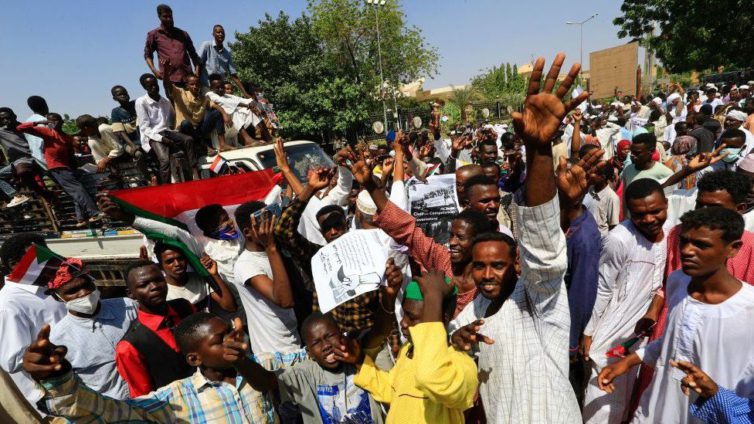
Opponents of Sudan's transition to democracy took to the streets of Khartoum on Saturday to call on the army to take control of the country.
Several thousand demonstrators gathered outside the presidential palace as the country's political crisis deepens.
Military and civilian groups have been sharing power since the toppling of President Omar al-Bashir in 2019.
However, tensions have grown since a coup attempt attributed to followers of Mr. Bashir was foiled in September.
Since then, military leaders have been demanding reforms to the Forces of Freedom and Change (FFC) coalition, a civilian alliance that led the anti-Bashir protests and formed a key part of the transitional government. The armed forces have also called for the replacement of the cabinet.
However, civilian leaders say that the demands are part of a power grab from the armed forces.
On Saturday, pro-military demonstrators chanted "down with the hunger government" and called for General Abdel Fattah al-Burhan, head of the armed forces and Sudan's joint military-civilian Sovereign Council, to instigate a coup and seize control of the country.
"We need a military government, the current government has failed to bring us justice and equality," one protester told AFP.
Unlike previous demonstrations in the country, protesters were allowed to reach the gates of the presidential palace and there was little police presence.
Pro-government protesters have also called a rally on Thursday in response to Saturday's demonstrations.
On Friday, Sudan's civilian Prime Minister, Abdallah Hamdok, unveiled a plan to tackle what he called the country's "worst and most dangerous" political crisis in its two-year transition.
"I am not neutral or a mediator in this conflict. My clear and firm position is complete alignment to the civilian democratic transition," he said.
Mr Hamdok was sworn in as Prime Minister in August 2019, after mass protests saw the military step in and end the 30-year-rule of Omar al-Bashir in April.
But support for the transitional government has slumped in recent months as economic reforms spearheaded by Mr Hamdok have seen fuel subsidies slashed and inflation soar.
Latest Stories
-
Oil traders bet millions minutes before Trump’s Iran talks post
56 minutes -
Fortnite-maker Epic Games lays off 1,000 more staff
1 hour -
Philippines declares energy emergency over Iran conflict
1 hour -
China dials back on fuel price hikes to ‘reduce burden’ on drivers
1 hour -
Elon Musk’s Starlink blocked from operating in Namibia
2 hours -
Kwame Dadzie: Did Stonebwoy’s ‘Jejereje’ really give NDC “significant” electoral impact?
2 hours -
Court exonerates Gabriel Tanko Kwamigah-Atokple and rebukes EOCO for abuse of power
4 hours -
Customer sues bank over alleged breach of confidentiality
4 hours -
Lands and Mines Watch Ghana commends Armah-Kofi Buah for transparent Damang Mine Lease Transition
4 hours -
GTVETS announces resumption of work as PSWU strike is called off
4 hours -
AratheJay brings “The Odyssey” to life with stunning live performance release
4 hours -
Gender Minister engages unemployed persons with disabilities
5 hours -
Formal education is a key to success, not the only path – Klef Carter
5 hours -
Why Africa’s creators must lead the movement To build Africa’s 1.5 Billion-consumer single market
5 hours -
IMANI-Africa flags ‘decade and a half of policy failure’ as SIM card re-registration returns
5 hours