

Audio By Carbonatix
When war broke out in Sudan in April 2023, ten-year-old Razan was forced to flee her home in Khartoum, cutting short her education and costing her an entire school year. It was a loss that pained her deeply, as she longed for her classroom and friends.
Once her family settled in a village near Sinjay, southeast of the capital, Razan re-enrolled in school and began rebuilding her routine, still clinging to her dream of continuing her education.
She recalls: “When we left Khartoum for the first time, I thought we would return home in a few days. I kept asking my father: when will I go back to my school? I missed my friends and my classroom so much. I don’t want more wars. All I want is to carry my schoolbag every morning and learn new things.”
Razan’s story was shared by Save the Children, which reports that more than three-quarters of Sudan’s school-age children are either at home or in makeshift shelters, with many at risk of never returning to education.
Figures show that around 13 million out of 17 million school-age children in Sudan are out of school, one of the world’s gravest education crises.
Crises in Khartoum
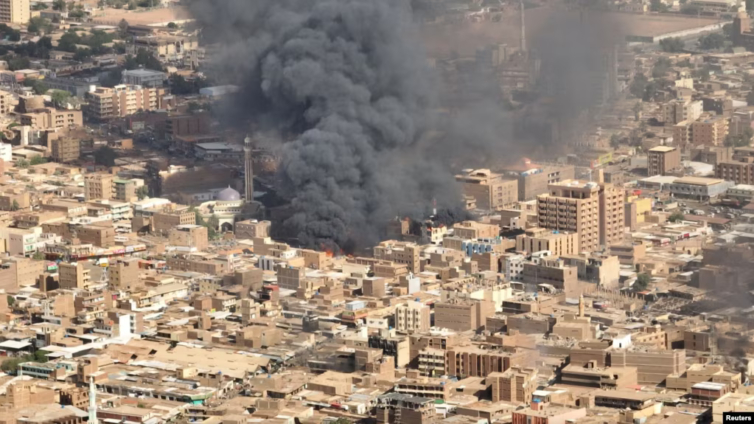
Meanwhile, Sudan’s capital Khartoum is mired in security, health, and education crises, all of which have severely affected thousands of pupils.
The Sudanese Teachers’ Committee denounced claims by officials from the army-appointed government that schooling was operating at “100% capacity” and that textbooks were fully provided, dismissing these statements as “a package of lies and fabrications.”
The committee stressed that the reality on the ground is starkly different: most residents -including teachers and students - are either displaced or refugees, while the area suffers from the collapse of basic services and the spread of diseases such as malaria and dengue fever, coupled with water and electricity cuts.
In secondary schools, there are just 187 teachers in total, averaging 8.2 per school, a shortfall of nearly 49%. Female teachers are even fewer, with an average of seven per school, representing a shortage of more than 50%.
The committee also confirmed that textbooks have not been fully provided as claimed, while teachers have gone unpaid for two years.
The committee added that education cannot resume until the root causes of its suspension are addressed and safe, basic living conditions are restored, including the payment of overdue salaries and allowances.
While many children remain unable to attend classes, Sudan’s National Human Rights Observatory released a shocking video showing a child soldier in the ranks of the extremist jihadist Al-Baraa ibn Malik Battalion, allied with the Sudanese army, waving his hand and threatening civilians with slaughter while chanting jihadist slogans.
In a statement on X, the Observatory condemned the incident, saying that involving children in combat and using them to spread terror among civilians constitutes a flagrant violation of international humanitarian law and the Convention on the Rights of the Child, a war crime requiring accountability.
Since the outbreak of war in April 2023 between the army and Tasis Alliance forces, Khartoum has witnessed mass displacement and near-total collapse of public services, with education emerging as one of the hardest-hit sectors. For many pupils, returning to classrooms has become fraught with risks and obstacles.
The Illusion of Civilian Work
The Al-Baraa ibn Malik Battalion has long attempted to promote the idea that it is shifting towards civilian activities. But a statement weeks ago by its commander, Al-Misbah Abu Zeid - vowing to continue fighting until the “liberation” of Kordofan and Darfur - shattered that narrative.
This prompted Sudanese writer Rasha Awad to raise a series of pressing questions, published by Sudan Watch Network, about the battalion’s stockpiles of weapons and military equipment, the number of its fighters, and the fate of the drones under its control.
Such concerns led the U.S. Treasury to impose sanctions on the Al-Baraa ibn Malik Battalion, aiming to curb Islamist influence in Sudan and restrict Iran’s regional activities, which have fueled instability, wars, and civilian suffering. The Islamic Movement, to which the battalion belongs, is the Muslim Brotherhood’s arm in Sudan.
This move coincided with a joint call from the UAE, the U.S., Saudi Arabia, and Egypt last week for a three-month humanitarian truce in Sudan to allow urgent aid deliveries, followed by a permanent ceasefire and the reduction of Islamist influence in the country.
The Al-Baraa ibn Malik Battalion is the military wing of Sudan’s Islamic Movement, an armed Islamist organization linked to the regime of former president Omar al-Bashir. According to the U.S. Treasury, it deployed around 20,000 fighters against Tasis Alliance forces, relying on training and weapons supplied by Iran’s Islamic Revolutionary Guard Corps.
The battalion has been implicated in arbitrary detentions, torture, and extrajudicial killings. Alongside other Islamist militias, it represents a major obstacle to ending Sudan’s civil war and hampers efforts towards a settlement, according to U.S. authorities.
Widely regarded as one of the Muslim Brotherhood’s most disciplined and heavily armed formations, the battalion espouses an extremist Islamist ideology closely aligned with that of al-Qaeda.
Latest Stories
-
Prioritise cocoa sector with better prices, timely payments-Annoh-Dompreh urges NDC
17 minutes -
Lands and Mines Watch Ghana endorses Heath Goldfields’ mining capacity
32 minutes -
Gbintiri residents protest alleged diversion of 24-hour market project
57 minutes -
Justin Bieber headlines Coachella with nostalgia-fuelled set
60 minutes -
Ukraine and Russia accuse each other of hundreds of ceasefire violations
1 hour -
Asha Bhosle: The sound of Bollywood dies aged 92
2 hours -
Fire destroys section of 4-bedroom apartment at Tantra Hill
2 hours -
Safe city: Unnoticeable protection
2 hours -
North East Regional Police Commander raises alarm over burning of checkpoints
2 hours -
Free Primary Healthcare Programme set for take-off — Health Ministry confirms readiness
2 hours -
3 co-wives, 5 children perish in canoe disaster – Maritime Authority insists life jackets use mandatory for all water transport
3 hours -
Iran war lands ‘triple blow’ to flood-ravaged Sri Lankans
3 hours -
Gunmen kill at least 11 people at Afghanistan picnic spot
4 hours -
Woman, 25, in court for stealing baby at Bogoso
4 hours -
Trump unveils giant gold-accented victory arch design for US capital
4 hours