

Audio By Carbonatix
Algerian President Abdelmadjid Tebboune wrapped up a two-day official visit to Italy on Thursday, July 24, aimed primarily at finalising major energy contracts and, crucially, at persuading Rome to support Algiers’ position on the Western Sahara.
But the trip ended without any shift in Italy’s longstanding stance, which remains aligned with growing international support for Morocco’s autonomy plan.
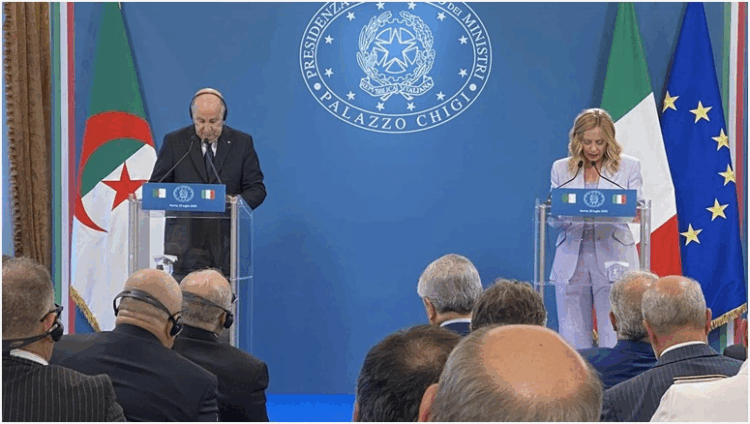
Tebboune’s attempt to frame Italy as an ally in the separatist cause quickly unravelled during a press briefing at Palazzo Chigi.
When the Algerian leader claimed that Rome and Algiers shared “similar positions” on Western Sahara, Italian Prime Minister Giorgia Meloni’s visibly startled expression, followed by a tight-lipped smile, spoke volumes. Her non-verbal reaction was a subtle but unmistakable rebuttal.
Italy has consistently supported the UN-led process and views Morocco’s autonomy initiative as a credible and realistic solution—far from the “self-determination” rhetoric of the Polisario Front, backed by Algeria.
This diplomatic faux pas echoed a similar episode from June 3, when Tebboune claimed Rwanda shared Algeria’s position on the Sahara after meeting with President Paul Kagame.
The Rwandan presidency swiftly released Kagame’s full speech, which made no such assertion, effectively debunking Tebboune’s claim and highlighting the widening cracks in Algeria’s diplomatic strategy.
Undeterred, Tebboune repeated familiar talking points, asserting that both Italy and Algeria supported “the efforts of the Personal Envoy of the UN Secretary-General to achieve a just political solution… allowing the Sahrawi people to exercise their inalienable right to self-determination.”
His remarks, however, appeared to further strain the atmosphere. At that point, Meloni’s disapproving glare reportedly turned icy, signalling clear discomfort with what many saw as a deliberate misrepresentation.
If the goal was to extract an explicit pro-Polisario stance from Italy, Tebboune’s efforts fell flat. In her own remarks, Meloni steered clear of the Western Sahara entirely, focusing instead on shared concerns over Libya, Syria, Gaza, the Sahel, and the war in Ukraine. Notably, she avoided echoing any of Tebboune’s Sahara-related rhetoric.
The final communiqué from the 5th Italy-Algeria Intergovernmental Summit reflected this divergence. While Algeria managed to include a general reference to Western Sahara, Italy ensured it was framed strictly within UN parameters. The agreed language reads:
“Regarding Western Sahara, the two parties reiterated their support for the efforts of the Personal Envoy of the United Nations Secretary-General, Mr. Staffan de Mistura, to relaunch direct negotiations and achieve a just, lasting, and mutually acceptable political solution, in accordance with the purposes and principles of the United Nations Charter and the relevant Security Council Resolutions.”
Absent were any mentions of the “Sahrawi people” or the supposed “inalienable right to self-determination”—terms routinely pushed by Algiers but rejected by most major capitals.
The disconnect raises deeper questions about the coherence of Algeria’s diplomatic playbook. As Morocco’s autonomy plan gains more international traction, Algiers finds itself increasingly isolated. The strategy of spinning phantom alliances and reframing ambiguous diplomatic language appears to be backfiring.
Rather than doubling down on narrative distortions, Algeria might be better served by acknowledging its role as a stakeholder in the conflict and engaging constructively with the UN process. The autonomy proposal—based on realism and compromise—remains the only path widely recognised by the global community as a viable solution.
Latest Stories
-
Planet One announces TVET projects worth $327m in three West African countries
6 minutes -
UN Chief condemns attack on Ghanaian peacekeepers in Lebanon, demands accountability
12 minutes -
US-Israeli air campaign hits hundreds of military targets in new wave of Iran strikes
16 minutes -
Ghana must lead Africa in criminalising environmental destruction – Annoh-Dompreh
18 minutes -
US-Israeli war against Iran enters new phase with rise of hardline successor Mojtaba Khamenei
23 minutes -
Kofi Adu Domfeh honoured with Excellence in Climate Journalism and Advocacy Award
24 minutes -
WPL 2025/26: Hasaacas, Ampem Darkoa Ladies close in on another final
26 minutes -
Bole MP donates GHS200,000 to support teacher training college establishment
41 minutes -
Danyame Old Town residents face eviction on a land occupied for 200 years
44 minutes -
60% of our water bodies are polluted – Minority Chief Whip pushes Ecocide Law
44 minutes -
Gov’t distributes seized ‘galamsey’ water pumps to farmers to boost irrigation – Dumelo
51 minutes -
MC Abeiku Sarkcess ignites Sarkodie’s Rapperholic UK with high-energy command
55 minutes -
Photos: Jonina Ladies record 3-0 win over Halifax Queens
56 minutes -
Government to establish over 250 Farm Service Centres in four years – John Dumelo
1 hour -
Full text: Statement by Frank Annoh-Dompreh, Minority Chief Whip and Nsawam-Adoagyiri MP on Legislation on Ecocide in Ghana
1 hour