

Audio By Carbonatix
A jury in Florida has found Tesla partly liable for a 2019 crash in which a Model S sedan using self-driving software killed a pedestrian and severely injured another.
Plaintiffs had argued the assistance software, called Autopilot, should have alerted the driver and activated the brakes before the crash.
Tesla had maintained the driver, George McGee, was at fault and called the verdict "wrong" in a statement to the BBC, while vowing to appeal. The result means the company will have to pay as much as $243m (£189m) in punitive and compensatory damages.
The verdict marks a setback for Tesla and CEO Elon Musk, who has touted self-driving technology as critical to the company's future.
Shares of Tesla dipped following the news and were nearly 2% lower when US markets closed.
Following the verdict, plaintiffs attorneys said Mr Musk had misrepresented the capabilities of the company's Autopilot driver assistance software.
"Tesla designed Autopilot only for controlled-access highways yet deliberately chose not to restrict drivers from using it elsewhere, alongside Elon Musk telling the world Autopilot drove better than humans," said attorney Brett Schreiber in a statement to the BBC.
Mr Schreiber said Tesla and Mr Musk had long propped up the company's valuation with "self-driving hype at the expense of human lives."
"Tesla's lies turned our roads into test tracks for their fundamentally flawed technology," he added.
The company was sued by the family of Naibel Benavides Leon, 22, who was killed when she was struck by the Model S at a T-intersection in the Florida Keys in 2019. Her boyfriend Dillon Angulo suffered life-long injuries and was also involved in the suit.
The court heard the driver, Mr McGee, lost sight of the road when he dropped his phone as he was approaching the intersection, causing his car to continue through it and crash into an SUV parked on the other side. The two victims were standing nearby.
Neither Mr McGee, nor the Autopilot software, hit the brakes in time to prevent the crash.
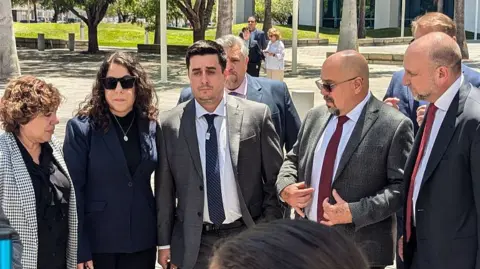
After a three-week trial, the jury awarded $329m in total damages, including $129m in compensatory damages and $200m in punitive damages aimed at deterring Tesla from harmful behaviour in the future.
Tesla will be responsible for paying one-third of compensatory damages - $42.5m - and the entirety of the $200m in punitive damages, but according to the company, punitive damages are likely to be capped at a lesser amount.
"Today's verdict is wrong and only works to set back automotive safety and jeopardize Tesla's and the entire industry's efforts to develop and implement life-saving technology," Tesla said in a statement.
Tesla said evidence at the trial showed the driver was solely at fault because he was speeding with his foot on the accelerator, which overrode Autopilot, while looking for his phone and not at the road.
"To be clear, no car in 2019, and none today, would have prevented this crash," Tesla said. "This was never about Autopilot; it was a fiction concocted by plaintiffs' lawyers blaming the car when the driver – from day one – admitted and accepted responsibility."
While there have been other federal lawsuits involving Autopilot during fatal crashes, Tesla has settled prior cases.
Last year, it settled a lawsuit over a 2018 crash that killed an Apple engineer after his Model X collided with a highway barrier while operating the company's Autopilot software.
The Florida case which culminated on Friday was the first to go to a jury.
At trial, Mr McGee said his concept of Tesla's Autopilot was that "it would assist me should I have a failure" or "make a mistake," and that he felt the software had failed him.
Mr McGee has settled a separate lawsuit with the plaintiffs for an undisclosed sum.
Tesla has long faced scrutiny over its Autopilot and self-driving technology, and critics hailed the jury's decision.
"Tesla is finally being held accountable for its defective designs and grossly negligent engineering practices," said Missy Cummings, a robotics professor at George Mason University.
The verdict comes as Tesla is battling weakening sales stemming in part from Mr Musk's political activities.
Latest Stories
-
FNB Ghana strengthens balance sheet with higher earnings and improved asset quality
10 minutes -
Stakeholders call for stronger action to advance women’s economic empowerment at UKGCC–British High Commission IWD Event
18 minutes -
Global Network of Export-Import Banks holds 6th exchange programme in Accra
22 minutes -
Prudential Bank Ladies celebrate IWD with candid talk on Love, Life, and Livelihood
23 minutes -
Kejetia Market now a ‘death trap’ – Federation of Kumasi Traders warns
25 minutes -
NDPC DG urges shift to resilient, shock-responsive social protection systems
26 minutes -
New Town building collapse: Enforce existing laws — Architecture Alliance
30 minutes -
Kudus to play under new coach as Tottenham appoint De Zerbi
31 minutes -
Gov’t may review fuel taxes amid rising oil prices – Kwakye Ofosu
40 minutes -
Iran–US conflict pushes fertilizer prices higher, raising food security risks in 2026
45 minutes -
Iran using children in security roles in war, reports and witnesses say
48 minutes -
Evalue-Ajomoro-Gwira MP pledges to safeguard peace in Lower Axim and Nsein
52 minutes -
Global collaboration in focus as Malaysia courts Ghanaian top business executives
1 hour -
Evalue Ajomoro Gwira MP calls for calm amid Lower Axim and Nsein chieftaincy tensions
1 hour -
I know the President listens and he will – Franklin Cudjoe
2 hours