

Audio By Carbonatix
The global shift towards electric vehicles (EVs) seems promising, especially as we face an environmental crisis driven by carbon emissions. However, as humanity strives to reduce greenhouse gases, we might be exchanging one set of environmental issues for another.
This article dives into the historical context of engine innovation, the demands placed on the earth by a growing population, and the complex impact of transitioning to EVs.
A Historical Evolution in Transportation
Since the dawn of civilization, human beings have continuously evolved, with each era bringing technological advances that shape society. The invention of the internal combustion engine in 1885 by Karl Benz marked a turning point in transportation. It paved the way for rapid advances, from the steam engines of the 17th century to turbochargers and rotary engines in the 20th century, making travel faster and more accessible. Today, with EV technology advancing, the auto industry is on the cusp of another major transformation.
Population Boom and Rising Demands
In 1800, the world population was just one billion. By 2024, it has surged to over eight billion. This increase has intensified the demand for both public and private transportation. With 1.47 billion vehicles worldwide, the impact on natural resources has been significant. Companies like Toyota, Volkswagen, and Renault-Nissan collectively produce millions of vehicles each year, relying heavily on metals such as aluminum, copper, and steel—materials that often require extensive mining, which disrupts ecosystems and generates pollutants contributing to global warming.
Environmental Impact of Mining
Mining has a profound impact on the environment, particularly as demand rises for minerals essential to the EV industry. For example, the U.S. operates approximately 13,000 mines occupying over 3,700 km², while Africa houses around 30% of global mineral reserves. The continent is home to hundreds of projects mining gold, coal, uranium, and diamonds, which often result in deforestation and environmental degradation. Africa’s forests have been depleted by 450,000 km² over the past two decades, with mining identified as a significant contributor.
In addition to land disruption, mining produces substantial waste. In the USA alone, overburden (unwanted material displaced by mining) accounts for around 40% of the solid waste generated each year. Copper mining alone increased land use threefold between 1976 and 2000, with 60% of disturbed areas dedicated to waste disposal.
A Call for Change
The automotive industry contributes significantly to greenhouse gas emissions. Road transportation was responsible for around 70% of these emissions in 2019. This rising impact has led to a global call for innovation, with traditional car companies pledging to transition to hybrid and electric car systems. But is this shift enough to solve our environmental woes?
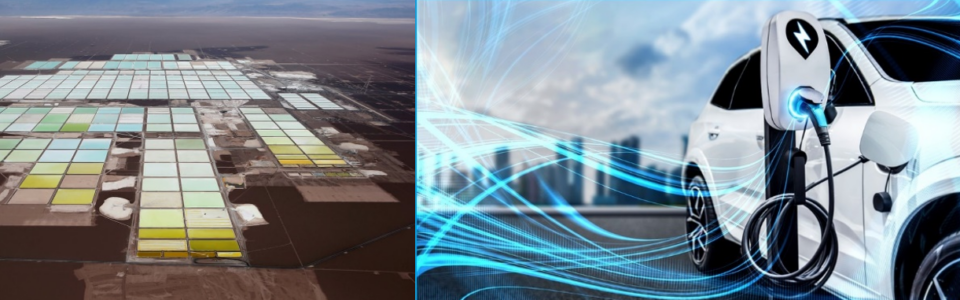
As EVs grow in popularity, the need for lithium batteries—and the facilities to produce them—has skyrocketed. Lithium mining operations are ramping up worldwide, particularly in Africa. The demand for “transition minerals” like lithium is reshaping the mining industry, raising concerns about environmental, social, and governance issues, particularly in Africa, where the history of exploitation is extensive.
Is This Really the Solution?
Currently, Australia, Chile, and China dominate global lithium production, but demand is expected to increase sixfold by 2035 if climate targets are to be met. As Africa’s lithium reserves become more attractive, several mining projects, like Ghana’s Ewoyaa Lithium Project, are set to clear large areas of virgin forest to extract resources. In Ghana alone, 791 km² of forest could be lost to meet the demands of the EV industry—a development that will impact the nation’s agriculture, ecosystems, and biodiversity.
The mining process not only threatens land and forest resources but also risks water contamination. The popular method of extracting lithium from brines, known as evaporite technology, is notorious for its extensive water use, slow process, and waste generation, raising concerns about brine pollution.
The Other Ways Out
Maria Helena Braga of the University of Porto, Portugal has been working together with the Nobel prizewinning inventor of the li-ion battery, John Goodenough, on something unusual. This is the Glass Battery. This battery is composed of an electrolyte, which is made of glass spike with sodium ions, with the potential to travel through it. “It is the most eco-friendly cell you can find, it can outperform lithium-based batteries”, said Braga.
The automobile industry could also invest in Chemist Lee Cronin of the University of Glasgow, UK’s invention, the liquid battery. Otherwise known are the flow batteries, these work on the same principle of the regular batteries except, all the components are liquids. The advantage of these is that, the charge-up liquid battery could be pumped into the electric vehicle more quickly, much like petrol or diesel. The only barrier to this at the moment is that all the electrical charges make the liquid electrolyte sticky and therefore a bit difficult to pump
Altogether, the world could take the more radical approach and invest in sustainable portable nuclear reactors for vehicles.
Conclusion
While EVs present a promising solution for reducing carbon emissions, the environmental costs of mining critical minerals threaten to undermine this progress. With careful consideration and sustainable practices, there may be a path forward those balances technological advancement with environmental preservation.
Latest Stories
-
US, Iran fail to reach peace agreement after marathon talks in Pakistan
58 minutes -
Port crises loom as 11,000 drivers threaten four-day strike
2 hours -
A source of excellence across generations – Vice President Opoku-Agyemang lauds Mfantsipim
2 hours -
(Photos) Mfantsipim School launches historic 150th anniversary
3 hours -
Knights and Ladies of Marshall group backs Catholic Bishops’ stance on anti-LGBTQ+
4 hours -
Bright Simons writes: All the Filla in the Ibrahim Mahama/E&P – Gold Fields Saga
4 hours -
Monetise Idiocy In Ghana
4 hours -
ECG kicks off Phase Two of transformer upgrades at Lashibi; brief outages expected
5 hours -
The Ghanaian prophet and the mysterious death of his scottish wife Charmain Speirs
5 hours -
Nearly 400 sentenced in Nigeria for links to militant Islamists
5 hours -
Ghana’s recovery supported by gold strength despite global oil price pressures – Standard Bank Research
5 hours -
Methodist Church hails Mfantsipim@150; calls for “fresh consecration” to excellence
6 hours -
‘Excellence is our inheritance’ – Nana Sam Brew-Butler hails Mfantsipim’s 150-year reign in leadership
6 hours -
Kwaku Azar writes: A-G vs OSP
6 hours -
Mfantsipim–Adisadel rivalry built excellence, not division – Sam Jonah
6 hours