

Audio By Carbonatix
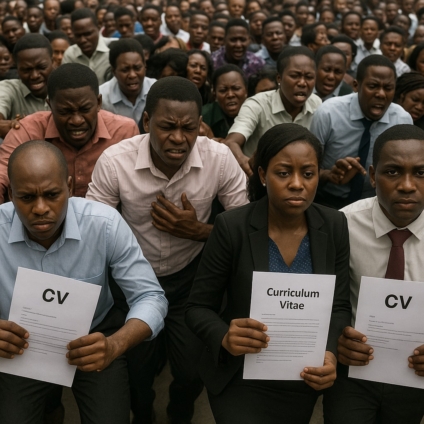
Six young people died today at El Wak Stadium, not in battle but in a queue for jobs. They came before sunrise, clutching their certificates and dreams, hoping to join the army. By nightfall, Ghana had turned their ambition into tragedy.
This is what unemployment looks like in a country where every youth depends on government postings for survival. Each year, Ghana produces over 350,000 job seekers, yet the formal economy can barely absorb 50,000. Because we have no functional secondary industries, the rest are left to drift. We mine gold but import jewellery. We grow cocoa, but buy chocolate. We harvest pineapples yet import juice. Our economy exports effort and imports everything else.
As the industry collapses, universities continue to train minds without hands. They teach theories, not skills. Students graduate fluent in definitions but unprepared for production. With no serious partnerships between government and industry, classrooms remain detached from factory floors. Because the state has failed to build a bridge between education and employment, every graduate ends up waiting, not for innovation but for a posting.
While families mourn at El Wak, soldiers in another region have arrested over 150 villagers for blocking anti-galamsey operations. Different scenes, same story. Both are about livelihood. When people cannot find decent work, survival itself becomes a crime. The young man who queues for recruitment and the miner who digs for gold are driven by the same hunger to live with dignity.
Yet our leaders seem deaf to that cry. They attend investment forums abroad while our youth die at home. They preach job creation while factories exist only in our dreams. They fly over the same communities whose only export is frustration.
If we truly want change, we must rebuild Ghana’s productive base. We need industries that can absorb skills, universities that teach practice, and policies that connect education to enterprise. We need leaders who build opportunities instead of reading condolences.
Until then, our youth will keep queuing for enlistment, for visas, for hope. And when hope dies in that queue, it is not only six lives we lose; it is Ghana’s promise that perishes with them.
Latest Stories
-
Meet us halfway – Trade Minister tasks private sector with AfCFTA success
2 hours -
After more than 14 years at Atletico Madrid, what next for Simeone?
3 hours -
Conquering the World – Building on the foundations laid by Otto Addo
3 hours -
[Watch Live] Kwaw Kese, Kwami Eugene, Tinny, Keche and others thrill fans at Gomoa Easter Carnival
3 hours -
Gomoa Easter Carnival: Experts charge indigenes to own festival to ensure sustainability
4 hours -
Gomoa Easter Carnival: Edem Agbana and Joy Prime fans shower festival with huge endorsements
5 hours -
Gathering of Royals 2026: Empowering women, boosting tomato production
6 hours -
Gov’t to overhaul free zones into manufacturing hubs for local production – Trade Minister
6 hours -
Ghana losing $2.5bn yearly from raw exports – Trade Minister reveals
6 hours -
Mahama unveils plans for Kwahu Airport, Convention Centre
7 hours -
World’s oldest leader, Paul Biya to get a deputy for first time in 43-year rule
7 hours -
Search for missing US airman continues as Trump threatens ‘hell’ if Iran does not reach deal
7 hours -
US says it has arrested relatives of late Iranian general Qasem Soleimani
7 hours -
La Liga: Real Madrid’s title hopes hang in the balance as Mallorca snatch stoppage-time winner
7 hours -
FA Cup: Haaland hat-trick powers Man City past Liverpool into semi-finals
7 hours