

Audio By Carbonatix
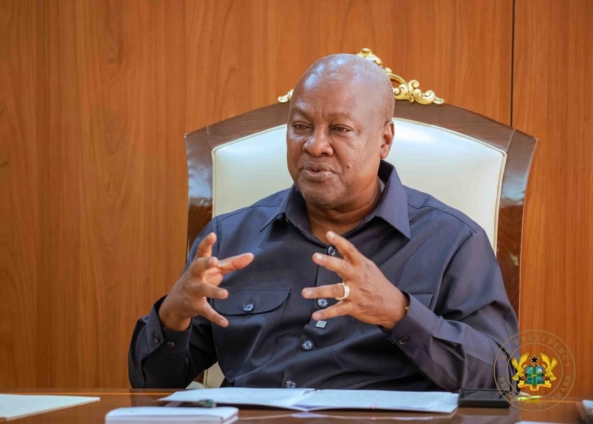
President John Mahama says Ghana has the potential to supply steel to the entire West African sub-region if the country succeeds in building a strong and competitive domestic steel industry.
Speaking at the commissioning of the B5 Plus Limited Steel Manufacturing Plant at Prampram on Friday, February 20, the President outlined an ambitious vision to position Ghana as a regional steel powerhouse.
He said the country is deliberately moving up the industrial value chain by prioritising the export of finished and semi-finished products instead of raw scrap materials.
“We are moving up the value chain. We’re exporting finished and semi-finished products, not raw scrap,” he stated.
President Mahama linked the growth of the steel industry to the government’s “Big Push” infrastructure programme, which includes heavy investment in roads and highways, railway modernization, bridges and interchanges, energy transmission lines, affordable housing and industrial parks.
“All these I have mentioned require iron and steel,” he said.
“Africa is projected to require over $100 billion annually in infrastructure development. West Africa alone faces significant infrastructure deficits.”
According to him, Ghana stands to benefit immensely if it develops a strong steel base capable of meeting both domestic and regional demand.
“If Ghana develops a strong steel base, we not only build our own roads and bridges, we will also supply steel to the whole sub-region. This is how infrastructure becomes industrial strategy,” he said.
The President further highlighted the importance of the government’s 24-hour economy initiative to energy-intensive industries such as steel manufacturing.
He revealed that signing the 24-Hour Economy Authority Bill into law is a critical step toward boosting industrial productivity.
He noted that B5 Plus Group is expected to be among the first companies to register under the 24-hour economy programme.
“Steel production benefits from continuous operation to reduce energy wastage, improve efficiency, lower unit production costs, and maximise asset utilisation,” he said.
President Mahama added that with dedicated industrial tariff reforms, improved grid stability and expanding domestic gas supply, Ghanaian manufacturers can operate competitively beyond traditional working hours.
He disclosed that $110 million has been allocated in the 2026 budget to operationalise the 24-hour economy initiative, signalling what he described as the government’s seriousness about industrial transformation.
“When factories run three shifts instead of one, employment rises, productivity increases, and exports expand,” he said.
The President added that a thriving steel industry, supported by infrastructure investment and continuous production, would not only strengthen Ghana’s economy but also position the country as a key industrial supplier within West Africa.
Latest Stories
-
Adom FM Y2K Jam delivers a night of music, fashion and nostalgia
37 minutes -
Lawrence Kobena Nsarko Otoo, Esq
2 hours -
Bel-Aqua intensifies mental well-being campaign ahead of 15th anniversary
2 hours -
From banking to party finances: Alfred Kwadwo Thompson elected NPP Treasurer
2 hours -
George Christian Papa Mends
2 hours -
Ali Suraj elected NPP NASARA Coordinator
2 hours -
Mustapha Hamid misses out on NPP Vice Chairmanship by 31 votes despite early poll lead
2 hours -
Kojo Bamba, Henry Nana Boakye and Nana Akomea elected NPP Vice Chairmen
3 hours -
From Delta Force to NPP First Vice Chairman – Kojo Bamba’s political journey
3 hours -
Police restore calm at Larteh following Odwira festival disturbance
4 hours -
‘All the camps will dissolve’ – Bawumia demands one NPP for 2028
4 hours -
There is no time to waste – Bawumia orders NPP to begin 2028 work
4 hours -
Sarkodie visits MobileMoney Fintech LTD
4 hours -
John Boadu unveils new NPP strategy to win back youth and modernise party
4 hours -
Hawa Koomson elected NPP National Women’s Organiser
4 hours