

Audio By Carbonatix
Introduction
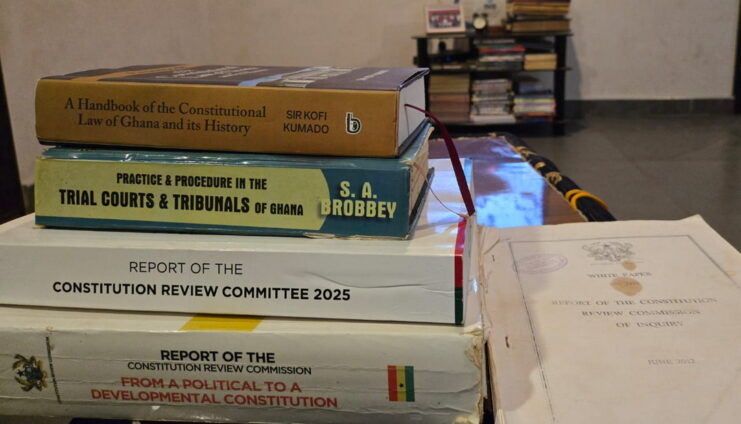
This is a three-part series that chronicles the historical trajectory of Ghana's tribunal system. The series relies, inter alia, on books by two legal luminaries to chart the evolution of the tribunal system from an opaque military apparatus into a structure widely rejected by the public, as evidenced by consecutive constitutional reviews recommending its total abolition and de-establishment. I reveal the sharp policy shift between sustained institutional dormancy and the sudden, midnight passage of the Tribunals Bill, 2026, clarifying how the new statute completely overhauls the defunct Act 459 (the Courts Act, 1993) framework to promise a highly transparent, hyper-expeditious mechanism for citizen-led justice under rigorous democratic oversight.
1. THE ARMED FORCES REVOLUTIONARY COUNCIL (AFRC) ERA (JUNE – SEPTEMBER 1979)
The modern roots of a specialized tribunal system parallel to traditional courts in Ghana began under military rule. The AFRC regime established a special court system under the Armed Forces Revolutionary Council (Special Courts) Decree, 1979 (AFRCD 3) to handle specific criminal offences.
Public attitude and transparency
This initial era was characterized by severe public opacity, fear, and executive finality. The national attitude was one of helplessness against summary justice, as the operations of these bodies bypassed all traditional safeguards of fair trial and standard evidentiary rules. In Practice & Procedure in the Trial Courts & Tribunals of Ghana, author Justice Stephen Alan Brobbey notes:
"Not much was known of the special courts or who actually sat to try cases there. The operations and procedures of these courts were also shrouded in mystery, but people were known to have been fined, imprisoned, executed or had their properties confiscated by orders from those courts."
Policy direction
The policy direction of the military government was to institutionalize revolutionary swiftness over established due process. The decisions of these panels were absolute and entirely insulated from the traditional judiciary, as the decree explicitly ensured that "its decisions were final and not appealable to any court."
2. THE THIRD REPUBLIC (1979-1981)
With the transition back to civilian governance under the 1979 Constitution of the Third Republic, there was a clear policy attempt to move away from military-style summary courts and restore the traditional hierarchy of the Judicature.
Policy direction
The state's primary policy direction during this brief democratic window was one of containment and winding down. However, the systemic impact of the AFRC could not be wiped away overnight. Section 17 of the transitional provisions of the 1979 Constitution reinforced the powers given to the special tribunal established under AFRCD 23 to conclude its pending cases. While the standard hierarchy of courts, stretching from the Supreme Court down to the District Courts, remained the dominant track for administration of justice, the special tribunals were progressively phased down as the country sought a return to constitutional normalcy.
3. THE PNDC ERA AND THE PARALLEL PUBLIC TRIBUNALS (1981–1992)
The most radical and lasting shift in Ghana's legal history regarding tribunals occurred following the overthrow of the Third Republic by the Provisional National Defence Council (PNDC). In 1982, the PNDC introduced a massive public tribunals system via the Public Tribunals Law, 1982 (PNDCL 24), which fundamentally altered the landscape of justice delivery.
Structural framework
The PNDC actively distrusted the traditional regular court system, viewing it as elitist, slow, and out of touch with the revolution. Consequently, state policy deliberately established an entirely separate, four-tier pyramid of public tribunals that ran completely parallel to the traditional court structure:
- National Public Tribunal
- Regional Public Tribunal
- District Public Tribunal
- Community Public Tribunal
Attitude and policy split
The regime’s policy direction was to maintain a system entirely independent of, and competitive with, the traditional judiciary. The public attitude was deeply polarized; while some populist factions welcomed the tribunals for their swiftness, the legal community and human rights advocates heavily criticized them for lacking structural independence. Justice S. A. Brobbey states:
"Until the enactment of Act 459, the courts and the public tribunals operated parallel to one another as two distinct and separate adjudicating institutions. No appeals or reviews in one system could be taken up in the other system..."
4. THE FOURTH REPUBLIC AND SYSTEM INTEGRATION (1993)
The advent of the 1992 Constitution marked a dramatic policy reversal driven by a national desire to restore unified judicial oversight, protect human rights, and eliminate sub-standard parallel legal tracks.
Abolition and restructuring
The 1992 Constitution drastically overhauled the hierarchy, abolishing the parallel system to bring all adjudicating bodies under a single judiciary headed by the Chief Justice. Justice, S. A. Brobbey writes:
"The 1992 Constitution abolished all the public tribunals: see articles 125(3) and 126(1); but did not alter the Supreme Court, the Court of Appeal or the High Court. It also created the Regional Tribunal..."
Under the Courts Act, 1993 (Act 459), the tribunal system was stripped of its "revolutionary" character and formally integrated into the orthodox judicial framework.
The modernized integrated hierarchy
- Regional Tribunals: Positioned on the same level as the High Court, focusing strictly on " certain criminal matters but cannot handle any case triable by jury or assessors or one punishable by death."
- Circuit and Community Tribunals: Act 459 established Circuit Tribunals (handling strictly criminal cases) and Community Tribunals (the lowest courts of the land, handling both civil and criminal matters) to replace the old District Courts, introducing strict guidelines regarding the legal experience and qualifications required for their panel chairmen.
The ideological compromise of populism
This transition was not a total erasure of the PNDC's institutional footprint, but rather a complex constitutional compromise. In A Handbook of the Constitutional Law of Ghana and its History, author Sir Kofi Kumado observes:
"In origin, it included the Regional Tribunals which was a carry-over from the Public Tribunal System established by the P.N.D.C. as a parallel system for the administration of criminal justice".
Furthermore, while the country demanded the restoration of strict rule of law, a policy sentiment favoring popular citizen participation at the community level persisted. This found expression in Article 125 of the 1992 Constitution, which allowed citizens to participate in the administration of justice. Sir Kofi Kumado critiques this inclusion, noting:
"The reference to 'public and customary tribunals' introduces a bit of populism into the justice system and is possibly a hang-over from the days of the P.N.D.C. Public Tribunals".
READ the other instalments in this article below:
Click this link to read Part II
Click this link to read Part III
Click this link to read Part IV
Join me on my weekly legal clinic THE LAW every Sunday @ 2pm on Joynews
Latest Stories
-
Ghana explores centre of excellence for hearing, communication and cochlear implant care
42 minutes -
Schizophrenia-related disorders lead mental health cases recorded in Ghana
1 hour -
Dutch authorities enlist Ghana in hunt for fugitive drug lord Bolle Jos
1 hour -
Ghana housing finance conference adopts communiqué to improve affordable housing access
6 hours -
Special Initiatives Minister urges Wa Technical Institute to enrol more girls as EU-backed solar training lab opens
6 hours -
In the matter of my first year at the Bar
7 hours -
ActionAid Ghana calls for an end to child marriage, greater investment in girls’ rights
7 hours -
Newsfile to tackle World Cup visa scandal, beach demolitions, education strikes, BRICS bid
7 hours -
UK-Ghana Trade & Investment Summit: Trade Resource Centre to help businesses maximise UK-Ghana trade opportunities
7 hours -
Embassy of Denmark celebrates World Maritime Day
7 hours -
Linking LEAP to productive inclusion could cut extreme poverty by 2030 – UNICEF
9 hours -
Trade Ministry backs use of creative arts to rehabilitate prison inmates
9 hours -
Negotiations with government to continue despite strike suspension – GNAT
9 hours -
‘Ghana cannot afford to waste public resources; every cedi has a job’ – Ato Forson
9 hours -
Ghana expects economic boost as World Assemblies of God Congress brings 10,000 delegates to Accra
9 hours