

Audio By Carbonatix
World Hypertension Day is here with us! Hypertension also known as High blood pressure and commonly referred to as ‘BP’ in Ghanaian medical consulting rooms is one of the leading causes of death worldwide.
Globally, around 1.3 billion people live with hypertension, and about two-thirds of that number are in low- and middle-income countries. In West Africa alone, hypertension affects more than 35% of the adult population, with rates rising in both urban and rural communities.
This trend is contributing to increasing incidences of stroke, heart disease, and kidney failure across the region. The high blood pressure epidemic is tied closely to changing lifestyles fuelled by urbanization, sedentary jobs, and dietary changes.
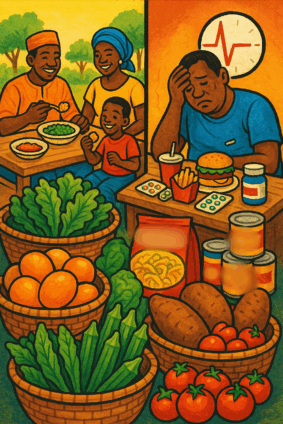
Traditional diets built around fruits, vegetables, legumes, whole grain cereals, and tubers are being sidelined, while more people are eating more processed and convenience foods that are high in salt, sugar, and unhealthy fats.
This article discusses recent research published in the Journal of Hypertension that investigates the connection between common West African dietary patterns and the risk of hypertension.
What the Science Says
To better understand the relationship between diet and hypertension in West Africa, researchers conducted a comprehensive review of 31 studies involving over 48,000 adults from the region.
Their findings, summarized below, reinforce what has long been recognized: diets high in salt, saturated fats, processed snacks, and red meat are strongly associated with an increased risk of hypertension. Conversely, diets abundant in fruits, vegetables, and other nutrient-rich, plant-based foods are linked to a significantly lower risk.
- Fruits and Vegetables Reduce Risk - High consumption of fruits and vegetables was associated with a 20% lower risk of hypertension. These foods are naturally rich in potassium, antioxidants, and fibre, all of which play important roles in regulating blood pressure. Good thing is, the protective effect of fruit and vegetables was found to be consistent across different countries and age groups.
- Salt Increases Risk - High salt intake was linked to a 25% increase in hypertension risk. While salt is a staple in many traditional dishes, the danger comes from excessive use and from hidden salt in processed foods like instant noodles, bouillon cubes, canned foods, and most packaged snacks.
- Junk Food Poses Greater Risk - Eating junk food (such as fried items, sugary snacks, and fast food) was associated with a 41% higher chance of hypertension. These foods often contain a worrying mix of trans fats, salt, and sugar, which can be a strain on the cardiovascular system.
- Excessive Intake of Red Meat and Dietary Fats Are Risky. High red meat intake was tied to a 51% increase in hypertension risk, and high consumption of dietary fat (especially from saturated fats) showed a 76% increase in risk. These high fat foods can lead to arterial stiffness, inflammation, and higher cholesterol levels, all of which are known contributors to high blood pressure.
- Alcohol Adds to the Problem. Even moderate alcohol consumption raised the odds of hypertension by 17%. This finding supports existing public health guidance to limit all alcohol intake.
The Local Advantage
An important part of the solution to West Africa’s growing hypertension crisis may already be found in its own markets and farms. The region is rich in locally available, nutrient-dense foods that can help combat high blood pressure. These include:
- Leafy greens like kontomire, aleefu, amaranth, bitter leaf, etc.
- Vegetables such as okro, garden eggs, pumpkins, tomatoes, etc.
- Fruits including avocados, oranges, mangoes, guavas, and pawpaw.
- Whole grains like brown rice, millet, fonio, and sorghum.
- Legumes such as beans, groundnuts, and cowpeas.
These foods are not only nutritious, but they are also culturally familiar, widely accepted, and often more affordable, especially when in season.
By promoting their consumption and placing them at the heart of everyday meals, individuals and communities alike can make significant progress toward reducing hypertension rates and improving overall health.
Final Thoughts
The battle against hypertension will not be won with pills and tablets alone. Diet must be front and centre in the conversation, and not just any diet but one that emphasizes local, traditional foods.
Eating foods made from local produce, cutting back on processed snacks, cooking with less salt, and reducing fried and fatty foods can make a measurable difference in blood pressure. Public health campaigns, school programs, and community-based education can help turn these habits into the new norm. On a personal level, meaningful change begins with the choices we make every day—starting with scrutinizing what is on our plates at every meal.
Taking small, intentional steps like incorporating more fresh fruits and vegetables, choosing whole grains over refined ones, and preparing and eating more meals at home using local produce can empower you to take control of your health and set an example for those around you.
Click here to join Full Proof Nutrition WhatsApp channel to receive more educative content. Send us a mail on fullproofnutrition@gmail.com
Written by Dr. Laurene Boateng (PhD, RD)
Dr. Laurene Boateng is a Registered Dietitian and Senior Lecturer in the Department of Dietetics, University of Ghana.
She is the founder and editor-in-chief of Full Proof Nutrition, a website committed to providing reliable, evidence-based, and practical healthy eating advice. Click here to join Full Proof Nutrition WhatsApp channel and send us a mail at fullproofnutrition@gmail.com.
Reference
Batubo, N. P., Moore, J. B., & Zulyniak, M. A. (2023). Dietary factors and hypertension risk in West Africa: a systematic review and meta-analysis of observational studies. Journal of Hypertension, 41(9), 1376–1388. https://doi.org/10.1097/HJH.0000000000003499
Latest Stories
-
Kwakye Ofosu says cost of living eased under Mahama government
1 hour -
Total banking deposits stood at GH¢302.0bn in October 2025, but foreign currency deposits contracted by 21%
2 hours -
Interior Minister calls for collective action to enhance security in Ashanti Region
2 hours -
Baobab: Tree of life dying as climate change ravages Northern Ghana
2 hours -
Extradition of Ofori-Atta and Tamakloe-Attinou could take up to three years – Victoria Bright
2 hours -
Government pledges support for Accra commuters amid transport challenges
2 hours -
GES probes alleged feeding problems at Savelugu Senior High School
2 hours -
Government is reviewing Saglemi Housing deal and private takeover – Kwakye Ofosu
2 hours -
Nana Ama McBrown, Kate Henshaw headline Women of Valour London 2026
2 hours -
David Asante’s contributions at GPCL must be recognised – Vicky Bright
2 hours -
I don’t want my people to be mistreated by ICE — Ambassador Victor Smith tells US Senator
2 hours -
Detained fugitives: If you’re not prepared to be accountable, don’t hold public office – Vicky Bright
2 hours -
Adutwum outlines vision for a growth-minded Ghana, draws lessons from global experiences
3 hours -
I wish former CSA boss Dr Antwi-Boasiako continues in office – Sampson Lardy
3 hours -
Kotoko maintain title ambition despite mixed results – Sarfo Duku
3 hours