

Audio By Carbonatix
Shock is giving way to anger in Hong Kong after a massive fire ripped through a densely populated subsidised housing estate on Wednesday, killing at least 94 people and critically injuring dozens.
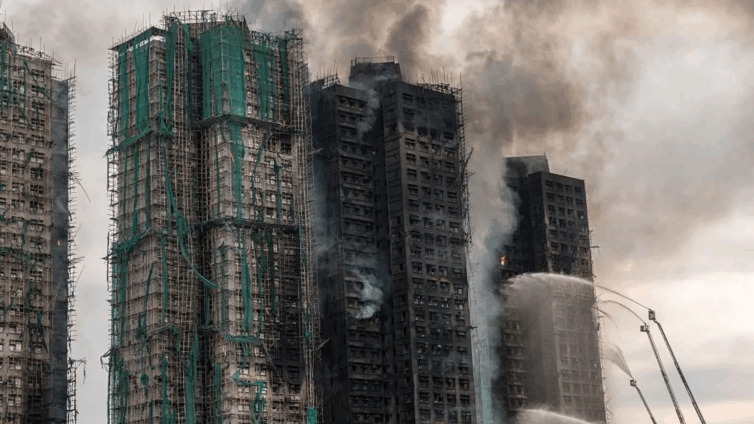
Authorities say substandard mesh and plastic sheets on the buildings' windows may have spread the blaze, which raged for more than a day in some blocks. Nearly 300 people are still unaccounted for.
Questions are mounting as to how the fire at Wang Fuk Court spread so rapidly and who to hold responsible, with many Hong Kongers calling it a "man-made disaster".
Three people in charge of renovation works in the complex are under arrest for manslaughter, and authorities have launched a corruption inquiry.
A post that has gone viral on social media in the wake of the blaze reads: "It's not an accident".
Several residents have revealed in interviews that the fire alarm did not sound when the fire broke out.
Kiko Ma, who owns an apartment at Wang Fuk Court, says the alarms had been turned off amid renovation works, as construction workers regularly used fire escapes to get in and out of the building.
Ms Ma lives in Canada with her family, but visits the Hong Kong apartment several times a year.
"This was preventable... A lot of people did not do their duties," the 33-year-old tells the BBC, claiming that the renovation firm used "poor quality, flammable materials".
Residents often saw construction workers smoking and found cigarette butts along their window ledges, she adds.
"People kept asking what would happen if there was a fire. Everyone was very worried about this."
This is Hong Kong's deadliest fire in at least 63 years - already having surpassed the toll of the August 1962 inferno in the Sham Shui Po neighbourhood, which killed 44 people and displaced hundreds.
Built in the 1980s, Wang Fuk Court in Hong Kong's north-eastern Tai Po district comprises eight 31-storey buildings, seven of which went up in flames. The apartments here are sold at subsidised prices, but day-to-day affairs in the estate are managed by privately appointed firms.
According to the 2021 census, the complex was home to about 4,600 people - nearly 40% of whom were 65 or older.
The city's fire department on Thursday said firefighters faced major challenges trying to rescue residents, including high temperatures, the risk of further scaffolding collapse, and the small and crowded interiors of the apartments.
Hong Kong is well-known for its tiny, densely packed inner-city dwellings, where many public rental housing tenants have, on average, a living space of just 14.1 square metres.
It is unclear how many people were in Wang Fuk Court when the fire broke out, but hundreds of residents have been evacuated to temporary shelters, and some are being allocated emergency housing units.
While police are investigating whether mesh netting, plastic and canvas sheets used during renovations met fire safety standards, some experts believe the bamboo scaffolding connecting the apartment blocks helped fuel the inferno.
Such scaffolding is an iconic sight across Hong Kong, and widely used in construction.
Earlier this year, authorities announced plans to phase out bamboo in favour of sturdier, fire-resistant steel, citing bamboo's combustibility and deterioration over time.

Residents at Wang Fuk Court had expressed unease about renovation plans when they were announced last year. Reports of those concerns have now resurfaced online, sparking accusations around a lack of transparency.
Another homeowner who was abroad when the fire broke out said the plans were "fundamentally shady".
"[Those in charge] used small favours to encourage unsuspecting elderly residents to support their plans," they wrote in a comment on Instagram.
Mr Lai, a sales associate who the BBC agreed to refer to by his last name only, says Wang Fuk Court residents had earlier questioned the high cost of renovation works.
Calls from some residents to re-elect the estate's management committee went unheeded, he added. This week's fire is not an isolated incident, Mr Lai said, claiming that construction companies "often prioritise cost efficiency" over safety.
He noted that a building in Hong Kong's Central district went up in flames last month after its bamboo scaffolding caught fire.
"When similar incidents happen, they raise the question of whether [there are] systemic weaknesses."
Hong Kong authorities on Thursday ordered inspections of all housing estates undergoing "major repairs" to check for the "safety of scaffolding and building materials".
Latest Stories
-
Kim Jong Un chooses teen daughter as heir, says Seoul
19 minutes -
Morocco to spend $330m on flood relief plan
25 minutes -
Ghana’s gold output hits record 6 million ounces in 2025, industry group says
27 minutes -
‘I’m a lover boy, not womaniser’ – 2Baba on fatherhood, marriage to Natasha
40 minutes -
Tems becomes first African female artist to have 7 entries on Billboard Hot 100
50 minutes -
Police arrest three for the alleged possession of firearm without license
1 hour -
Suspected robber shot dead by police while fleeing with officer’s vehicle
1 hour -
Head porter charged over mobile phone theft
1 hour -
Tuchel extended England stay for ‘amazing players’
2 hours -
Atletico Madrid put four past Barcelona in Copa del Rey semi-final
2 hours -
Tottenham are ‘not a big club’ – Postecoglou
2 hours -
Nottingham Forest close in on Pereira appointment
2 hours -
England to face Spain and Croatia in Nations League
2 hours -
Sterling joins Feyenoord until end of season
2 hours -
A Tax for Galamsey: Akwasi Acquah slams government for failing to punish complicit officials
2 hours