

Audio By Carbonatix
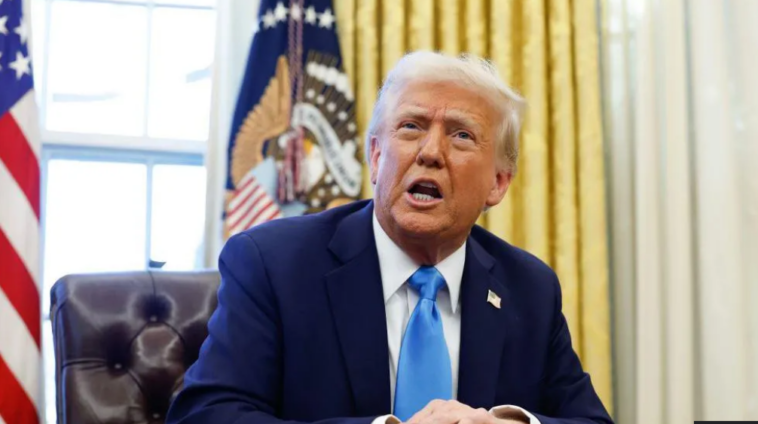
The International Criminal Court (ICC) has vowed to continue its judicial work after US President Donald Trump signed an order to impose sanctions on its staff.
The ICC said it "stands firmly" by its personnel and the order seeks to harm its "independent and impartial" work.
Trump's order accuses it of "illegitimate and baseless actions", after the ICC issued an arrest warrant for Israeli Prime Minister Benjamin Netanyahu over alleged war crimes in Gaza, which Israel denies. The ICC also issued a warrant for a Hamas commander.
The ICC is a global court, although the US and Israel are not members, with the power to bring prosecutions for genocide, crimes against humanity and war crimes.
In its statement, it said: "The ICC condemns the issuance by the US of an executive order seeking to impose sanctions on its officials and harm its independent and impartial judicial work."
It added it stood by its personnel, pledging "to continue providing justice and hope to millions of innocent victims of atrocities across the world".
In recent years, the court has issued arrest warrants for Russian President Vladimir Putin over alleged war crimes in Ukraine, Taliban leaders for "persecuting Afghan girls and women" and Myanmar's military leader for crimes against the Rohingya Muslims.
More than 120 countries are members, including the UK and many European nations.
Judges at the court have said there are "reasonable grounds" to suggest Netanyahu, his former defence minister Yoav Gallant, and Hamas' Mohammed Deif - who died last year - bear "criminal responsibility for alleged war crimes and crimes against humanity".
But a White House memo circulated on Thursday accused the Hague-based ICC of creating a "shameful moral equivalency" between Hamas and Israel by issuing the warrants at the same time.
Trump's executive order said the ICC's recent actions "set a dangerous precedent" that endangered Americans by exposing them to "harassment, abuse and possible arrest".
The order adds it "threatens to infringe upon the sovereignty of the United States" and "undermines" the national security and foreign policy work of the US and allies.
The sanctions, announced while Netanyahu was in the US, place financial and visa restrictions on individuals and their families who assist in ICC investigations of American citizens or allies.
The move has been met with condemnation by many US allies, including the Netherlands and Germany.
A spokesperson for Prime Minister Keir Starmer said the UK supported the independence of the ICC.
The United Nations (UN) has called for the measure to be reversed, while Ursula von der Leyen, the European Commission president, said on X that the ICC "must be able to freely pursue the fight against global impunity".
But in a post on X on Friday, Israel's Foreign Minister Gideon Saar said he "strongly" commended Trump's executive order.
He claimed the ICC's actions were "immoral and have no legal basis", accusing the court of not operating "in accordance with international law".
Hungarian Foreign Minister Peter Szijjarto said on Facebook on Friday that Trump's decision was "absolutely understandable", alleging the ICC had "in recent times disguised itself as a biased political tool".
Hungary's government has received widespread criticism for retaining close ties to the Kremlin following its full-scale invasion of Ukraine, and has invited Netanyahu to visit despite the international arrest warrant.
A former clerk to the court's first chief prosecutor warned the sanctions could have "a profound practical impact" on its operations.
"The sanctions... do have the potential of freezing property and assets, as well as suspending entry into the United States of ICC officials and their immediate family members," Zachary Kaufman told the BBC World Service.
The US has repeatedly rejected any jurisdiction by the body over American officials or citizens, and has accused the ICC of placing constraints on Israel's right to self-defence, while ignoring Iran and anti-Israel groups.
During his first term in office, Trump imposed sanctions on ICC officials who were investigating whether US forces had committed war crimes in Afghanistan.
This included a travel ban and asset freezes against former chief prosecutor Fatou Bensouda.
Those sanctions were lifted by President Joe Biden's administration.
Last month, the US House of Representatives voted to sanction the ICC, but the bill foundered in the Senate.
In response to efforts to what they described as attempts to challenge the ICC's authority, nine nations - including South Africa and Malaysia - launched the 'Hague Group' last month in an effort to defend the court and its rulings.
Latest Stories
-
LA 2028: Black Queens hold final training session ahead of second leg against Mauritius
10 minutes -
Standards are not Seasonal: What the EC appointments teach both sides
24 minutes -
King Mohammed VI urges private sector to create youth jobs and spread benefits of growth
25 minutes -
KGL U17 Colts 2026: Greater Accra win title after penalties win over Western Region
25 minutes -
UK Investment Roadshow opens in London to advance UK-Ghana growth partnership
36 minutes -
Assemblies of God requires pastors to resign before entering partisan politics – Rev. Wengam
46 minutes -
Ghana targets 20% annual reduction in maternal deaths – Health Minister
51 minutes -
Cyber attacks in Africa grow faster than global rate, report finds
53 minutes -
Ghana signs UAE deal to create 5,000 overseas jobs
60 minutes -
One Million Coders Programme targets 100,000 digital jobs in two years – Sam George
1 hour -
John Jinapor, Italian Ambassador explore opportunities for energy sector investment
1 hour -
NHIA seeks legal reforms to support Free Primary Healthcare
1 hour -
Beatrice Annan defends Afi Agbenyo’s EC appointment, cites record of gender advocacy
1 hour -
Ghana seeks investment deals in Bangkok amid global economic crises
1 hour -
IMF raises Ghana’s 2026 growth forecast to 5.7%, sees inflation falling to 4.8%
1 hour