

Audio By Carbonatix
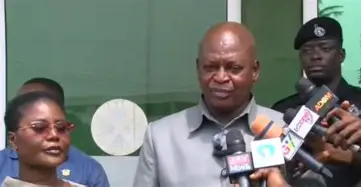
The Minister of Transport, Joseph Bukari Nikpe, says he is strengthening collaboration with key government agencies to address longstanding challenges in Ghana’s transport sector and improve comfort, efficiency, and safety for commuters.
Speaking on ‘Ekosiisen’ on Asempa 94.7 FM, on Thursday February 5, Mr Nikpe explained that Ghana’s transport system has, over the years, suffered from fragmentation, with various ministries and agencies working independently, leading to congestion and inefficiencies.
Transport issues come up daily, and it became a heavy burden. But our people deserve to travel in comfort, and that is what government is determined to achieve,” he said.
According to the Mr Nipke, transport is a multi-sector activity involving the Ministries of Transport, Roads, Interior, Local Government, and Trade. However, the absence of coordinated planning in the past meant each institution operated in isolation.
“Every sector was working in a piecemeal manner, and that created a lot of challenges within the transport sector,” he noted.
Mr. Joseph said that in the past year, government has focused on fostering collaboration, clarifying institutional roles, and jointly addressing transport bottlenecks.
He disclosed that a high-level meeting of ministers responsible for the transport system, chaired by the Vice-President, helped align priorities, with transport unions also contributing to discussions on existing challenges.
The Minister identified poorly engineered inner-city roads as a major cause of congestion and reduced vehicle turnaround.
“Many of our inner-city roads are narrow. A driver who should be making four or five trips a day ends up making one or two because of congestion,” he explained.
He said the Ministry of Roads has begun re-engineering key inner-city routes, including the Ofankor–Kaneshie, Odorkor to open up roads and create designated parking bays to prevent roadside parking.
On inter-city transport, the Minister said responsibility lies with the Ministry of Local Government, which oversees the Bus Rapid Transit (BRT) system introduced in 2015 to improve mobility within metropolitan areas.
He added that Metropolitan, Municipal and District Assemblies (MMDAs) are actively decongesting terminals, relocating street traders, and improving pedestrian movement to ease traffic flow.
Mr. Nikpe also highlighted the role of the Ministry of Interior, noting that indiscipline on the roads remains a major contributor to congestion.
“The Interior Ministry is deploying more police officers to direct traffic and ensure free flow on our roads,” he said.
Touching on transport fares, the Minister revealed that government negotiated a 15 percent reduction in fares last year, the highest reduction recorded in the country.
He admitted that drivers had resisted further reductions due to the high cost of spare parts, despite falling fuel prices and relative stability of the dollar.
To address this, he said the Ministry of Trade is developing a mobile application to display approved prices of spare parts, enabling drivers to compare prices and purchase from affordable outlets.
“Once this is operational, it will help reduce spare parts costs and ultimately reflect in transport fares,” he added.
Latest Stories
-
Netherlands Fire Chief in Ghana to support fire safety reforms and market fire prevention efforts
4 hours -
Mason goes on remand for stealing
5 hours -
Gov’t cuts fuel taxes, deploys buses to curb impact of rising fuel prices
5 hours -
Interior Minister calls for intelligence-driven strategy as Ghana strengthens counter-terrorism efforts
5 hours -
Adenta Circuit Court remands Pastor William Gyimah over viral threats against Vice President
6 hours -
“We’ve implemented changes to prevent a repeat of the AFCON final” – CAF President Motsepe
6 hours -
Gov’t orders deployment of Metro Mass buses to cushion commuters amid fuel price hike
7 hours -
Key Indian state polls begin in test for Modi’s party
7 hours -
Playback: Gomoa Easter Carnival in photos
7 hours -
Gov’t orders removal of fuel taxes to ease pump price hikes
7 hours -
“Whatever the decision of CAS, we will respect it” – CAF President Motsepe after AFCON final meetings in Morocco
7 hours -
Emma Ankrah: When waiting becomes part of treatment – Reflections on hospital care
7 hours -
Ghana urges travellers to prepare for new EU border system roll-out
8 hours -
Mahama enforces fuel coupon ban for ministers as cabinet moves to slash fuel taxes
8 hours -
Task force probes strange fish deaths in Tema
8 hours