

Audio By Carbonatix
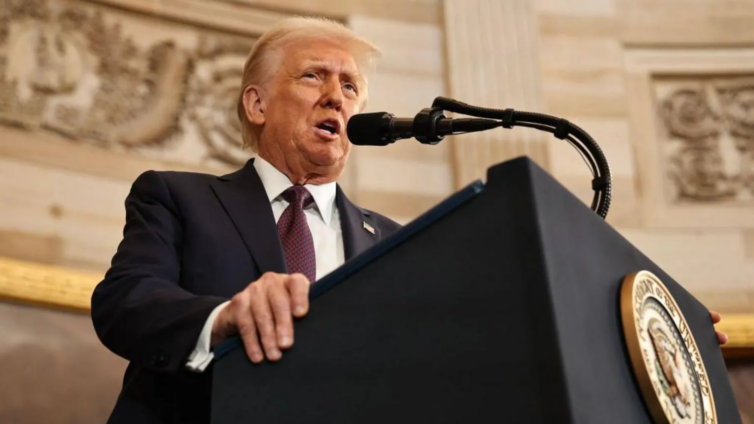
President Donald Trump has said he plans to end "birthright citizenship", which refers to automatic American citizenship granted to anyone born in the US.
On Monday, he signed an executive order addressing the definition of birthright citizenship, though the details so far are unclear.
Birthright citizenship stems from the 14th Amendment of the US Constitution, which states that "all persons born" in the United States "are citizens of the United States".
Though Trump has vowed to end the practice, attempts to do so would face significant legal hurdles.
What is 'birthright citizenship'?
The first sentence of the 14th Amendment to the US Constitution establishes the principle of "birthright citizenship":
"All persons born or naturalized in the United States, and subject to the jurisdiction thereof, are citizens of the United States and of the state wherein they reside."
Immigration hardliners argue that the policy is a "great magnet for illegal immigration", and that it encourages undocumented pregnant women to cross the border in order to give birth, an act that has been pejoratively called "birth tourism" or having an "anchor baby".
How did it start?
The 14th Amendment was adopted in 1868, after the close of the Civil War. The 13th Amendment had abolished slavery in 1865, while the 14th settled the question of the citizenship of freed, American-born former slaves.
Previous Supreme Court decisions, like Dred Scott v Sandford in 1857, had decided that African Americans could never be US citizens. The 14th Amendment overrode that.
In 1898, the US Supreme Court affirmed that birthright citizenship applies to the children of immigrants in the case of Wong Kim Ark v United States.
Wong was a 24-year-old child of Chinese immigrants who was born in the US, but denied re-entry when he returned from a visit to China. Wong successfully argued that because he was born in the US, his parents' immigration status did not affect the application of the 14th Amendment.
"Wong Kim Ark vs United States affirmed that regardless of race or the immigration status of one's parents, all persons born in the United States were entitled to all of the rights that citizenship offered," writes Erika Lee, director of the Immigration History Research Center at the University of Minnesota. "The court has not re-examined this issue since then."
Can Trump overturn it?
Most legal scholars agree that President Trump cannot end birthright citizenship with an executive order.
"He's doing something that's going to upset a lot of people, but ultimately this will be decided by the courts," said Saikrishna Prakash, a constitutional expert and University of Virginia Law School professor. "This is not something he can decide on his own."
Mr Prakash said that while the president can order employees of federal agencies to interpret citizenship more narrowly - agents with the US Immigration and Customs Enforcement, for example - that would trigger legal challenges from anyone whose citizenship is denied.
That could lead to a lengthy court battle ultimately winding up at the US Supreme Court.
A constitutional amendment could do away with birthright citizenship, but that would require a two-thirds vote in both the House of Representatives and the Senate and approval by three quarters of US states.
How many people would it impact?
According to Pew Research, about 250,000 babies were born to unauthorised immigrant parents in the United States in 2016, which is a 36% decrease from a peak in 2007. By 2022, the latest year that data is available, there are 1.2m US citizens born to unauthorised immigrant parents, Pew found.
But as those children also have children, the cumulative effect of ending birthright citizenship would increase the number of unauthorised immigrants in the country to 4.7m in 2050, the Migration Policy Institute, a think tank, found.
In an interview with NBC's Meet the Press, Trump said he thought the children of unauthorised immigrants should be deported alongside their parents - even if they were born in the US.
"I don't want to be breaking up families," Trump said last December. "So the only way you don't break up the family is you keep them together and you have to send them all back."
What countries have it
More than 30 countries - including Canada, Mexico, Malaysia and Lesotho - practise automatic "jus soli", or "right of the soil" without restriction.
Other countries, like the UK and Australia, allow for a modified version where citizenship is automatically granted if one parent is a citizen or permanent resident.
Latest Stories
-
NAIMOS has failed in galamsey fight; it’s time for a state of emergency – DYMOG to President Mahama
3 hours -
Mahama to open African Court judicial year in Arusha, mark 20th anniversary
3 hours -
Ghana begins partial evacuation of Tehran Embassy as Middle East tensions escalate
3 hours -
EPA tightens surveillance on industries, moves to cut emissions with real-time monitoring system
3 hours -
Police conduct show of force exercise ahead of Ayawaso East by-election
5 hours -
Ghana launches revised Early Childhood Care and Development Policy to strengthen child development framework
5 hours -
AI to transform 49% of jobs in Africa within three years – PwC Survey
5 hours -
Physicist raises scientific and cost concerns over $35m EPA’s galamsey water cleaning technology
6 hours -
The road to approval: Inside Ghana’s AI strategy and KNUST’s leadership
6 hours -
Infrastructure deficit and power challenges affecting academics at AAMUSTED – SRC President
6 hours -
Former US diplomat sentenced to life for abusing two girls in Burkina Faso
7 hours -
At least 20 killed after military plane carrying banknotes crashes in Bolivia
7 hours -
UK reaffirms investment commitment at study UK Alumni Awards Ghana 2026
7 hours -
NCCE pays courtesy call on 66 Artillery Regiment, deepens stakeholder engagement
7 hours -
GHATOF leadership pays courtesy call on Chief of Staff, Julius Debrah
7 hours