

Audio By Carbonatix
US President Donald Trump has issued an executive order hitting India with an additional 25% tariff over its purchases of Russian oil.
That will raise the total tariff on Indian imports to the United States to 50%, among the highest rates imposed by the US.
The new rate will come into effect in 21 days, so on 27 August, according to the executive order.
A response from India's foreign ministry on Wednesday said Delhi had already made clear its stance on imports from Russia, and reiterated that the tariff is "unfair, unjustified and unreasonable".
"It is therefore extremely unfortunate that the US should choose to impose additional tariffs on India for actions that several other countries are also taking in their own national interest," the brief statement read.
"India will take all actions necessary to protect its national interests," it added.
The US president had earlier warned he would raise levies, saying India doesn't "care how many people in Ukraine are being killed by the Russian War Machine".
On Wednesday, the White House said in a statement that the "Russian Federation's actions in Ukraine pose an ongoing threat to US national security and foreign policy, necessitating stronger measures to address the national emergency".
It said India's imports of Russian oil undermine US efforts to counter Russia's activities in Ukraine.
It added that the US will determine which other countries import oil from Russia, and will "recommend further actions to the President as needed".
Oil and gas are Russia's biggest exports, and Moscow's biggest customers include China, India and Turkey.
Speaking later at an event in the White House, Trump took a question from the BBC on the subject and said the tariff on India was just the start - "You're going to see a lot more, so much secondary sanctions," he said.
The threatened tariff hike follows meetings on Wednesday by Trump's top envoy Steve Witkoff in Moscow, aimed at securing peace between Russia and Ukraine.
The additional tariff would mean a steep 50% duty on key Indian exports like textiles, gems and jewellery, auto parts, and seafood, hitting major job-creating sectors.
Electronics, including iPhones, and pharma remain exempt for now.
Delhi has previously called Trump's threat to raise tariffs over its purchase of oil from Russia "unjustified and unreasonable".
In an earlier statement, a spokesperson for India's foreign ministry said the US had encouraged India to import Russian gas at the start of the conflict, "for strengthening global energy markets stability".
He said India "began importing from Russia because traditional supplies were diverted to Europe after the outbreak of the conflict".
The latest threatened tariff demonstrates Trump's willingness to impose sanctions related to the war in Ukraine even against nations that the US considers to be important allies or trading partners.
This could be a warning that other countries could feel a real bite if Trump ramps up those kind of sanctions once Friday's deadline passes, when the US president has threatened new sanctions on Russia and to place 100% tariffs on countries that purchase its oil.
This would not be the first time the Trump administration has imposed secondary tariffs, which are also in place to punish buyers of Venezuelan oil.
India has previously criticised the US - its largest trading partner - for introducing the levies, when the US itself is still doing trade with Russia.
Last year, the US traded goods worth an estimated $3.5bn (£2.6bn) with Russia, despite tough sanctions and tariffs.
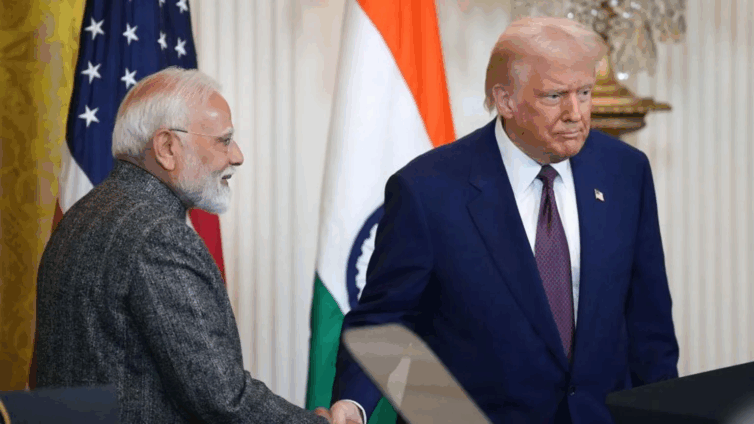
Trump and Indian Prime Minister Narendra Modi have in the past referred to each other as friends and, during Trump's first term, attended political rallies in each others' countries.
But that has not stopped Trump from hitting India with the levies, suggesting diverging interests between New Delhi and Washington.
The Federation of India Exports Organisations has called the decision to impose additional tariffs "extremely shocking", adding that it will hit 55% of India's exports to America.
The tariffs are expected to make Indian goods far costlier in the US, and could cut US-bound exports by 40–50%, according to the Global Trade Research Initiative (GTRI), a Delhi-based think tank.
"India should remain calm, avoid retaliation for at least six months, and recognise that meaningful trade negotiations with the US cannot proceed under threats or mistrust," former Indian trade official and head of GTRI, Ajay Srivastava, said.
Latest Stories
-
UNIFIL condemns air strikes that injured Ghanaian peacekeepers in Lebanon
6 minutes -
Armed robots take to the battlefield in Ukraine war
32 minutes -
AI-generated Iran war videos surge as creators use new tech to cash in
2 hours -
Kufuor calls for intellectual revolution to fix Ghana’s structural cracks
2 hours -
This Saturday on Prime Insight: Experts to tackle Mahama’s land transit ban on rice and ORAL progress
3 hours -
‘Tragic event’: Israeli Ambassador reacts to missile attack on Ghanaian soldiers in Lebanon
4 hours -
Huge US bomber lands at UK air base
4 hours -
Introducing Regalia Residence: Accra’s new luxury standard
4 hours -
Emirates restores flights as airspace reopens, moves toward full global operations
4 hours -
Widows’ bodies in exchange for land: A call to the state and traditional authorities
4 hours -
Ghanaian faces 20 years in US prison after $100m global romance scam bust
5 hours -
Foreign Affairs Minister engages US, Israel and Iran on protection of Ghanaians
7 hours -
The Republic at 69: A Birthday Party with Too Many Speeches and Too Few Solutions
7 hours -
Ghana’s Economic Turnaround: From Junk Status to Renewed Growth
8 hours -
Seidu Agongo donates Ramadan supplies to Accra Academy students
9 hours