

Audio By Carbonatix
There are few US presidential actions more sensitive, more fraught with peril, than when and where to use American military force.
If such information were obtained by American adversaries in advance, it could put lives – and national foreign policy objectives - at risk.
Fortunately for the Trump administration, a group chat with information about an impending US strike in Yemen among senior national security officials on the encrypted chat app Signal did not fall into the wrong hands.
Unfortunately for the Trump administration, the message thread was observed by an influential political journalist, Jeffrey Goldberg.
The Atlantic Magazine editor-in-chief, in an article posted on Monday on his publication's website, says he appears to have been inadvertently added to the chat by White House National Security Adviser Michael Waltz.
Members of the group seemed to include Vice-President JD Vance, CIA Director John Ratcliffe, White House chief of staff Susie Wiles and Defence Secretary Pete Hegseth, among others.
A National Security Council spokesman told the BBC the text message thread "appears to be authentic".
Goldberg says the group debated policy and discussed operational details about the impending US military strike – conversations that provided a rare near-real-time look at the inner workings of Trump's senior national security team.
"Amazing job," Waltz wrote to the group, just minutes after the US strikes on Houthi targets in Yemen took place on Saturday 15 March.
He followed up with emojis of a US flag, a fist and fire. Other senior officials joined in on the group congratulations.
These White House celebrations may prove short-lived after Monday's revelations, however.
That an outsider could inadvertently be added to sensitive national defence conversations represents a stunning failure of operational security by the Trump administration.
And that these conversations were taking place outside of secure government channels designed for such sensitive communications could violate the Espionage Act, which sets rules for handling classified information.
"This administration is playing fast and loose with our nation's most classified info, and it makes all Americans less safe," Senator Mark Warner of Virginia, the ranking Democrat on the Senate Intelligence Committee, posted on X.
Democratic congressman Chris Deluzio said in a press statement that the House Armed Services Committee, on which he sits, must conduct a full investigation and hearing on the matter as soon as possible.
"This is an outrageous national security breach, and heads should roll," he said.
Criticism wasn't limited to Democrats, either.
Don Bacon, a Republican congressman from Nebraska, told the political website Axios that the administration's action was "unconscionable".
"None of this should have been sent on non-secure systems," he said of Waltz's messaging. "Russia and China are surely monitoring his unclassified phone."
With Republicans in control of both the House of Representatives and the Senate, Trump's own party would have to initiate any kind of formal congressional investigation into the matter.
Republican Speaker of the House Mike Johnson appeared to downplay such a possibility as he told reporters that the White House had admitted its error.
"They'll tighten up and make sure it doesn't happen again," he said. "I don't know what else you can say about that."
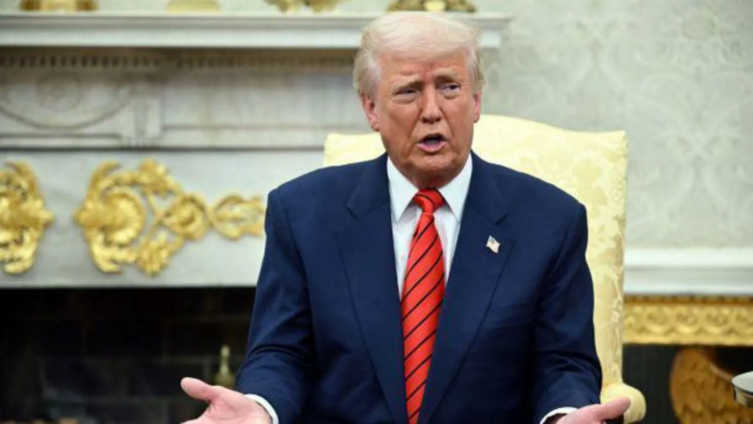
Trump, for his part, pleaded ignorance when asked by reporters in the Oval Office about the Atlantic story, saying that it was the first he had heard of it.
The White House then released a statement defending the president's national security team, including Waltz.
By Monday evening, however, rumours in Washington were swirling that high-level resignations may ultimately be necessary, with attention focusing on Waltz, whose invitation brought Goldberg into the group conversation. The White House has provided no further comments even as this speculation has grown.
In its afternoon statement, the White House noted that the strikes were "highly successful and effective". That could help minimise some the political fallout from the chat-group discussions, which also revealed some divisions within Trump's national security team.
JD Vance was the highest-ranking participant in the Signal text group that discussed detailed plans about the US military strike on Yemen.
While the vice-president has typically marched in lockstep with Trump in his public comments on foreign policy, in the private discussions he said that he thought the administration was making a "mistake" by taking military action.
He noted that the targeted Houthi forces in Yemen posed a larger threat to European shipping, while the danger to American trade was minimal.
"I am not sure the president is aware how inconsistent this is with his message on Europe right now," Vance wrote. "There's a further risk that we see moderate to severe spike in oil prices."
The vice-president went on to say that he would support what the team decided and "keep these concerns to myself".
"But there is a strong argument for delaying this a month, doing the messaging work on why this matters, seeing where the economy is, etc."
This is far from the first time a vice-president has disagreed with their president on matters of foreign policy.
Dick Cheney clashed with George W Bush in the later years of his presidency over the handling of the Iraq war, and Joe Biden believed that Barack Obama's covert operation to kill Osama Bin Laden was too risky.
This is also not the first time that the handling of sensitive national security material has generated headlines. Both Trump and Joe Biden were investigated for their possession of classified information after leaving office. Special Counsel Jack Smith indicted Trump for alleged violations related to his refusal to turn over material stored at his Mar-a-Lago residence – a case that was dropped when Trump won re-election last year.
In 2016, Hillary Clinton's use of a private email server for communications while US secretary of state became a major issue during her unsuccessful presidential campaign.
Like this White House group chat, some of those messages provided insight into the inner workings of Clinton's team.
Their revelation also proved to be political damaging. A handful of her stored messages were later deemed to contain "top secret" information.
"We can't have someone in the Oval Office who doesn't understand the meaning of the word confidential or classified," Trump said during that campaign – one of many attacks on Clinton for what he said was a clear violation of federal law.
On Monday afternoon, Clinton took to social media to posted her own, brief comment on the revelations of the White House group chat on Signal.
"You've got to be kidding me," she wrote.
Latest Stories
-
Gomoa Easter Carnival: Edem Agbana and Joy Prime fans shower festival with endorsements as masquerades and ‘street anthems’ ignite Day 3
2 hours -
Gov’t to overhaul free zones into manufacturing hubs for local production – Trade Minister
3 hours -
Ghana losing $2.5bn yearly from raw exports – Trade Minister reveals
3 hours -
President Mahama unveils plans for Kwahu Airport, Convention Centre
3 hours -
World’s oldest leader, Paul Biya to get a deputy for first time in 43-year rule
3 hours -
Search for missing US airman continues as Trump threatens ‘hell’ if Iran does not reach deal
3 hours -
US says it has arrested relatives of late Iranian general Qasem Soleimani
3 hours -
La Liga: Real Madrid’s title hopes hang in the balance as Mallorca snatch stoppage-time winner
3 hours -
FA Cup: Haaland hat-trick powers Man City past Liverpool into semi-finals
3 hours -
FA Cup: Chelsea thrash Port Vale to reach Wembley semi-final
4 hours -
Gov’t to boost tourism in coastal communities through infrastructure, sanitation – Vice President
4 hours -
Universities management urged to involve alumni in curricula development, career guidance to reduce unemployment after school
4 hours -
Vice President Opoku-Agyemang enstooled as Development Queen of Kedzi
4 hours -
Globen School @30: From humble beginnings to a hub of innovation and excellence
4 hours -
Children’s health and happiness take centre stage at 2026 Giggle Fun Fest in Peki Avetile
5 hours