

Audio By Carbonatix
Trains and flights have been cancelled in Japan as one of the strongest typhoons to hit the country in decades drenches cities in its path.
At least six people have been killed and more than 100 injured after Typhoon Shanshan made landfall in the south-western Japan on Thursday.
Now downgraded to a tropical storm, Shanshan is still packing winds of 90km/h (56mph).
Thousands of people remain without power.
The highest level-five order was issued to millions of residents in the southern island of Kyushu as the storm approached on Thursday, with winds of up to 252 km/h.
After making landfall, the typhoon weakened to a severe tropical storm, but it is still pummelling its way north-east. Up to 300mm (12in) of rainfall is expected in places in the next 24 hours.
Residents of the affected areas have been warned of landslides, flooding and large-scale damage.
A trail of destruction is visible across Shanshan's path, with many buildings damaged by flying debris, trees uprooted and cars overturned or buried under floods.
Heavy rain was falling in Gifu and Mie prefectures on Saturday, as the Japan Meteorological Agency urged people "to remain vigilant for landslides, flooding and overflowing rivers".
"This is the first time I saw a typhoon sweeping across all of Japan," a resident in the capital, Tokyo, told Reuters news agency.
"Typhoons are supposed to go north from Okinawa. So, I didn't expect it to be like this. I'm very surprised."
All Nippon Airways and Japan Airlines have cancelled dozens of domestic flights.
Bullet train services between Tokyo and Osaka are among those affected throughout Saturday and Sunday.
Shinkansen bullet trains in the central city of Nagoya were also suspended - and there are warnings that more could be halted.
Map shows predicted path of Shanshan
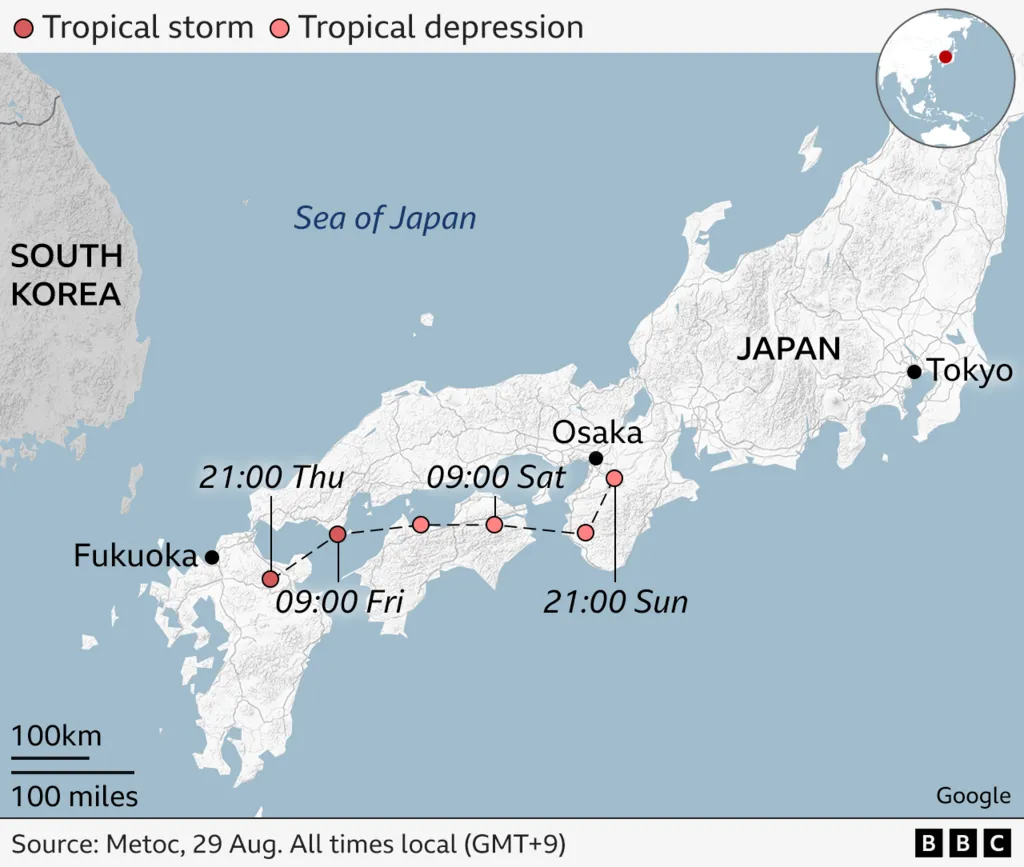
Special typhoon warnings, like the one issued for Shanshan, are declared in Japan in cases of extraordinarily powerful storms. The same warning was issued in September 2022 as Typhoon Nanmadol approached Kyushu - the first such warning declared for a region other than Okinawa.
Typhoons in the region have been forming closer to coastlines, intensifying more rapidly and lasting longer over land due to climate change, according to a study released last month.
Latest Stories
-
2,280 students graduate with B-Tech, M-Tech from Takoradi Technical University
29 seconds -
‘We were trained to serve, not lead’ – Special Prosecutor condemns colonial education legacy
1 hour -
Education must preserve identity and drive innovation – Special Prosecutor
2 hours -
Corruption raises bank risk, weakens diversification benefits, research finds
2 hours -
The Apostolic Church-Ghana bans ‘you may kiss your bride’ during marriage ceremonies
5 hours -
Ɔdadeɛ 95 marks reunion with GH₵200k Solar Project at PRESEC-Legon
5 hours -
AI is the new phase of the digital age, and Africa must be ready or risk being left behind – Dr Bawumia warns at LSE Africa Summit
5 hours -
Ghana’s Gold Reserve Policy Reversal: An Analytical Review of Costs, Timing, and Governance
6 hours -
Joyce Blessing blesses Adom TV Fufu Party patrons with thrilling performance
6 hours -
Toasehene commissions community centre, urges traditional leaders to prioritize development
7 hours -
ECG to replace transformers in parts of Accra to improve power supply
7 hours -
Photos: Two brothers who perished in the tragic Tema aircraft crash laid to rest
7 hours -
Pamela Bridgewater Project urges stakeholders to join outreach programme on teenage pregnancy
8 hours -
Shot on duty: A Ghanaian journalist’s five-year struggle for recovery
8 hours -
Rainstorm rips off Kassena-Nankana West District block
8 hours