

Audio By Carbonatix
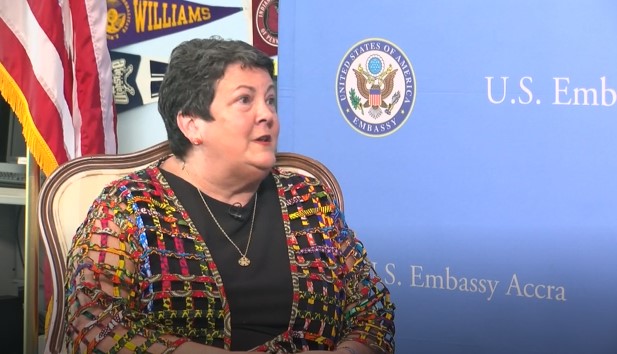
The U.S. Ambassador to Ghana, Virginia Palmer, has highlighted the significance of the Flintlock 2024 Exercise, which showcases the robust partnership between the United States and Ghana in enhancing regional security.
"This is the second year I have seen you for this exercise – as promised it is bigger and better this year," she said last Friday when she delivered a speech at the Distinguished Visitor Demonstration for the event in Tamale in the Northern region.
She noted that Flintlock is one of three major exercises taking place in Ghana this month, alongside Obangame Express and African Lion, reflecting comprehensive cooperation to bolster regional security.
Addressing the assembled forces and international partners, Palmer extended a warm welcome: "Akwaaba to our distinguished international partners, and Medaase to our gracious hosts, the Ghana Armed Forces."
She acknowledged the immense effort that went into planning and executing the exercise, which involved nearly 1,300 multinational forces from 31 nations.
Flintlock, a multinational effort dating back to 2005, underscores the U.S.'s long-term commitment to regional security.
Ambassador Palmer emphasized the exercise's timely relevance, given the escalating security threats from violent extremism in the Sahel.
She expressed concern over the security, humanitarian, and political crises unfolding in the region, highlighting the need for continued vigilance and cooperation.
"African Lion is here to stay in Ghana and to continue strengthening ties in coastal West Africa," Palmer declared. She described African Lion as the U.S. Army’s premier exercise focused on countering shared threats in Africa through the deployment and mobilization of conventional forces.
Ambassador Palmer highlighted the growing influence of violent extremist groups in the region, noting the rise in threats to civilians, human rights abuses, displacement, and humanitarian needs.
She stressed that violent extremism flourishes in the absence of state authority, weak service delivery, fragile democracy, inaccessible justice, and economic and political exclusion.
In conjunction with African Lion, medical outreach events were conducted in communities to build trust between at-risk populations and security forces. "It's that trust and connection that can truly improve security," Palmer said.
The ambassador underscored that addressing violent extremism requires more than military efforts. Under the Strategy to Prevent Conflict and Promote Stability, the U.S. has committed long-term support to at-risk local communities.
This includes fostering social cohesion, providing economic opportunities, strengthening military relationships, and enhancing Ghanaian security services. Since 2022, Congress has approved over $85 million for these initiatives, with an additional $45 million expected this year.
Ambassador Palmer praised the Ghana Armed Forces for their leadership in specialized operations and command and control. "The Ghana Armed Forces have demonstrated that in addition to being a net exporter of security and stability through peacekeeping, it is a capable leader," she said.
She reaffirmed the U.S.'s commitment to supporting the Ghana Armed Forces through continued training and technical support.
The partnership between the two nations is built on shared democratic values and a shared history. Ghana's commitments to freedom of assembly, interfaith religious tolerance, and respect for human rights serve as a model for modern democracies.
In conclusion, Palmer emphasized the strength and mutual benefits of the U.S.-Ghana bilateral relationship.
"Through Flintlock and African Lion, we have demonstrated that our bilateral relationship is strong, productive, and mutually beneficial," she said.
Ambassador Palmer expressed pride in partnering with Ghana, a leader in West Africa, to advance regional security, invest in people, protect democratic institutions, and promote mutual prosperity.
The presence of senior leaders at the event underscored the importance of these exercises and the focus on security in coastal West Africa.
"Ghana’s efforts are backed by international and regional partners who value Ghana’s leadership," Palmer concluded, reinforcing the collective commitment to upholding shared values and democratic norms in the face of regional threats.
Latest Stories
-
Black Stars: Seven years of decline while hashtagging love
9 minutes -
Today’s front pages: Thursday, October 1, 2026
10 minutes -
Gov’t to suspend GH¢1 D-Levy on diesel for October and November
43 minutes -
Fire destroys belongings in Akweteyman apartment
1 hour -
Baffour Awuah to turn himself in to EOCO today – JoyNews sources
1 hour -
Government identifies payment discrepancy holding up teachers’ strike resolution
2 hours -
BoG signals no FX intermediation for October as GoldBod plans $1bn support for banks
2 hours -
When share ownership becomes personal: The African mindset of the Dangote IPO
2 hours -
Why MFWA Legal Fund matters to Ghana’s democracy
2 hours -
Fuel prices to rise from October 1; diesel could hit GH¢19.60 – COMAC
2 hours -
Parliament must investigate how 3.9 tonnes of cocaine left Ghana undetected – Samuel Jinapor
2 hours -
Government pledges to pay striking teachers as payment dispute is resolved
2 hours -
Government cannot investigate drug exports under its own watch – Abu Jinapor
2 hours -
Government extends GH¢2 diesel subsidy for two more months
2 hours -
GTEC flags over 100 tertiary institutions as unrecognised
2 hours