

Audio By Carbonatix
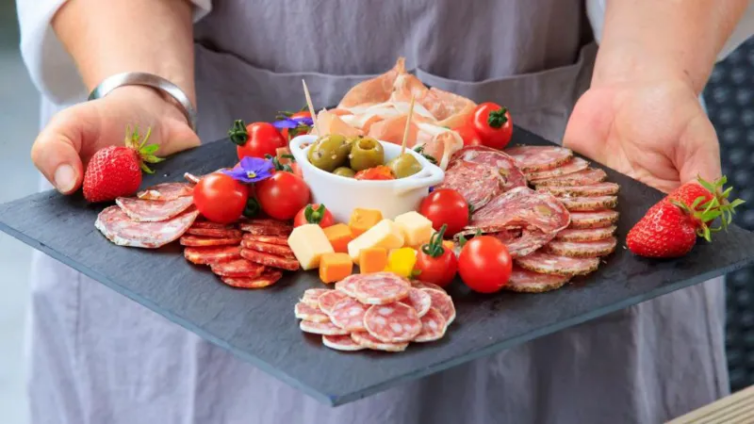
The UK government has brought in a temporary ban on holidaymakers bringing in cheese and meat products from the EU in a bid to prevent the spread of foot-and-mouth disease.
Travellers have not been allowed to bring back items such as cured meat and cheese, including in sandwiches, since Saturday due to the growing outbreak on the continent.
The restrictions apply regardless of whether the goods are packed or packaged, or bought from duty free.
It follows an earlier ban of similar products from Germany, Hungary, Slovakia and Austria after rising cases of the cattle disease in those countries.
The restrictions apply to people arriving in Great Britain, not Northern Ireland, Jersey, Guernsey, or the Isle of Man.
Products will be seized and destroyed if people try to bring them in, and in "serious cases" people could be fined up to £5,000.
The list of restricted products includes:
- pork
- beef
- lamb
- mutton
- goat
- venison
- other products made from these meats, for example sausages
- milk and dairy products like butter, cheese and yoghurt
People can bring up to 2kg per person of powdered infant milk, infant food, or special food needed for medical reasons.
Foot and mouth disease is a highly infectious virus which causes blisters inside an animal's mouth and under their hooves, and can cause lameness and problems feeding.
There are currently no cases of foot-and-mouth disease in the UK.
The last outbreak in the UK was in 2001. Although there were only 2,000 confirmed cases, more than six million sheep, cattle and pigs were slaughtered.
This is because each of those cases meant a farm having all of its livestock killed and burned.
The Guild of Fine Food, which represents independent food and drink retailers, said the ban on "holiday treats" had been "hurried", but added it brought UK government policy for holidaymakers more in line with restrictions already placed on small businesses.
"The food and drink industry absolutely supports the fact that we must protect our farmers and that biosecurity is paramount," said John Farrand, managing director of the Guild of Fine Food.
However, he said that "bureaucracy" brought in after Brexit had added "significant constraints" for small food and drink importers and exporters.
Latest Stories
-
Breaking borders, building futures: How African-led AI is rewriting the rules of global innovation
46 minutes -
Guinea orders dissolution of 40 political parties, including three main opposition groups
52 minutes -
Iran Embassy in Ghana opens Book of condolence after death of Supreme leader in US-Israel attacks
3 hours -
GPL 2025/26: Vision FC cruise past Berekum Chelsea with emphatic 3–1 win
3 hours -
GPL 2025/26: Samartex held by Dreams FC as winless run extends to five
3 hours -
New Juaben North MP challenges gov’t to provide evidence of jobs created and cheap loans
4 hours -
Nadowli-Kaleo District marks 69th Independence Day with cultural exhibition, academic awards
4 hours -
Confusion, tension rock NPP polling station registration exercise in Tarkwa-Nsuaem
5 hours -
Burger King opens first Kumasi branch in Ahodwo
5 hours -
Burma Camp Tennis Club hosts successful 12th Ghana–Nigeria Independence Day Tennis Tournament
5 hours -
Rights, justice and action for all women and girls must include women and girls with disabilities
5 hours -
The Lover and the Fighter: China, the west, and Africa’s geopolitical awakening
6 hours -
UCC student dies in tragic road accident on campus
6 hours -
Health Ministry establishes committee to probe death of hit-and-run victim
6 hours -
RTI Commission, NACOC explore collaboration to promote transparency and accountability
6 hours