

Audio By Carbonatix
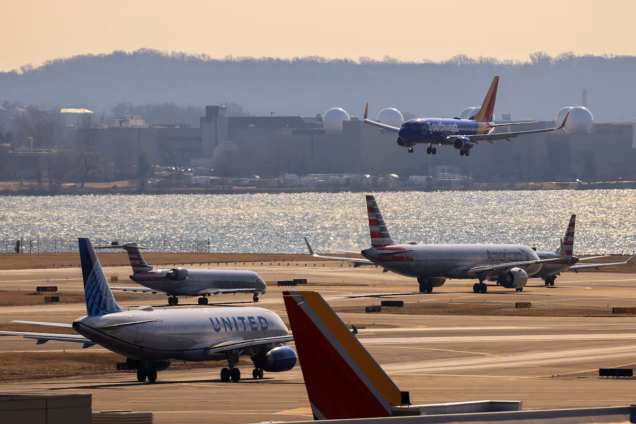
The Federal Aviation Administration said it will investigate a close call that occurred on Friday between a Delta Air Lines flight and a U.S. Air Force jet near Reagan Washington National Airport.
The incident follows a mid-air collision on January 29 near the same airport involving a passenger jet a U.S. Army helicopter, which killed 67 in the first deadly U.S. passenger airline crash in 16 years.
A series of troubling near-miss incidents over the past two years has raised concerns about U.S. aviation safety and the strain on understaffed air traffic control operations.
On Friday, Delta Flight 2389, an Airbus A319 headed for Minneapolis, was cleared for takeoff around 3:15 p.m. ET (1915 GMT), while four U.S. Air Force T-38 Talons were inbound to nearby Arlington National Cemetery for a flyover, the FAA said.
The Delta jet received a cockpit collision warning alert that another aircraft was nearby, and controllers issued corrective instructions to both aircraft, it said.
Senator Amy Klobuchar, who represents Minnesota, called the incident "unbelievably dangerous and thank God people are safe. My first call to Department of Defense tomorrow: why are your planes flying 500 feet (150 meters) below passenger jets full of Minnesotans."
The Pentagon said it was aware of reports about Friday's incident but did not have an immediate comment.
Delta, which said there were five crew on board and 131 passengers, said "the flight crew followed procedures to maneuver the aircraft as instructed... We will cooperate with regulators and aviation stakeholders in any review of this flight."
CNN, citing audio captured by website LiveATC.net, reported the Delta pilot asked controllers if there was "an actual aircraft about 500 ft below us" as the commercial jet left the airport. The controller responded "affirmative," CNN said.
The January collision raised questions about the military's failure to use a key safety system known as ADS-B on helicopter training flights.
The FAA has since imposed permanent restrictions on non-essential helicopter operations around Reagan and barred helicopters and passenger jets from flying near each other.
The FAA's actions followed two urgent safety recommendations made by the National Transportation Safety Board after the collision.
Last month, a Southwest Airlines LUV.N flight was less than 200 feet behind a business jet when the Southwest pilot aborted the landing and made an emergency maneuver to narrowly avoid a collision at Chicago Midway Airport.
On March 1, more than a dozen flights on final approach to Reagan National received false cockpit collision warnings, prompting at least six to abort landings.
The FAA and a senator said it was prompted by government testing of counter-drone technology.
Latest Stories
-
Iran–US conflict pushes fertilizer prices higher, raising food security risks in 2026
3 minutes -
Iran using children in security roles in war, reports and witnesses say
6 minutes -
Evalue-Ajomoro-Gwira MP pledges to safeguard peace in Lower Axim and Nsein
9 minutes -
Global collaboration in focus as Malaysia courts Ghanaian top business executives
17 minutes -
Bondaye Residents accuse Heath Goldfields of unsafe mining and broken promises
21 minutes -
Evalue Ajomoro Gwira MP calls for calm amid Lower Axim and Nsein chieftaincy tensions
30 minutes -
I know the President listens and he will – Franklin Cudjoe
50 minutes -
Former AG Godfred Dame demands retraction from Kwakye Ofosu over galamsey claims
50 minutes -
All Big Push contractors paid, projects on track – Roads Minister
1 hour -
Photos: Mahama meets CSOs on accountability, anti-corruption and governance
1 hour -
Big Push prioritises precision, quality and value – Roads Minister Agbodza
1 hour -
Big Push agenda targets local contractor development – Agbodza
1 hour -
Between memory and partnership: Ghana’s moral test on reparatory justice
1 hour -
“OSP has always lacked the opportunity to speak” – Samuel Appiah-Darko
1 hour -
Local experts unlock pension capital as Ci Gaba Fund raises GH¢380m to finance SMEs
1 hour