

Audio By Carbonatix
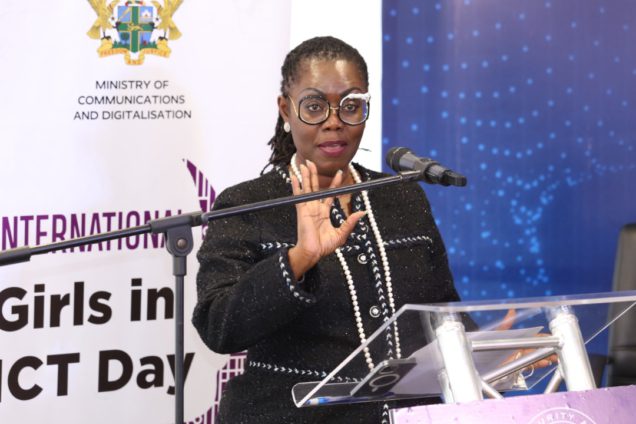
The Communications Minister, Ursula Owusu-Ekuful, has urged chief directors and chief executive officers of the public sector not to use personal emails for government business.
“I am happy to announce that the use of personal emails for government business will no longer be permitted by the end of this year. Please let me repeat, it will not be acceptable to use personal email to do official government business from next year,” she stated.
She said government had partnered with Microsoft E-Solutions, its local partner to roll out the Smart Workplace platform, a virtual office which provided the needed tools for staff communication, collaboration and meetings without participants being in the same space.
She asked any government agency that had not yet been on board to contact the National Information Technology Agency (NITA) for redress.
Mrs Owusu-Ekuful gave the advice at a Technology Breakfast Meeting with public sector executives in Accra on Tuesday on the theme, “Government Digitalisation Agenda: The Role of the Public Sector.”
The meeting was organised by NITA in collaboration with the State Interest and Government Authority (SIGA) and the Office of the Head of Civil Service.
It was aimed at ensuring that key decision makers such as the chief directors and chief executives, who drive government policies, appreciate systems used and initiatives undertaken to achieve the digitalisation agenda.
The Minister said chief directors and the CEOs were key stakeholders in achieving a digital public sector and by extension a digital Ghana; adding, “Your leadership and support in driving the needed reforms that come with introduction and use of digital initiatives are key.
“You will have to lead by example and set the right tone for your staff to understand and appreciate the reforms being rolled out.”
Mrs Owusu-Ekuful said the cabinet had also decided that all Ministries, Departments and Agencies (MDAs) and Metropolitan, Municipal and District Assemblies (MMDAs) must procure internet services from NITA and host their data and disaster recovery sites at the National Data Centre.
“NITA and its technical partner have the capacity to provide high-speed broadband services to its public sector clients. With support from the World Bank, we are about to roll out connectivity to all MMDAs, selected police stations, post offices and hospitals across the country.
“This is a dawn of a new era, but we need to work with you to make it succeed. Just as you budget and pay for transport and utilities, you must do same for connectivity and data services from NITA in this digital age,” the Minister told the directors and the CEOs.
Mr Edward Boateng, the Director-General of SIGA, said Ghana was at the forefront of the digitalisation agenda in Africa and it had become increasingly important for State-owned Enterprises, Joint Ventures, and other state entities to work smart to become more efficient and productive.
“I implore all of us to prioritise the conversion of existing physical documents and data into soft or digital form for ease of leverage in transforming business processes and outcomes.”
Mr Richard Okyere-Fosu, Director-General of NITA, in a welcoming address said government had invested over $500 million and continued to invest in the effort to digitalise the country’s economy.
“Most of these investments by government is to provide the needed infrastructure and enabling environment to provide the basic and needed framework to allow all other sectors within the public sector to also digitalise or automate the delivery of their mandate,” he stated.
He said, as public sector executives, it was important for them to know and align with what government had done, what it was doing and what it planned to do in digitalisation.
Mr Okyere-Fosu stated that per government policy, NITA’s role as the operator of the eGovernment Infrastructure had been handed to a private partner, Smart Infraco, to maintain and operate the infrastructure on behalf of government.
“This frees NITA to now concentrate on its mandate to regulate the ICT space. NITA through the NITA Act (Act 771) and the Electronic Transaction Act (Act 772) is empowered by an Act of Parliament to Regulate the ICT space, electronic transactions, electronic signature, and electronic records.”
He said as the executives are the champions of government’s digitalisation agenda, they have a duty to marshal their institutions to adopt the policies, systems and services government deploys for the public sector.
“Let’s try to understand the happenings within this space and provide the needed support to our technical directors or IT heads to implement the needed IT transformations required to improve service delivery in the public sector,” he stated.
Latest Stories
-
Photos: Mahama commissions 85-bed Police Hospital ward, donates two ambulances
8 minutes -
GTEC directs Ghana’s public universities to reopen by October 16 and begin lectures on October 19
9 minutes -
Star Oil donates GH¢1million towards construction of new CID facility
13 minutes -
Court hands Adjetey Sowah, two others lifetime bans after Amputee Football legal dispute
22 minutes -
NDC appoints Julius Kwame Anthony as a Deputy Communications Director
23 minutes -
Ghana repatriates 120 Nigerians rescued from suspected cybercrime centres
27 minutes -
NPP rejects Emelia Agbenyo’s appointment as Deputy EC Chair, demands withdrawal
32 minutes -
EOCO grants Suame MP John Darko enquiry bail in GH¢27m SIC investigation
35 minutes -
NPP cannot question EC appointment after appointing own people to Commission – Kwakye Ofosu
41 minutes -
BoG deepens public trust with regional stakeholder forum in Techiman
50 minutes -
‘We have turned the tide’ – Ato Forson says Ghana is ready to take off
55 minutes -
Police arrest man captured in viral video assaulting wife in Agona Nkwanta
57 minutes -
KATH Mother and Baby Unit construction stalled for 14 months over unpaid contractor arrears
1 hour -
Government wanted to ‘tilt the balance’ with new EC appointments – Kwakye Ofosu
1 hour -
Angry Tema Community 25 residents threaten to sleep at GWL over water shortage
2 hours