

Audio By Carbonatix
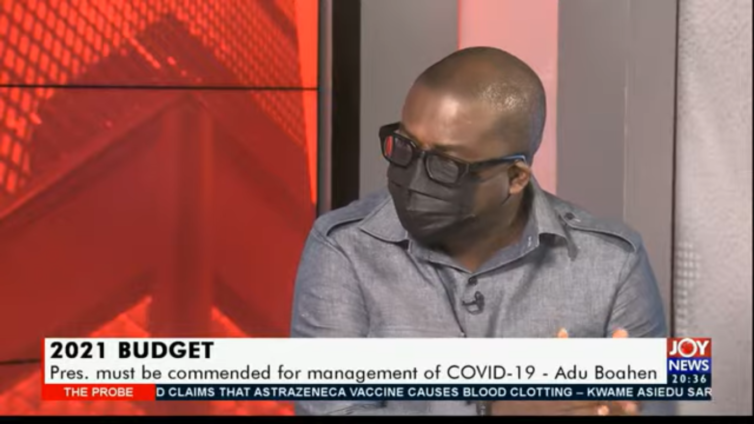
The President’s Representative at the Finance Ministry Charles Adu Boahen has justified government’s decision to introduce new levies.
Speaking to JoyNews’ Emefa Apawu, he intimated that the only solution to recovering the economy is to introduce new levies and not borrow money.
According to him the levies proposed by government if approved will help restore the country’s economy following the dire effect Covid-19 pandemic on the country.
“Somehow we have to find a way to share the burden. We can’t borrow anymore we have borrowed to the hilt so what we have to do is we have to look at the revenue side of the equation and that is why we are looking at the compliance of introducing new levies.”
The caretaker Finance Minister Osei Kyei-Mensah-Bonsu during the 2021 budget statement, Friday hinted at government's decision to introduce new taxes as steps to revamp the economy amidst the pandemic.
The new taxation includes a 1% Covid-19 levy, sanitation levy and increment in prices of petroleum products.
However, the announcement of the new levies by Mr Kyei-Mensah-Bonsu has since been rejected by several Ghanaians insisting that the new taxes will impact negatively on their finances and increase hardship in the country.
Reacting to the outcry of citizens on the increment of petroleum prices, Charles Adu Boahen indicated that, the pandemic had a great toll on the energy sector, hence the need to introduce a petroleum levy.
In his justification of the new taxes, he insisted that the increment of the petroleum levies by 5.7%, will still be less than what Ghanaians had been paying in the past years.
“The fuel levies we have proposed will increase the pump by only 5.7%, less than 6% and so when you look at it in that sphere you realize that in fact fuel prices are going down by almost 7 or 8 per cent last year due to Covid because oil prices went down.
“The prices of fuel at the pump today is less than what it was in 2019, so we have been paying more for fuel in the past,” he stated.
He further stated that the high earning class are likely to be affected more than a low-income citizen with a 5.7% petroleum levy.
“In a nutshell, it’s only a 5.7% increase in the pump I think the biggest people who will bear the branch of that tax are the people with big 4x4 Landcrusiers whose engine takes a lot of fuel and they will be the one paying a bunch of it.”
Latest Stories
-
Anti-LGBTQ Bill: Forget the rumour mongers, I’m a man of action, and will pass the bill – Speaker
20 minutes -
Women and children among those killed in Sudanese army shelling of wedding celebration
24 minutes -
President Mahama is not sincere with Ghanaians on LGBTQ bill matter – Hassan Tampuli
42 minutes -
Gov’t to establish Prison Industrial Hub to equip inmates with income-generating skills – Prison Service boss
1 hour -
Alhassan Tampuli donates cement, roofing sheets to support storm victims in Gushegu
1 hour -
Alhassan Tampuli appeals for urgent support for storm victims in Gushegu
1 hour -
The hypocrisy must stop; pass Anti-LGBTQ+ Bill now – Alhassan Tampuli to Mahama
1 hour -
Imprisonment should be rehabilitative, not punitive – Ghana Prisons boss at UNGA
1 hour -
Ga Adangbe traditional priests petition Mahama over McDan aviation licence revocation
2 hours -
Anti-LGBTQ Bill: NDC’s arrogance is worrying – Hassan Tampuli
2 hours -
Let’s give OSP time to mature, not to scrap it – Hassan Tampuli
2 hours -
Nigeria convicts 386 Islamist militants in mass trials
2 hours -
Djibouti president wins election with 97.8% of vote, state media says
2 hours -
We don’t have mandate to deduct tax from rent allowance of security services personnel – Interior Ministry clarifies
2 hours -
Ablakwa receives Presidential Special Envoy on Reparations to advance global agenda
3 hours