

Audio By Carbonatix
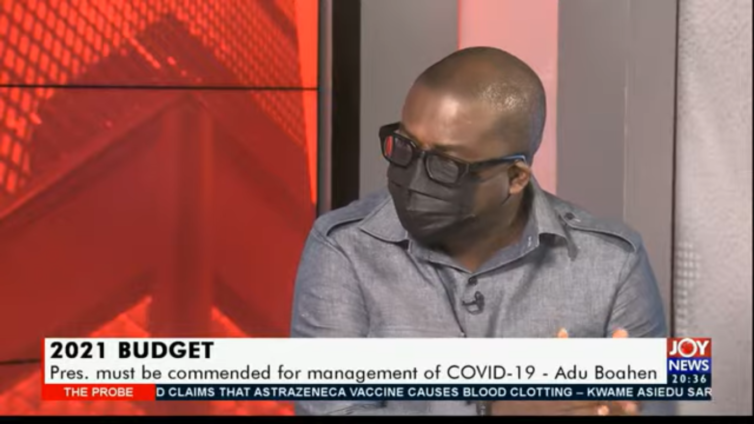
The President’s Representative at the Finance Ministry Charles Adu Boahen has justified government’s decision to introduce new levies.
Speaking to JoyNews’ Emefa Apawu, he intimated that the only solution to recovering the economy is to introduce new levies and not borrow money.
According to him the levies proposed by government if approved will help restore the country’s economy following the dire effect Covid-19 pandemic on the country.
“Somehow we have to find a way to share the burden. We can’t borrow anymore we have borrowed to the hilt so what we have to do is we have to look at the revenue side of the equation and that is why we are looking at the compliance of introducing new levies.”
The caretaker Finance Minister Osei Kyei-Mensah-Bonsu during the 2021 budget statement, Friday hinted at government's decision to introduce new taxes as steps to revamp the economy amidst the pandemic.
The new taxation includes a 1% Covid-19 levy, sanitation levy and increment in prices of petroleum products.
However, the announcement of the new levies by Mr Kyei-Mensah-Bonsu has since been rejected by several Ghanaians insisting that the new taxes will impact negatively on their finances and increase hardship in the country.
Reacting to the outcry of citizens on the increment of petroleum prices, Charles Adu Boahen indicated that, the pandemic had a great toll on the energy sector, hence the need to introduce a petroleum levy.
In his justification of the new taxes, he insisted that the increment of the petroleum levies by 5.7%, will still be less than what Ghanaians had been paying in the past years.
“The fuel levies we have proposed will increase the pump by only 5.7%, less than 6% and so when you look at it in that sphere you realize that in fact fuel prices are going down by almost 7 or 8 per cent last year due to Covid because oil prices went down.
“The prices of fuel at the pump today is less than what it was in 2019, so we have been paying more for fuel in the past,” he stated.
He further stated that the high earning class are likely to be affected more than a low-income citizen with a 5.7% petroleum levy.
“In a nutshell, it’s only a 5.7% increase in the pump I think the biggest people who will bear the branch of that tax are the people with big 4x4 Landcrusiers whose engine takes a lot of fuel and they will be the one paying a bunch of it.”
Latest Stories
-
The 7-foot giant of Ngleshie Amanfro: Seven-foot Ghanaian Ephraim Saawa dreams of joining the national basketball team
31 minutes -
Government promises support for Kumasi Central Market fire victims
37 minutes -
Vibes The Movie: Big Ghun’s Ghanaian film earns five nominations at 2026 REFFA
1 hour -
MamaCare CEO warns unresolved conflicts among health workers could undermine maternal and neonatal care
2 hours -
Health professionals urged to translate medical knowledge into practice to save mothers
2 hours -
Conflicts among care providers linked to maternal, neonatal deaths – Expert
3 hours -
GIS marks 10th TIME conference, champions improved teaching practices
3 hours -
BRICS Or Balance? What Ghana’s bid really means
4 hours -
GPRTU wants full TRAFFITECH-GH implementation to start in 2027
4 hours -
Mahama announces plans to import electric wheelchairs for PWDs
4 hours -
KGL U17 Colts 2026: Western beat Prempeh Elite Academy to set up final final with Greater Accra Region
4 hours -
Late Solanke strike salvages 10-man Spurs draw at Man United
5 hours -
Gender Ministry to monitor welfare of Nana Akua Addo’s children amid domestic violence case
5 hours -
Benedict Okyere Yeboah: Ghana’s football problem goes beyond sacking a coach
5 hours -
GPL 2026/27: Darkwah Wiafe’s winner sees All Blacks beat Kotoko
5 hours