

Audio By Carbonatix
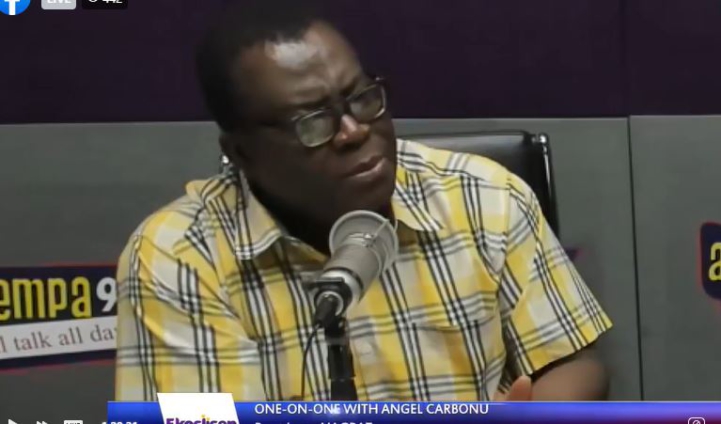
The President of the National Association of Graduate Teachers (NAGRAT), Angel Carbonu, has expressed deep concern over Ghana’s lack of robust democratic systems that can function independently of human emotions, particularly during political transitions.
Mr. Carbonu noted that while Ghana is often celebrated as a beacon of democracy, the country has failed to establish institutional systems that transcend individual sentiments and ensure smooth governance transitions.
In an interview on Joy FM Top Story on Tuesday, December 17, he said: “As a Ghanaian and a public sector worker, I am very disturbed and worried. Over the years, we’ve been touting ourselves as a beacon of democracy, yet we have failed to put in place democratic systems that can transcend individual human sentiments."
His comments come at a time of heightened debate over the delayed mini-budget, with public sector salaries and government operations for early 2025 hanging in the balance.
Mr. Carbonou emphasized the need for automatic systems to manage critical state functions, especially during the period between elections and the swearing-in of a new government.
“If systems were in place, whenever elections are over and a government becomes a lame duck, and the newly elected party prepares to assume office, we would know how to transition seamlessly. We currently rely too much on human emotions and last-minute decisions.”
He cited the importance of operational budgets to sustain the nation during the transition period. “For example, the operational budget—funds necessary to manage this country for the next three months, covering salaries, emoluments, and financial obligations of various agencies—should have been managed by a system that automatically kicks in after December 7 until January 7 when power is handed over.”
Mr. Carbonou stressed that the absence of such systems exposes the country to unnecessary risks.
He also referenced past instances where laws were hurriedly passed during the final days of a government, only to have negative repercussions later.
Calling for urgent reforms, Mr. Carbonu urged stakeholders to develop clear frameworks that define what an outgoing government can and cannot do in its final month in office.
“…We should put in place measures to know what the government can do and cannot do in the last month.”
Latest Stories
-
‘The gravest crime against humanity’: What does the UN vote on slavery mean?
6 minutes -
Ablakwa expresses disappointment over US ‘no’ vote on the UN Slavery Resolution
1 hour -
India grants ‘penalty-free’ exit window for overstayed Ghanaian nationals
2 hours -
This Saturday on Prime Insight: Experts to probe slavery and next NDC flagbearer
2 hours -
This Saturday on Newsfile: ‘No-bed syndrome’ and sole-sourcing under the lens
3 hours -
Only 14% of the world’s cities breathed safe air in 2025, new global report finds
3 hours -
Ghana’s air quality improves for the first time since 2021; country places 11th in Africa – IQAir 2025 report
3 hours -
Ghana’s £32 million debt to UK universities halts government-sponsored education
3 hours -
Chad, DR Congo have dirtiest air in Africa; Réunion, Canary Islands cleanest, IQAir 2025 report
3 hours -
Divine Mission Academy advances to finals of 2026 Luv FM VitaMilk Primary Schools Quiz
4 hours -
Iran-backed hackers breach FBI director Kash Patel’s personal emails
5 hours -
University of Ghana beat UENR to reach 2026 Honda Football Championship final
5 hours -
President Mahama urges international partners to respect Ghana’s position on LGBTQ issues
5 hours -
UDS edge UBIDS to reach 2026 Honda Football Championship final
5 hours -
Gender Minister holds first quarter ministerial advisory board meeting
5 hours